
@MidnightNetwork #night $NIGHT
Lately, the most revealing thing in crypto is not who is loudly optimistic. It is how quietly people have become selective. They still want utility, but they hesitate when an app asks for more visibility than feels necessary. They still use wallets, but they pause before linking everything, signing everything, or making every activity publicly legible. That hesitation is not always ideological. A lot of it looks like fatigue, caution, and a growing awareness that on-chain transparency can feel useful right up until it starts to feel expensive in a different way.
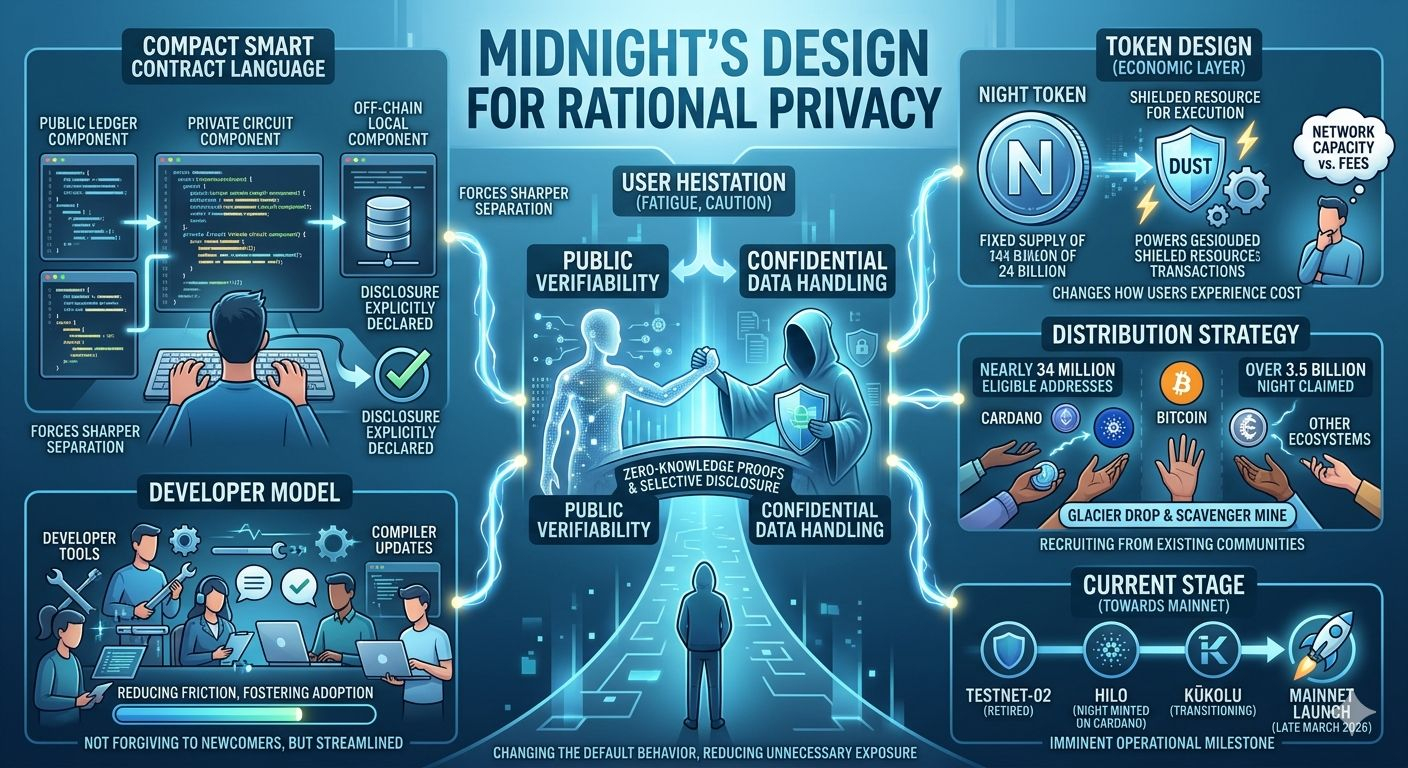
Seen from that angle, Midnight is trying to solve a very specific kind of friction. Its own materials describe it as a privacy-first blockchain that blends public verifiability with confidential data handling, using zero-knowledge proofs and selective disclosure so people can verify correctness without exposing sensitive data. The broader framing is consistent across its website and docs: the network says it is built for “rational privacy,” meaning users should not have to choose between utility and privacy just to interact with a blockchain. That matters because the real problem is rarely “privacy” in the abstract; it is the practical cost of being forced to reveal too much by default.
What stands out is that Midnight does not present privacy as a blanket wall. Its docs explicitly position selective disclosure as a middle path between fully public blockchains and fully private ones, and they use banking as the obvious example: disclose only what is required, keep the rest private. The Compact language also requires disclosure to be explicitly declared before private data can be stored publicly, returned from a circuit, or passed to another contract. That design choice sounds small, but practically it changes the default behavior of builders. Instead of assuming visibility and adding privacy as a patch, Midnight pushes developers to treat disclosure as the exception. That reduces accidental leakage, but it also raises the bar for implementation discipline, which is exactly the kind of tradeoff that usually gets ignored in promotional language.
The developer model is another clue to what the project is trying to become. Compact is described in the docs as a strongly statically typed, bounded smart contract language used with TypeScript, and each contract is split across a public ledger component, a zero-knowledge circuit component, and an off-chain local component. In plain terms, that means Midnight is not just “a chain with privacy”; it is a system that forces a sharper separation between what is public, what is privately proven, and what remains local. The upside is clearer structure and fewer accidental assumptions. The downside is that the system will probably feel less forgiving to newcomers than simpler smart contract environments. The project’s own tooling docs and release notes suggest that the team is trying to reduce that friction with official developer tools and ongoing compiler updates, which is usually what happens when a chain knows its real bottleneck is not theory but developer adoption.
The token design reflects the same philosophy, but with an economic layer added. Midnight’s tokenomics page says NIGHT is the utility token with a fixed supply of 24 billion, and that holding NIGHT generates DUST, the shielded resource used to power transactions and smart contract execution. DUST is described as non-transferable, dynamically computed, and tied to the status of the associated NIGHT position, which means transaction capacity is treated more like a renewable resource than a simple fee balance. That is a meaningful design choice because it changes how users experience cost. Instead of constantly thinking in terms of visible fees, they are nudged toward thinking in terms of network capacity and underlying resource ownership. That can make usage more predictable, but it also creates a more complex mental model than the average retail user is used to.
The distribution strategy shows the same attempt to work with existing user habits rather than against them. Midnight said Glacier Drop opened claims for nearly 34 million eligible addresses across eight blockchain ecosystems, and its official tokenomics posts say the initial allocation was spread across Cardano, Bitcoin, and six other ecosystems. By late 2025, the project said Glacier Drop and Scavenger Mine had allocated about 4.5 billion NIGHT, with the later distribution update reporting more than 8 million eligible addresses and over 3.5 billion NIGHT claimed by more than 170,000 addresses in the first phase. The practical signal here is not just “broad airdrop.” It is that Midnight appears to be trying to recruit from communities already trained in self-custody, chain hopping, and token-based participation. That is a rational move, but it also means the project is betting that attention can be converted into habitual use, which is never guaranteed.
The current stage of the project also matters, because it shapes how seriously a cautious market participant should read the claims. Midnight’s January 2026 update said the network was in Hilo, with NIGHT minted and live on Cardano mainnet, while the February 2026 update said Midnight had moved into Kūkolu and that mainnet would launch in late March 2026. In other words, as of those official updates, the project was still in the transition from distribution and liquidity-building toward a live federated mainnet, with testnet-02 already retired in preparation for that shift. That is important because a lot of blockchain narratives blur the gap between “the architecture makes sense” and “the network is already operating at scale.” Midnight’s own wording does not blur that gap. It presents mainnet as an imminent operational milestone, not a completed fact, and that is a more trustworthy way to read the situation.
What I find most interesting is that Midnight’s design seems aimed less at maximal secrecy and more at reducing the amount of unnecessary exposure that modern crypto users have quietly learned to tolerate. That is a subtle difference, but a powerful one. A blockchain that lets users prove something without revealing everything changes the social pressure around on-chain behavior. A system that makes disclosure explicit instead of automatic changes the incentives for builders. A token model that separates utility ownership from transaction capacity changes how people think about cost. None of that guarantees adoption, and none of it eliminates complexity. But it does address a real source of friction: the feeling that using crypto often means giving up more information than the task actually requires.
That is why Midnight matters beyond the technical novelty. For everyday crypto participants, the useful question is not whether a privacy chain sounds impressive. It is whether a system like this can make decision-making clearer and less reactive. In a market that often rewards speed, visibility, and overexposure, a design that treats privacy as default and disclosure as deliberate may encourage more careful habits. That does not make the network safer by magic, and it does not remove execution risk. It simply tries to make the tradeoffs visible before users pay for them. For people trying to survive crypto long enough to think in years rather than cycles, that kind of clarity may be more valuable than another wave of noise.