
I’ll be honest, when I first came across Fabric Protocol, I almost dismissed it in the usual way. I have seen too many projects trying to sit between AI, crypto, and robotics, and after a point they start sounding interchangeable. Same big ambition, same language about coordination and infrastructure, same suggestion that a token somehow makes the future arrive faster. So my first instinct was skepticism. Not aggressive skepticism, just the tired kind.
But then I kept coming back to one thought.
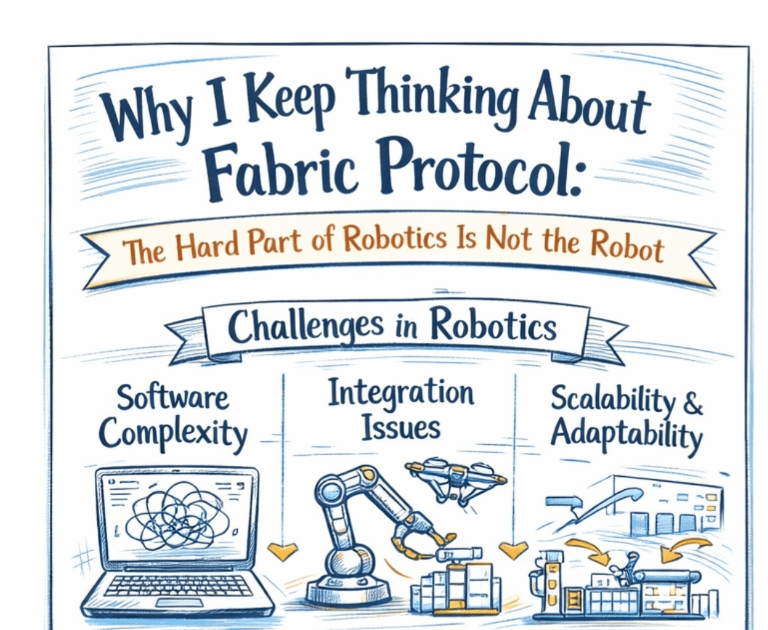
Most people talk about robotics as if the hard part is building the machine. I do not think that is the hard part anymore, or at least not the only hard part. What keeps bothering me is everything around the machine. Who decides whether its work was valid. Who supplied the data that shaped its behavior. Who gets paid if the task is completed properly. Who carries responsibility if something goes wrong. And maybe most importantly, whether all of that ends up controlled by one company or shared across a wider network. That is the part Fabric made me think about.
My personal view is that Fabric is more interesting as a coordination experiment than as a robotics story.
Why I Keep Thinking About Fabric Protocol: What Happens After the Robot Finishes the Task:
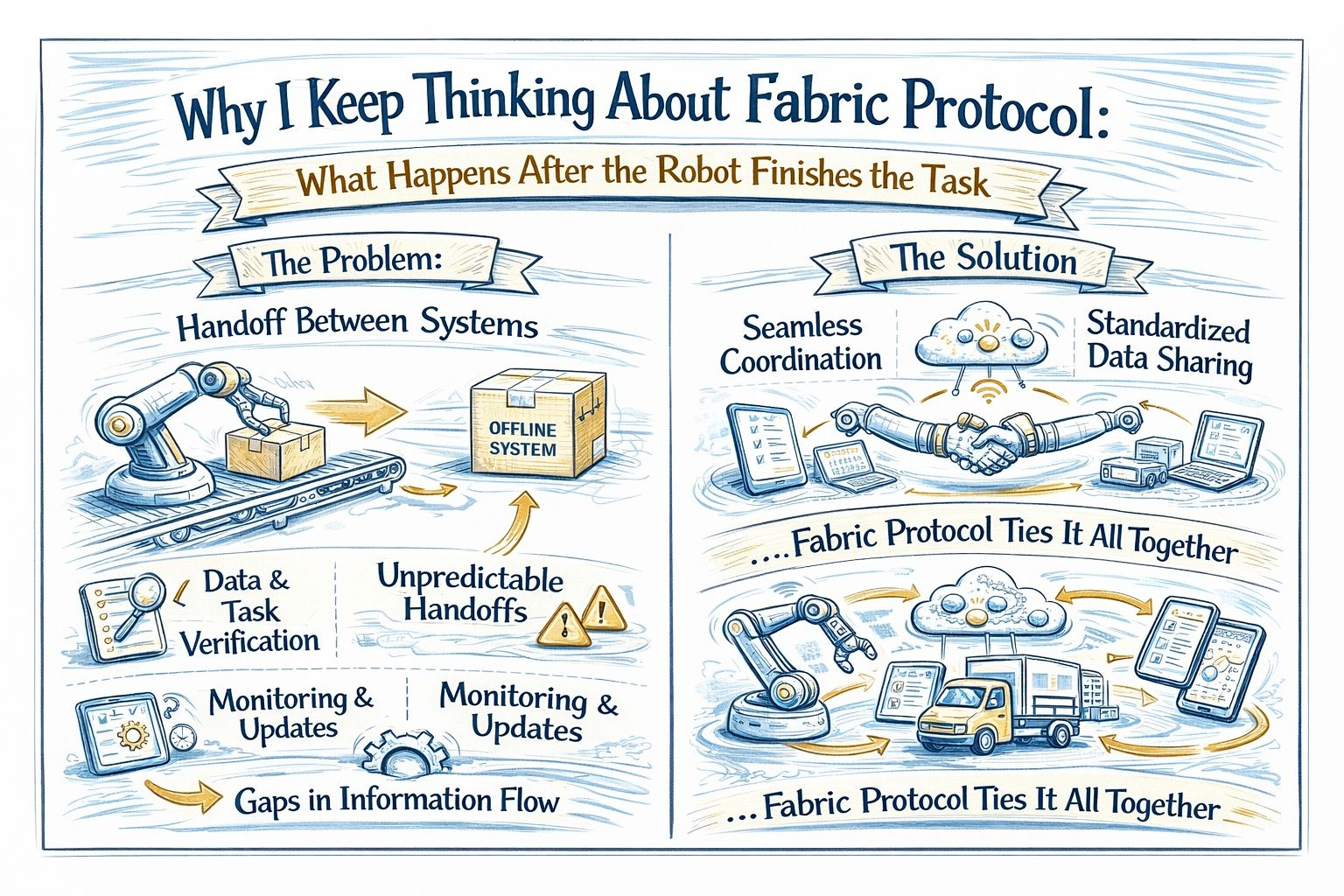 On the surface, it presents itself as an open protocol for general purpose robots, with a public ledger, verifiable computing, agent-native infrastructure, and all the rest of it. That wording can feel heavy very quickly. The simpler way I think about it is this: Fabric is trying to build rules for how machines, developers, data providers, validators, and operators can work together without relying entirely on private trust. I find that much more important than the futuristic language around it.
Because honestly, that is where most automation stories become weak.
A robot doing a task is impressive for a moment. A robot doing a task inside a system where contributions can be tracked, incentives can be aligned, and bad behavior can be penalized is a different thing entirely. That starts to look less like a demo and more like infrastructure. I think that is the distinction that gives Fabric some weight for me. Not certainty. Just weight.
The token side usually makes people either excited or dismissive right away. I tend to lean cautious. ROBO, as I understand it, is not just supposed to exist as a speculative asset. It is meant to be part of the network’s fee structure, bonding requirements, and incentive design, while veROBO shapes governance. In theory, that means participants are not just observing the system but taking economic positions inside it. I can see why that matters. If people validating work or contributing resources have something at stake, then the protocol has a way to attach consequences to behavior.
Still, this is exactly where my doubts start creeping in again.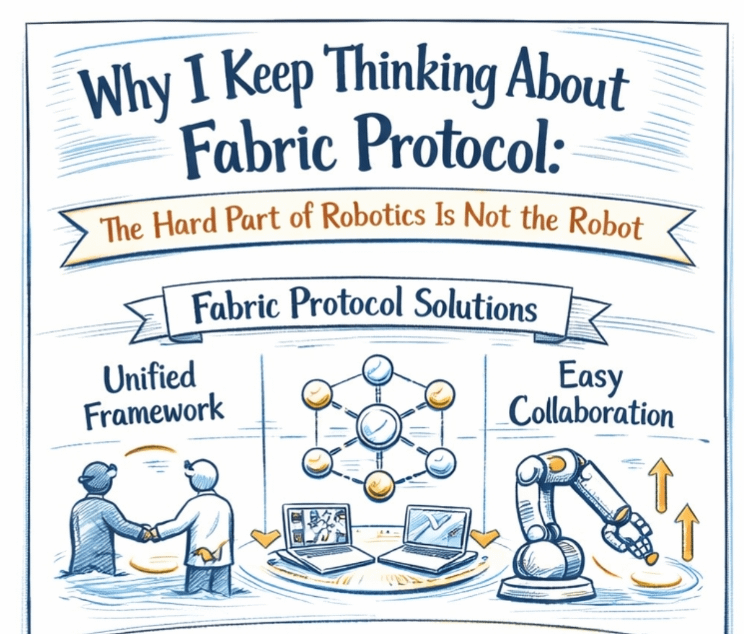
It is one thing to verify digital events. It is another to verify physical work in the real world. A ledger can record a claim. That part is easy to write down. But did the robot actually perform the task well. Was it safe. Was the data honest. Was the evaluation meaningful. These questions are not solved by putting an event onchain. So even though I think Fabric is asking one of the right questions, I do not assume that means it has already solved it. In fact, I think the project becomes more interesting when viewed as unfinished. It is reaching toward a difficult layer that many people prefer to skip over.
That may be why it stayed with me.
A lot of AI and robotics discussion today feels strangely shallow to me. We talk about capability all the time, but not enough about governance, verification, and economic coordination. We get excited about what machines might do, but spend less time thinking about the systems that would make those actions trustworthy at scale. Fabric, at least in my reading of it, is trying to work on that less glamorous layer. And I tend to think the less glamorous layer is often the real one.
The market attention around Fabric makes sense in that context. Anything that sits between AI, crypto, and robotics is going to attract interest right now. But I do not find market attention very persuasive on its own. Volume can show curiosity. Listings can show access. Neither tells me whether a project is becoming structurally important. What I look for instead is whether the core idea keeps making sense after the narrative cools down.
With Fabric, I think it does.
Not because I believe it is already proven. Not because I think every part of the design will work cleanly. Mostly because it touches a problem I suspect will become harder, not easier, over time. If autonomous systems really do become more common, then the question will not only be what they can do. It will be how humans coordinate around them, how trust gets distributed, and whether the rules of that world stay open or become concentrated.
That is why I keep thinking about Fabric Protocol. Not as a polished answer, and definitely not as some guaranteed future winner. More as one of the few projects that seems pointed at the uncomfortable middle of the problem. And in my experience, that uncomfortable middle is usually where the real story is.
@Fabric Foundation $ROBO #ROBO