
@Fabric Foundation I was at my kitchen table before sunrise with coffee going cold beside a scratched notebook when another story about AI agents using tools and robots moving into factories crossed my screen. I cared more than usual because this no longer felt theoretical to me and I could feel the question getting closer. What keeps all that action tied to human intent?
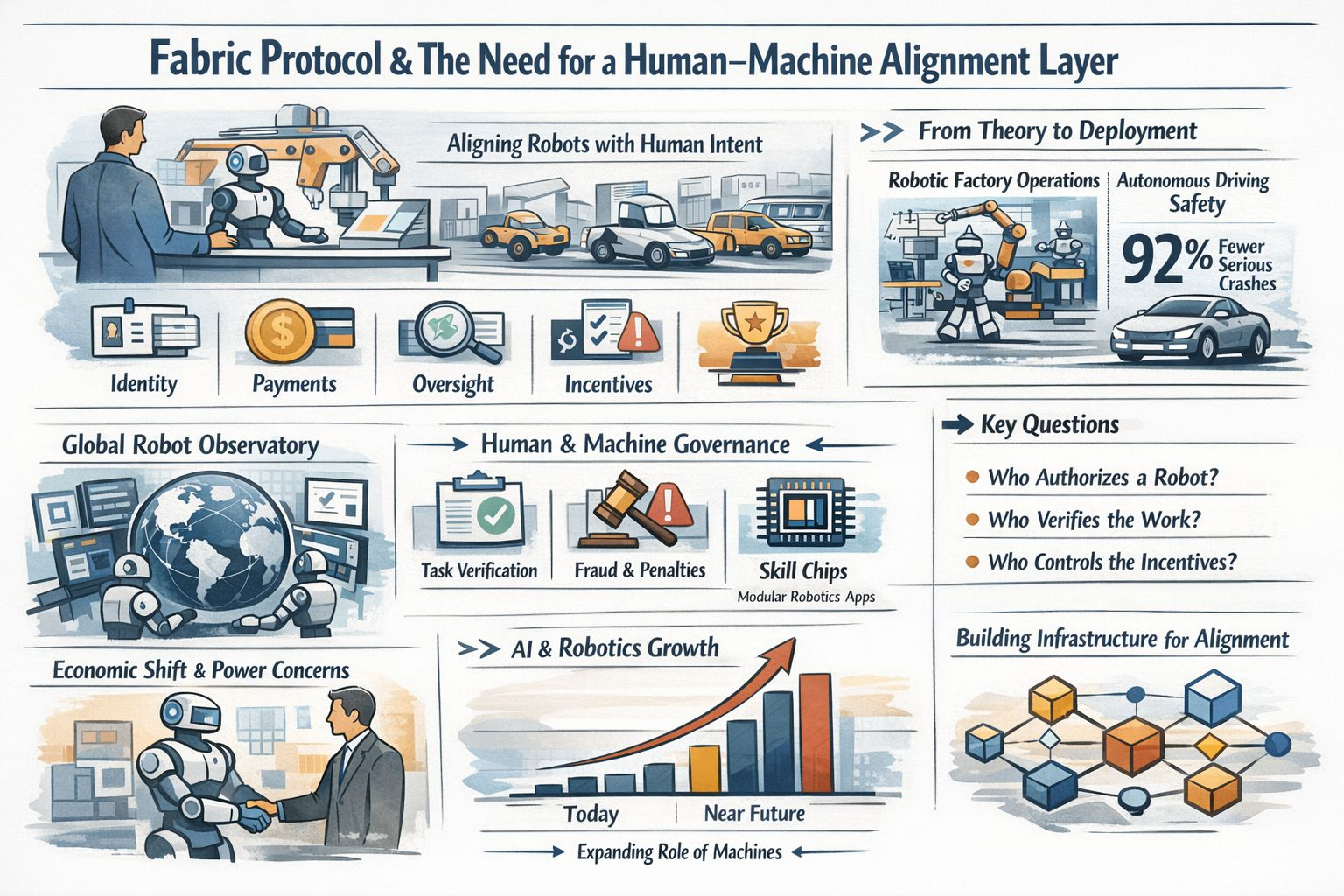
I’ve been paying attention to Fabric Protocol because it tries to answer that question where systems behave rather than where they are sold. In its whitepaper Fabric describes itself as an open network for building and governing general purpose robots. What interests me is not the token or the chain. It is the claim that blockchains can work as a human machine alignment layer by making identity payments oversight and incentives more visible. That frame matters because misalignment in the physical world is rarely abstract. It shows up as a wrong delivery a denied payment a safety failure or a machine doing exactly what it was rewarded to do instead of what a person meant.
This idea is getting attention now because several threads are coming together at once and they are moving out of theory and into ordinary operations. Open standards for software agents are moving into formal governance and a widely used protocol for connecting models to external tools was recently placed inside a broader effort to standardize agent infrastructure. Robotics is also moving beyond the demo stage. A major AI conference spent this week pushing physical AI for factories and robots while recent reporting described new robotics software being deployed on assembly lines. The safety side is becoming more concrete too. One autonomous driving company says its latest analysis over 170 million miles shows 92 percent fewer crashes causing serious or fatal injuries than human drivers. When systems start touching roads and factories and payroll I stop thinking about model quality on its own and start thinking about records disputes permissions and accountability.
That is where Fabric feels more interesting to me than a lot of AI rhetoric. I read it as an attempt to build the institutional plumbing for a machine economy. The foundation says it wants open systems for machine and human identity with clearer task allocation accountability payments that can be tied to place or human approval and machine to machine communication. It imagines humans observing and critiquing robot behavior through a global robot observatory while modular skill chips work more like reusable apps. It also proposes validation in which validators can investigate fraud and trigger slashing penalties. I may not agree with every design choice but I respect that this is trying to answer practical questions that matter once machines start acting in the world. Who authorizes a machine. Who verifies the work. Who gets paid when a robot uses a skill.
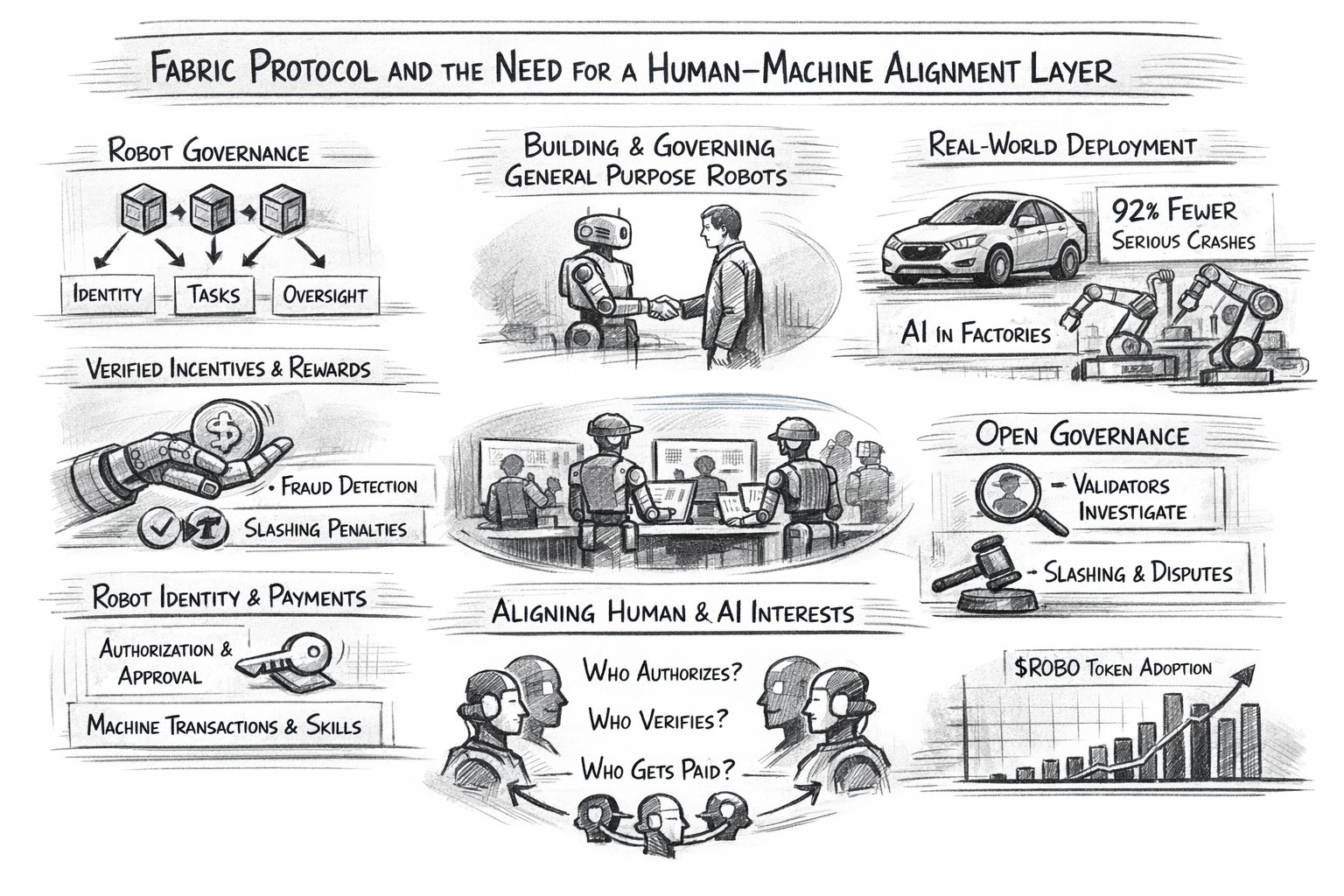
I also think Fabric is tapping into an anxiety that many AI discussions glide past. A capable machine is not only a technical object. It is also an economic actor or at least close enough to one that institutions start to wobble. Fabric’s own materials keep returning to that point. The foundation argues that today’s institutions and payment rails were not built for machine participation and the whitepaper warns that robotics could concentrate power and wealth if governance stays closed. That concern feels plausible to me. If skills can be copied across machines at network speed then the old connection between expertise wages and local labor markets weakens fast. An alignment layer is not only about preventing rogue behavior. It is also about making the terms of participation legible before a few platforms quietly decide them for everyone else.
I’m careful not to mistake ambition for completion. Fabric is early and its biggest claims still sit in design rather than proof. The whitepaper itself lists open questions around the initial validator set and around how the protocol should define sub economies. Governance can sound neutral until someone has to decide who gets to judge fraud which metrics count as quality and when a human override is allowed. I also think any protocol that wraps robotics incentives and governance into one package inherits the usual risks of complexity speculation and uneven adoption. None of that makes the project trivial. It simply means the hard work begins after the concept starts sounding elegant.
What keeps me interested is the shift in perspective. I don’t see Fabric’s contribution as a promise to make machines perfect. I see it as a reminder that alignment needs rails rather than slogans. Once agents and robots can act spend verify and learn in public settings I want more than model behavior tucked inside a lab report. I want systems that record who did what who approved it who challenged it and how the incentives were set. Fabric may or may not become the answer. But the need it is pointing to feels very real to me right now and I doubt it is going away.