
@Fabric Foundation I was at my desk just after 6 a.m. with coffee cooling beside a half-open notebook when I reread Fabric Protocol’s whitepaper instead of clearing email. I care because robotics suddenly feels less like a lab story and more like an operations problem. I keep wondering whether most people have noticed that shift yet.
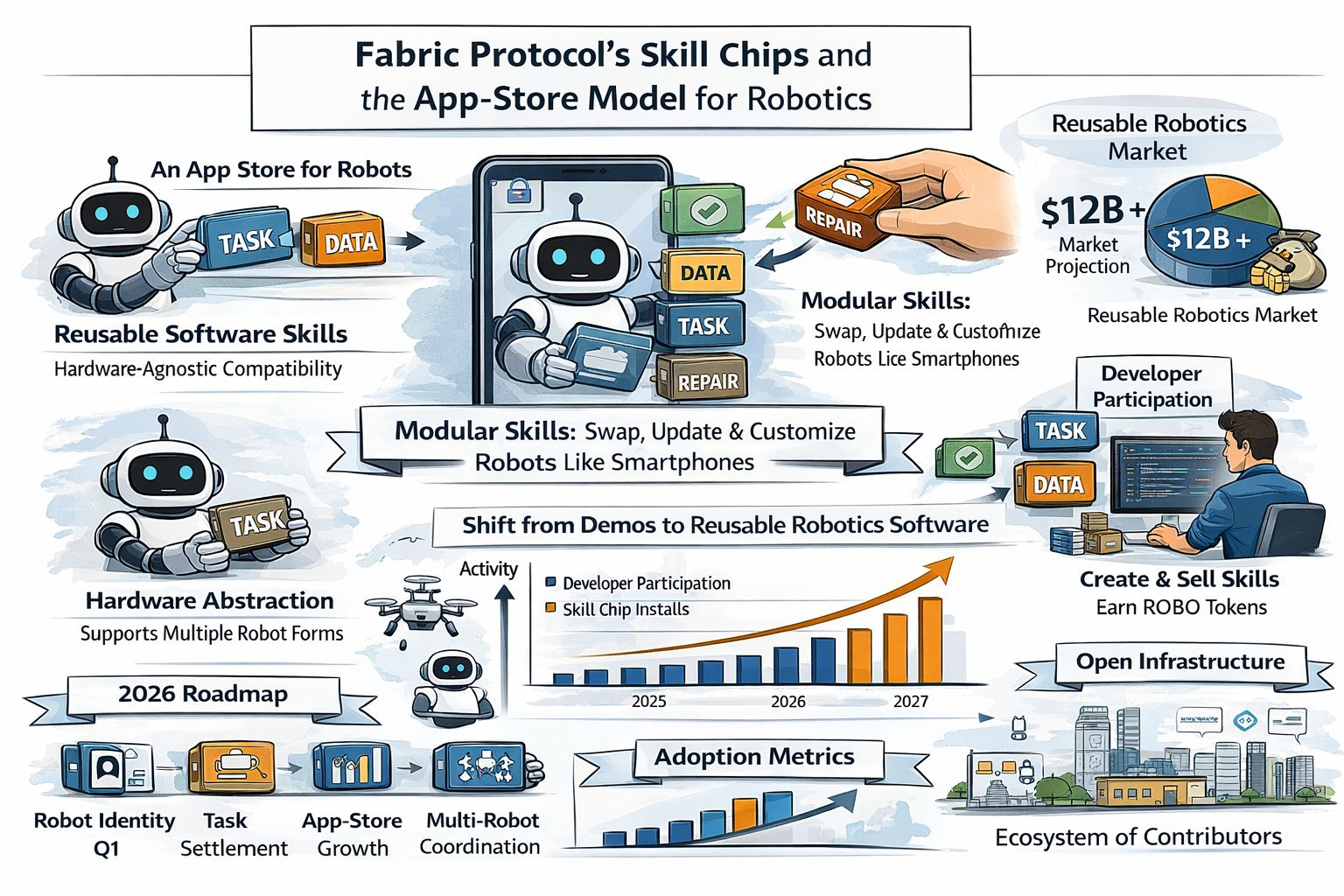
What caught me is Fabric’s plain claim that robot software should work more like phone software. In its model robots gain abilities through “skill chips” which are compact software packages that can be added or removed as needed much like apps. The idea feels obvious once I say it out loud because a robot would not need to be sold as one fixed bundle of hardware and code. It could be updated and specialized and repurposed over time. That matters because Fabric is not only describing a marketplace metaphor but also arguing for modular robotics as infrastructure.
I think this is landing now because the wider robotics market has changed tone over the past year. The conversation is no longer only about impressive demos or futuristic humanoids waving at conferences because larger players are pushing open robot models and simulation tools and cross-platform development stacks while newer companies are starting to talk about actual deployments and data loops and repeatable work. When one major company introduced an open humanoid robot foundation model in March 2025 and kept expanding that line through 2026 it strengthened the idea that robot intelligence will be trained and shared and adapted across many developers rather than guarded inside one machine maker’s walls.
That is the opening Fabric is trying to use. Its whitepaper says skill chips depend on abstracting away low-level hardware differences and that is the part I find most practical. An app store for robots is meaningless if every robot speaks a different technical language. Fabric pairs the marketplace idea with a hardware-agnostic operating system that supports multiple robot forms and configurations. Recent documentation reads less like a manifesto and more like a developer toolkit because it points to configuration files and autonomy modes and payment modules and examples that span different machines. I take that as real progress rather than branding and I like that focus on details instead of being asked to trust rhetoric.
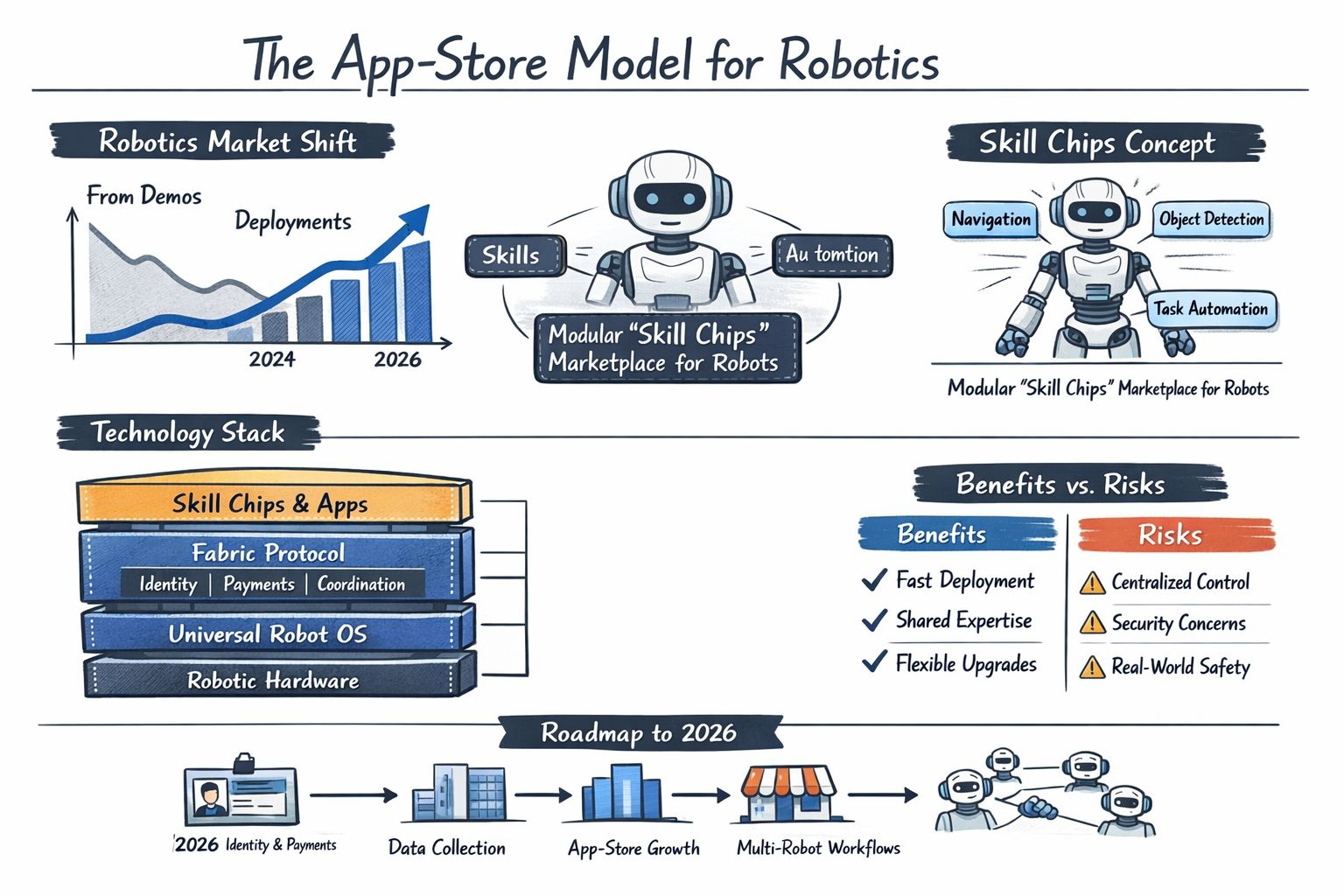
I also think Fabric is tapping into a frustration I hear often in robotics which is that there is too much custom work and too many silos and too much reinvention. Its March 2026 writing argues that the real bottleneck is no longer the robot alone but the coordination layer around identity and payments and deployment and shared context. I find that persuasive because a robotics app-store model only works if someone handles trust and billing and permissions and versioning with less friction than the industry tolerates now. Fabric’s answer is to put those functions into a protocol and then let developers build and sell skills on top.
Still I can’t treat the whole idea as settled. When I read Fabric’s examples including the thought experiment about electrician robots sharing expertise instantly I see both the attraction and the discomfort. Reusable robot skills could cut deployment costs and spread scarce expertise fast while also concentrating power even further if one marketplace or one protocol becomes the gatekeeper. I am also wary of how easily an app-store analogy can make physical work sound cleaner than it is because robots do not fail like phones. They fail around people and in buildings and on streets and under legal constraints.
What keeps me interested is that Fabric’s roadmap is not only talking about distant theory. The whitepaper maps 2026 around identity and task settlement and real-world data collection and broader app-store participation and later multi-robot workflows. That sequence feels grounded to me. I am not convinced the robot economy will look the way Fabric imagines and I am even less convinced blockchain needs to sit at the center of it. Even so I think the skill-chip idea points at something real because robotics is moving toward reusable software markets and whoever makes that layer workable could matter almost as much as whoever builds the robot.