
I’ll be honest: Sign doesn’t excite me in the way most crypto projects try to excite people. No flashy promises, no over-the-top hype. And honestly? That’s exactly why it caught my attention.
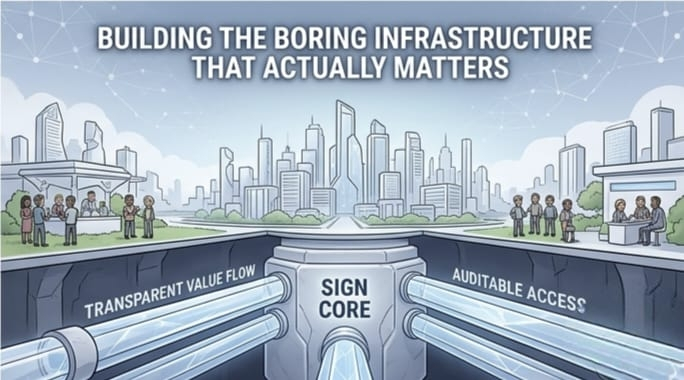
I’ve been around long enough that “excitement” in this space doesn’t really move me anymore. It’s everywhere. What actually stands out is when a project seems to be tackling something real something that keeps breaking, no matter how many bull runs come and go. With Sign, that thing is painfully simple: proving who gets what, who qualifies, who can be trusted with access or value, and then actually making the distribution happen without things falling apart.
I know that doesn’t sound sexy. It’s not. But the boring problems are usually the ones that stick around.
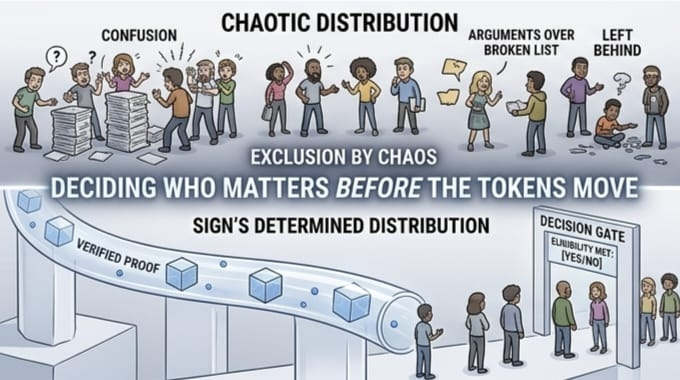
Most of crypto still handles eligibility and token distribution like it’s running on sticky notes and hope. You’ve got a team trying to reward contributors, verify participants, roll out claims, or manage unlocks, and suddenly it’s all held together by half-broken spreadsheets, wallet snapshots, weird edge cases nobody planned for, and that one ops person quietly losing their mind after everyone else has moved on to the next narrative. I’ve seen it so many times that I’ve stopped assuming teams just don’t know better. Some of them just don’t care until it blows up publicly.
Sign feels like it was built with that mess in mind.
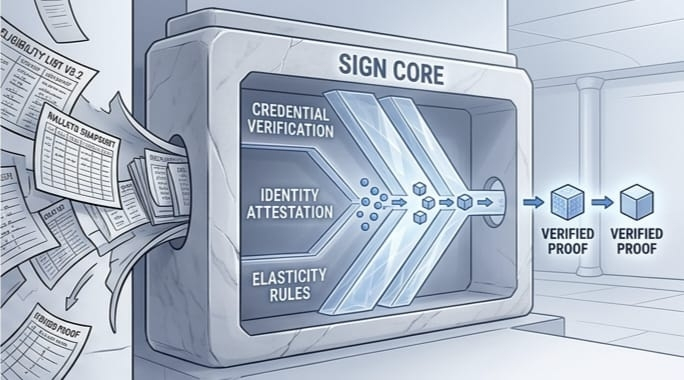
What it’s really trying to do if you strip away all the protocol buzzwords is connect proof to action. If you have a credential, meet a requirement, belong to a group, or hit a milestone, that shouldn’t live in some fragile internal doc that falls apart the second things get real. It should exist in a way that can actually be verified and used. That’s what stands out to me. Not the branding. Not the token. Just the idea that verification and distribution should feel like two parts of the same process, not two separate disasters duct-taped together.
Because that gap is where things quietly rot.
Projects love talking about fairness until it’s time to define it. Communities want transparency until the rules exclude someone they care about. Teams say they want clean distribution until they realize how much work clean distribution actually takes. That’s when the shortcuts start. Then the excuses. Then someone gets left out, someone games the system, someone else gets overpaid, and suddenly the whole thing turns into a postmortem dressed up as a celebration.
Sign looks like it was shaped by that reality. That’s not something I admire in the abstract it’s something I respect. Admiration is easy. Respect usually comes from seeing that someone actually picked a problem with teeth.
And I think that’s the heart of it. This isn’t really a project about moving tokens. It’s a project about deciding who matters before the tokens move at all. That’s a much heavier question than most people want to admit. Once you start verifying identities, credentials, eligibility you’re not just handling data. You’re making judgments. Drawing lines. Deciding who belongs inside the rules and who gets left out.
That’s where it gets interesting. And also a little uncomfortable.
Because the cleaner the system, the more obvious its assumptions become. A messy process hides its bias in chaos. A structured one can’t. If Sign works the way it wants to, it’s not just making distribution more efficient it’s making the logic of access more explicit. And honestly? Clearer rules don’t automatically mean better outcomes. Sometimes they just make exclusion more efficient.
Still, I’d rather watch a project wrestle with that than watch another one recycle the same “community-first” language while running its backend like a pile of broken spreadsheets.
There’s also something telling about the kind of problem Sign chose to solve. It’s not trying to win attention with novelty. It’s sitting in the layer where systems tend to break when things get real. Identity gets messy. Credentials get scattered. Distribution gets abused. Records become a mess. And then everyone suddenly remembers that infrastructure actually matters not when the market’s euphoric, but when there’s friction, disputes, and money on the line.
That’s when I start paying attention.
I’m not saying Sign is safe from the usual crypto nonsense. Nothing is. A serious idea can still be implemented badly. Good infrastructure can still get buried by hype, bad incentives, weak adoption, or teams that focus on the token before the product. I’ve seen that plenty of times too. Plenty of projects start with a real problem and end up circling their own token because the market rewards spectacle over discipline.
The real test is whether Sign can hold up when people stop reading the docs and start pushing on the edges. When users try to game eligibility. When communities argue over criteria. When distribution rules meet real-world exceptions. When institutions want trust without giving up control. That’s the moment I’m looking for. That’s where the pitch ends and the project really begins.
Maybe that’s why Sign feels more serious to me than most of what crosses my screen. Not cleaner. Not more inspiring. Just more aware of where the actual grind is. It’s building around proof, access, and distribution which sounds boring until you remember how much of digital life now depends on those three things actually working.
I keep coming back to that. In a market full of recycled ideas, the projects that matter are often the ones working on the least glamorous failures. The ones dealing with the back-office pain everyone else tries to ignore. The ones that understand trust isn’t a vibe it’s a process, and usually a pretty annoying one.
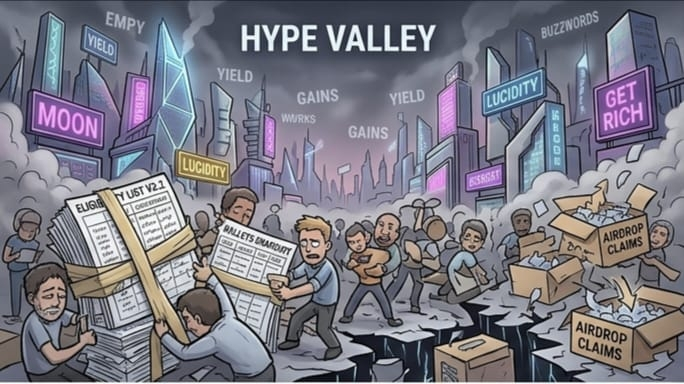
So when I look at Sign, I don’t really see a story about a token. I see a project trying to turn messy human decisions into systems that can survive scale, incentives, and bad behavior. Sometimes that ends well. Sometimes it just creates a cleaner version of the same old mess. But at least it’s trying to solve something that actually breaks.
