
Blockchain did a great job at making information verifiable, but in making everything public, it stumbled into a whole new problem: full exposure. Every transaction is out in the open, every clever move is basically an open secret, and with enough time, you can piece together who’s who. If you’re just dabbling, maybe this is an annoyance. But for institutions and serious players, it’s an actual barrier to entry.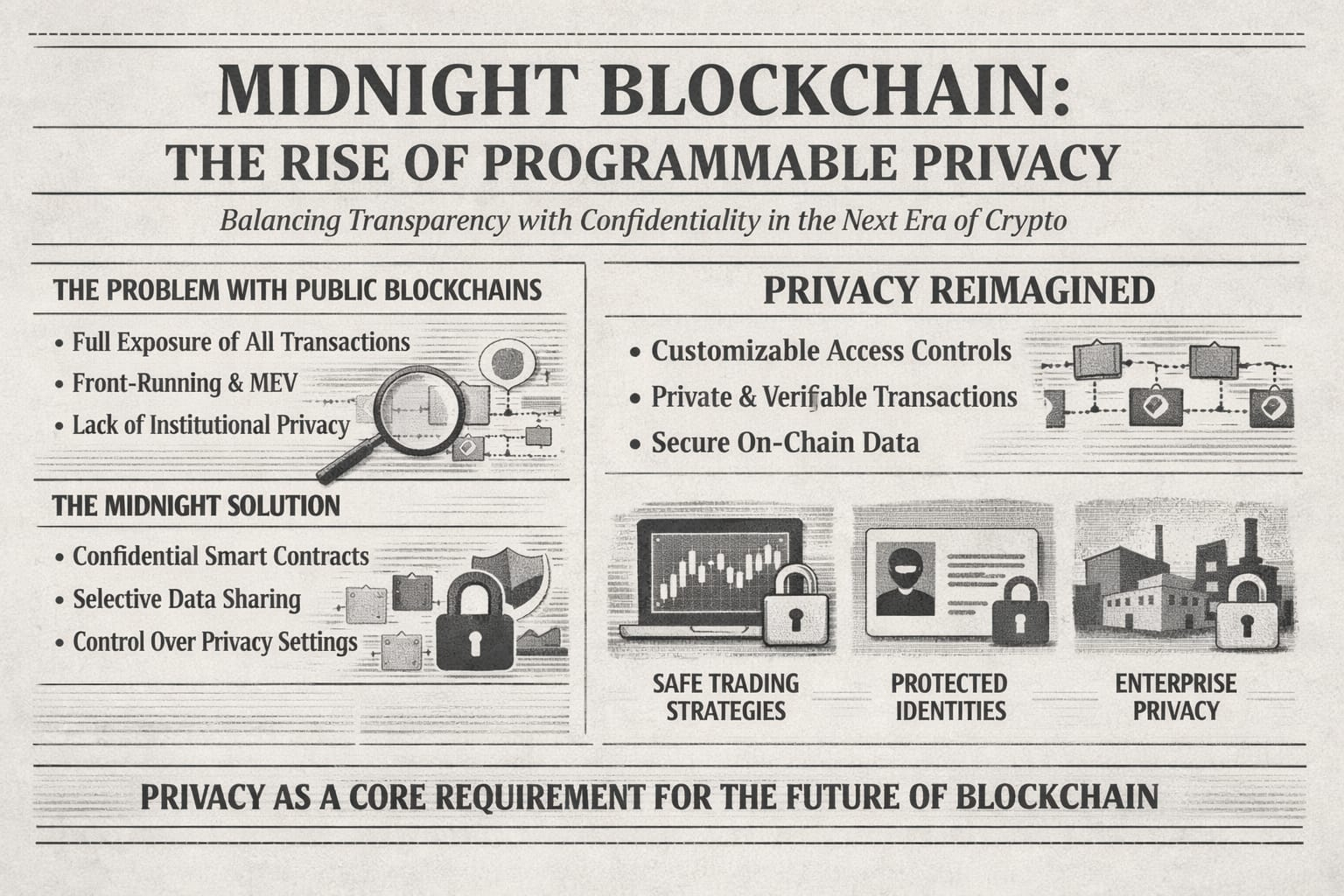
Midnight doesn’t treat privacy as an add-on or a botched afterthought. Instead, it makes privacy part of the foundation. The core idea is pretty straightforward: privacy shouldn’t be glued on after the fact it should be part of the structure from the start.
Public blockchains run on radical transparency. That’s why people trust them, but it comes at a cost. When everyone sees everything, traders lose their edge, because their positions are visible to anyone who knows how to look. Bots jump ahead in line thanks to front-running and MEV. For companies that have to keep some data under wraps, putting anything sensitive on-chain just isn’t an option. The very thing that makes the system trustworthy makes it harder to use for anything serious.
Midnight flips the script on privacy. It’s not about hiding everything. It’s about giving control who sees what, when, and why. This turns privacy from a wall into a valve. Instead of the old “public or private” binary, developers can actually design for intent, controlling how information moves and what stays in the shadows.
That changes how apps are built. Developers can set the rules: who’s allowed to access this piece of data, under what conditions, and how to prove you’ve complied without spilling the details. The blockchain isn’t just a history book anymore. It’s more like an intelligent information control system.
This is possible because of confidential smart contracts. These contracts can run their logic in private. The outcome can still be checked, but the guts the inputs, the steps stay hidden. That opens up a range of new use cases: trading strategies safe from competitors, identity tools that only reveal the necessary bits, and enterprise processes that can move on-chain without leaking info no one should see.
And it’s not by chance that privacy is getting its moment now. As real money looks toward crypto, controlled privacy isn’t optional it’s essential. Meanwhile, AI needs ways to work with data safely, and on-chain tactics are more complicated and cutthroat than ever. Public-by-default just can't keep up. Privacy isn't just a nice-to-have anymore it's a core requirement.
Of course, this isn’t a free lunch. Cryptographic proofs chew up more computation, so you’ll pay in cost and speed. Building these systems demands more from developers, too. Regulators sometimes get nervous when privacy features blur into secrecy. And honestly, when you start hiding too much, it gets harder for everyone to coordinate.
Still, the direction’s pretty clear. If Midnight and others pull it off, the blockchain world could split into layers a public base for transparency and a private layer handling the sensitive stuff. Apps move between the two, showing what’s needed and keeping the rest protected.
That means fewer signals for others to spot and exploit. Institutions can finally join without exposing everything. For developers, suddenly, there’s a range of design possibilities that just didn’t exist before.
But the real shift isn’t about picking transparency or privacy. It’s about creating systems that reveal things on purpose, not by default. The blockchains that really matter won’t be the ones that show you everything or keep secrets for the sake of it. They’ll be the ones that know the difference, and handle information with real intention.
@MidnightNetwork #night $NIGHT
