
@MidnightNetwork I started taking Midnight more seriously when I noticed how often people described it as a privacy chain and then stopped there. That framing felt too neat. In a market that still treats “on-chain” as a synonym for radical transparency, Midnight looks less like a privacy add-on and more like a quiet attempt to rewrite what counts as being on-chain in the first place.
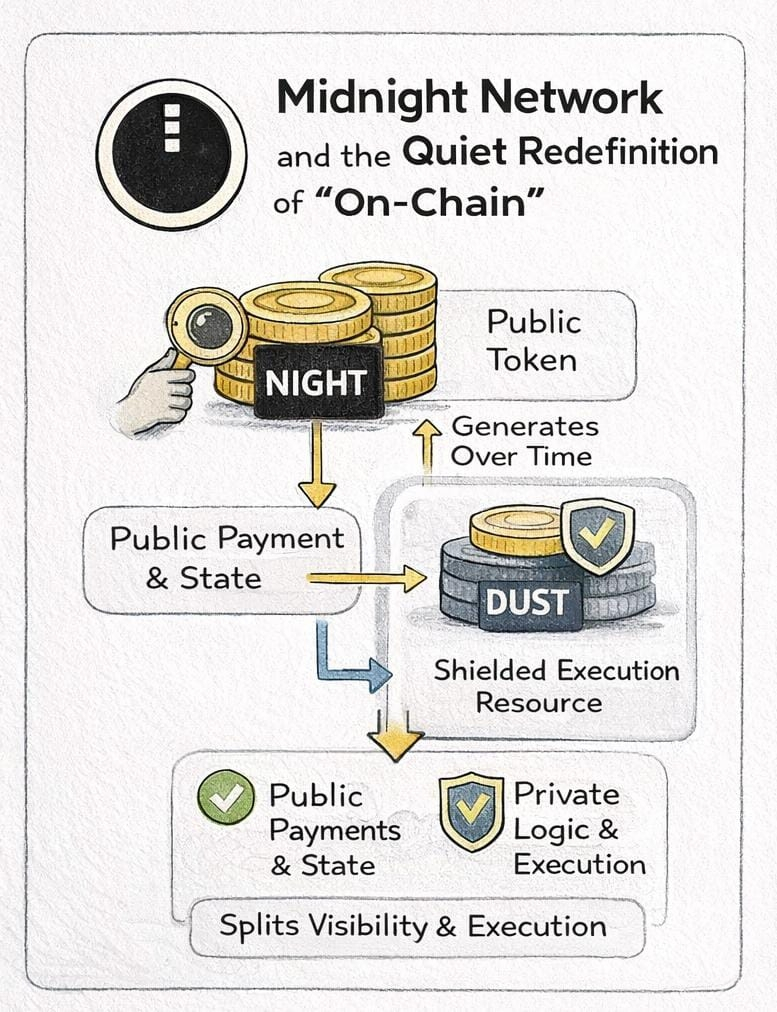
The common assumption is simple: if something is truly on-chain, everyone sees the data, the payment, and the logic in the same public space. Midnight questions that assumption early. On the surface, observers see zero-knowledge privacy; underneath, the architecture splits functions apart, with $NIGHT kept public and DUST used as a shielded, non-transferable execution resource. That is not just privacy. It is a redesign of what gets exposed, and when.
That split matters because it changes the meaning of transaction activity. A normal chain makes usage legible through fees and visible state changes. Midnight instead lets NIGHT generate DUST over time, so execution starts to look less like buying blockspace and more like drawing from reserved capacity. What appears, at the surface, to be a smoother fee model is really a move away from pure auction logic and toward managed operational budgets.
You can see the system straining toward that model in the numbers. Midnight says 4.5 billion NIGHT were allocated through Glacier Drop and Scavenger Mine; that is not just a distribution statistic, it is an attempt to seed future coordination across multiple ecosystems before mainnet even settles into routine use. Its January update also showed a 19% increase in block producers and a 35% rise in smart contract deployments, which reads less like speculative heat than like a network trying to thicken its supply side before demand arrives.
The validator story pushes the same interpretation further. Midnight’s late-March 2026 mainnet is launching through a federated model, and at least nine named operators have been publicly identified across cloud, payments, fintech, telecom, and crypto infrastructure. Surface reading: centralization. Underneath: the network is choosing operational predictability over purity while it tries to attract regulated flows that do not tolerate chaotic early-stage infrastructure.
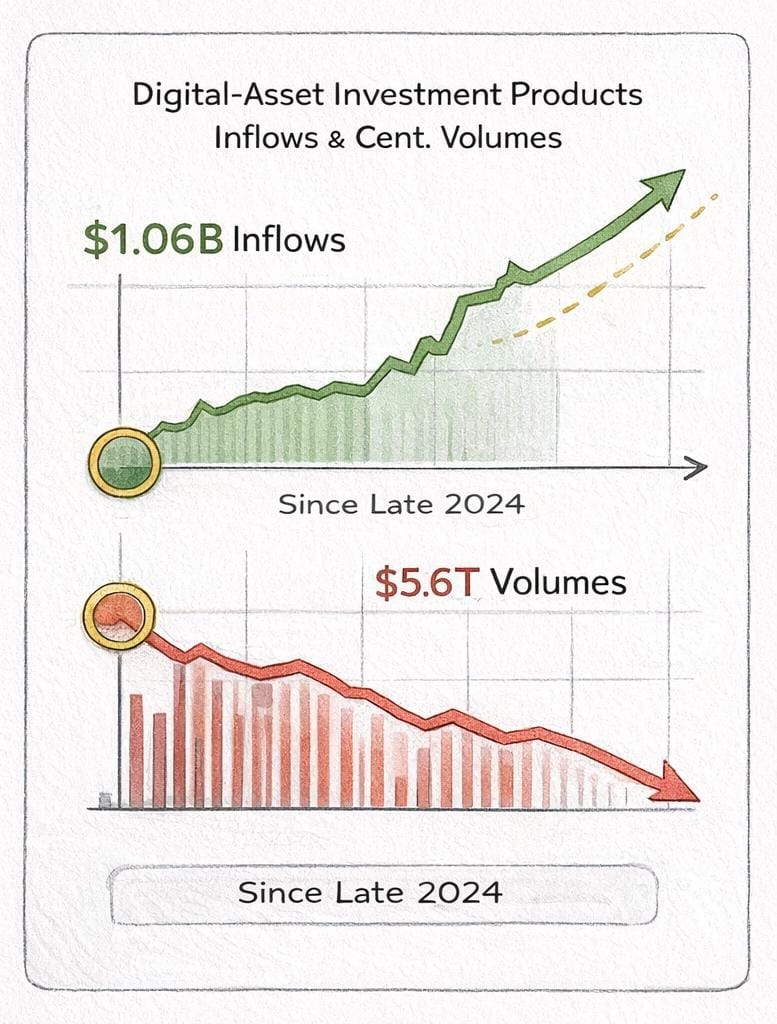
That choice also fits the wider market. Last week alone, digital-asset investment products took in $1.06 billion and total ETP assets reached $140 billion, while centralized Binance exchange volumes in February still slipped to $5.61 trillion, the lowest since October 2024. Capital is returning, but it is returning selectively: institutions want exposure, while market structure still shows thinning conviction and tighter risk tolerance. Midnight is being built for exactly that contradiction.
So the deeper point is not that Midnight makes private crypto possible. It is that Midnight treats “on-chain” less as public disclosure and more as verifiable settlement with selective visibility. If that model holds, the next phase of blockchain infrastructure may not look more transparent than the last one. It may look quieter, more partitioned, and much closer to how serious systems actually coordinate under pressure.#night