

I want to be honest about something upfront. I have been watching NIGHT bleed from $0.1185 all the way down to where it sits right now at $0.044, and most of the takes I have read about it are either people celebrating the collapse or cheerleading through it. Neither of those things is useful to me. So let me just tell you what I actually think, as someone who has spent time genuinely trying to understand what this project is building and whether the price reflects any of that reality.
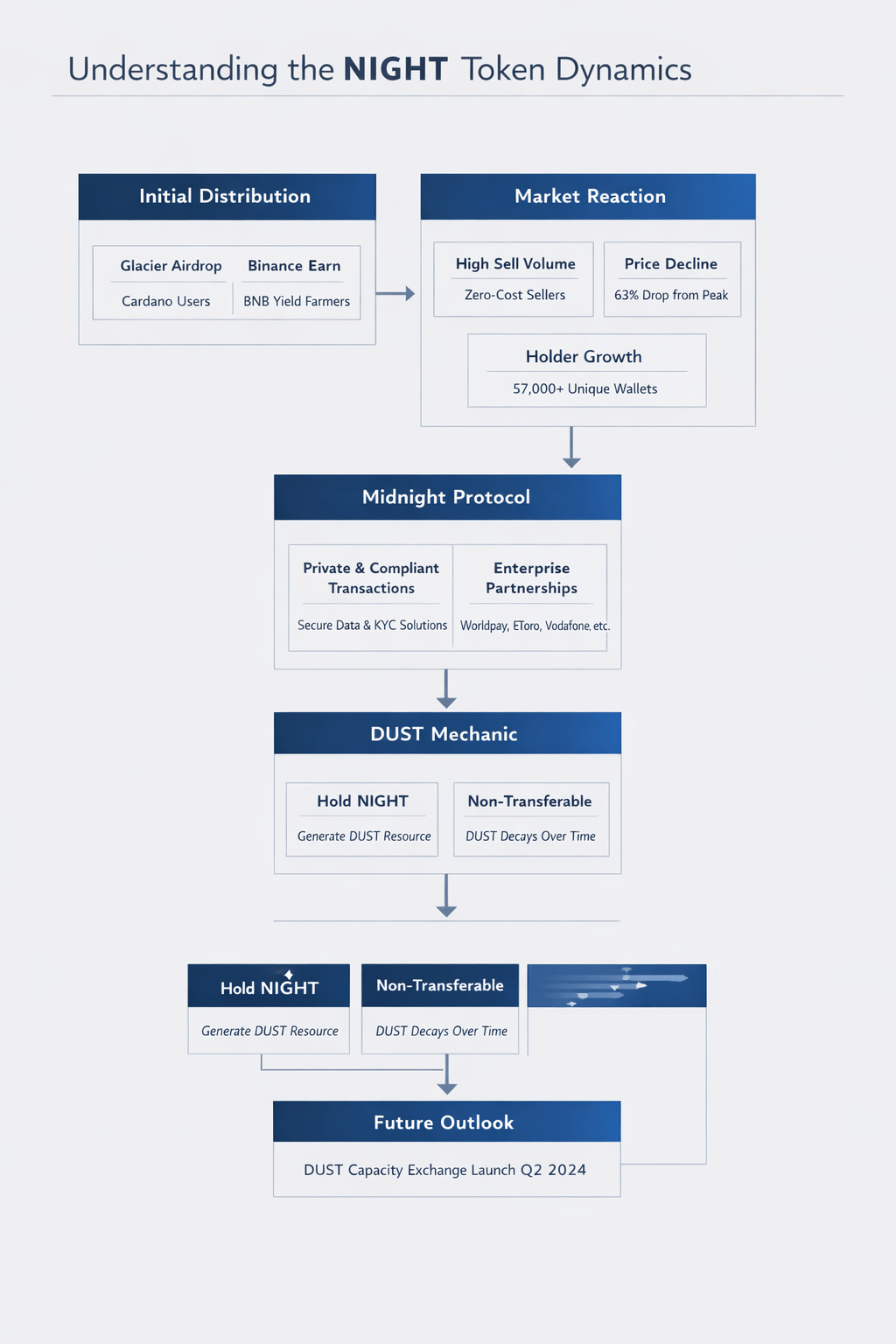
The first thing that struck me when I looked at the numbers closely is how violent the volume story is. The trading volume of NIGHT hit $533 million in a single 24-hour period against a market cap of $731 million, and when I saw that I genuinely had to sit with it for a minute. That is not normal behavior. That is the kind of turnover you see when a huge portion of the people holding a token have no attachment to it whatsoever. They got it for free, they see a number they can sell at, and they are selling. Which is exactly what is happening. The Glacier Drop handed tokens to Cardano ecosystem participants. Binance handed another chunk to BNB yield farmers who qualified by sitting in an earn product for two days in February. Neither of those groups made a decision about Midnight. They made a decision about Cardano, or about BNB yield, and NIGHT arrived in their wallets as a side effect. Of course they are selling. I would probably sell too in their position.
But here is where I think the market is making a mistake. It is reading that seller behavior as a verdict on the asset when it is really just a verdict on the distribution method. These are motivated sellers with zero cost basis, not disillusioned believers. The holder count grew 300% in two months, surpassing 57,000 unique wallets, and simultaneously the price is down 63% from the top. I know the instinct is to read that as fake growth inflated by airdrop wallets, and that instinct is partly right. But it is not all right. There is a subset of those holders who found Midnight on their own, researched it, and decided to stay through a brutal drawdown. I want to know who those people are and what they know, because in my experience the people who hold through a 60% collapse without selling are either very wrong or very right, and the distribution of those outcomes is not random.
What actually keeps me interested in Midnight beyond the price chart is something that took me a while to fully appreciate. The protocol lets you build an application where a hospital proves a patient qualifies for a procedure without publishing a medical record, or where a bank verifies KYC status without storing a single piece of personally identifying information anywhere. That is not a niche use case. That is the exact problem that has made every serious institutional blockchain project of the past decade either legally unviable or politically untenable. The people who tried to put healthcare data on Ethereum in 2019 did not fail because the idea was bad. They failed because a public ledger and GDPR compliance are structurally incompatible. Midnight is the first real attempt I have seen to solve that incompatibility at the protocol level rather than papering over it with private sidechains.
The DUST mechanic is where I started genuinely paying attention to the tokenomics rather than just skimming them. The system has two components. NIGHT is the utility token and DUST is a shielded non-transferable resource that decays over time and is the only way to execute transactions on the network. What this means in plain language is that if you want transaction capacity on Midnight, you need DUST, and the only way to generate DUST is to hold NIGHT and keep it stationary. The moment you sell your NIGHT or move it somewhere else, your DUST generation stops and whatever you had accumulated starts to decay. For a retail trader that mechanic means almost nothing. For Worldpay, which processes $3.7 trillion in annual payments and has already joined Midnight's federated node operator set ahead of mainnet, it means something very different. If Worldpay ever routes meaningful payment volume through this infrastructure they need guaranteed transaction capacity, and guaranteed transaction capacity requires NIGHT sitting in their treasury not moving. That is not a speculative position. That is operational infrastructure spend. I genuinely do not know when that transition happens, but I know it changes the demand picture entirely when it does.
I try to hold myself accountable to the counterargument here because I think it is a serious one. The distance between running a validator node and routing live customer transaction volume through ZK infrastructure is not small. With approximately 30.8% of maximum supply yet to be released, the unlock schedule runs until December 4, 2026, and that overhang is real. If enterprise adoption moves at enterprise speed, which is slow, committee driven, and dependent on procurement approvals that take quarters, then the unlock pressure wins by default. The supply keeps arriving, the demand does not materialize fast enough, and the conviction holders who weathered this entire drawdown eventually run out of patience. I think about that scenario more than I think about the bull case, honestly, because it is the one that requires no unusual assumptions. Enterprises moving slowly is not a black swan. It is the default.
What gives me enough confidence to stay interested rather than dismiss this entirely is the quality of the people who have already made that enterprise commitment. Worldpay, Bullish, MoneyGram, eToro, Google Cloud, and Vodafone are running production nodes on a live mainnet right now. That decision was made by legal teams and risk committees, not by crypto enthusiasts. Organizations that process trillions in annual payments do not run production infrastructure on networks that have not cleared their compliance review. The fact that they are already there, on a live chain, is the quiet version of a very loud endorsement. It just does not read that way in the market because it did not come with a press release showing a price chart going up.
The next 90 days are genuinely informative rather than just another window to watch price action. The DUST Capacity Exchange is coming in Q2, and that is the first moment where holding NIGHT becomes liquid in a real economic sense. A third party outside the Midnight ecosystem pays for DUST access from a NIGHT holder and creates actual observable demand that shows up in on-chain data. If that exchange launches with real participants on both sides, the thesis stops being theoretical. If it launches thin with no meaningful volume, I will update my view materially downward. I am not in the business of defending positions against evidence. The architecture is genuinely elegant, the partners are legitimately credible, and buyers appear to be defending higher lows on the chart which suggests the floor is not as fragile as the price action implies. But elegant architecture and institutional logos do not pay holders. Network usage does. That part has not happened yet at any scale worth pointing to, and I am honest enough with myself to know that matters more than anything else I have written here.
@MidnightNetwork #night $NIGHT
