
I’ve been thinking for a long time about how trust works in our world today, and how surprisingly fragile it is. Everywhere I look, there are systems designed to verify information, to prove identity, or to ensure legitimacy, yet somehow none of them seem to connect. I still remember the frustration of submitting the same documents to multiple institutions—universities asking for transcripts I’d already submitted elsewhere, banks requesting government-issued IDs I had no reason to reissue, and online platforms asking me to prove the same things over and over again. It felt like I was trapped in a loop of verification, where trust was assumed to be scarce, and I was constantly forced to prove myself.
The problem, as I see it, isn’t that verification is inherently difficult. It’s that the architecture of these systems has evolved in isolation. Every institution has its own silo, its own rules, and its own way of thinking about identity. These silos were fine when the world was more localized and paper-based, but in the global digital economy, they create friction. They waste time, energy, and resources. They also introduce vulnerabilities. I’ve watched stories about data breaches and identity theft, and I realize that fragmented systems not only frustrate people—they expose them to real risk.
When I started exploring $SIGN, I approached it not with excitement, but with curiosity. I wanted to understand how it could tackle a problem that seems baked into the very way modern institutions operate. What struck me immediately is that doesn’t attempt to create a flashy product. It isn’t a new social network or a marketplace. Instead, it focuses on laying the groundwork for a global infrastructure—one that can issue, verify, and distribute credentials in a reliable, decentralized way. From the start, I felt that this was a system designed to address friction at its roots.
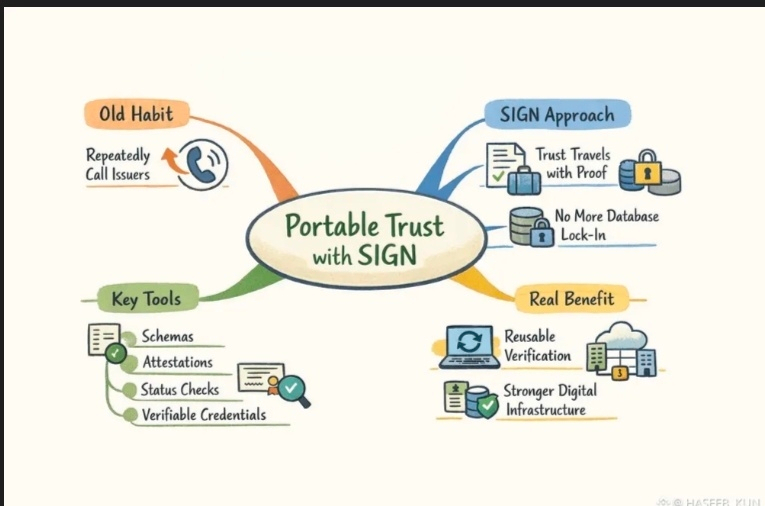
I like how sign treats credentials as modular, first-class objects. In my mind, this is critical. A credential should not be just a piece of paper, a PDF, or a record buried in a database somewhere. It should be a verifiable object that carries its authenticity wherever it goes. What $SIGN does, as I understand it, is anchor these credentials on-chain. That means anyone, anywhere, can verify the authenticity of a credential without relying on a single central authority. I think about this a lot, because it’s more than just a technical detail—it fundamentally changes how trust is established. It’s not blind faith in an institution; it’s verifiable proof that is portable and resilient.
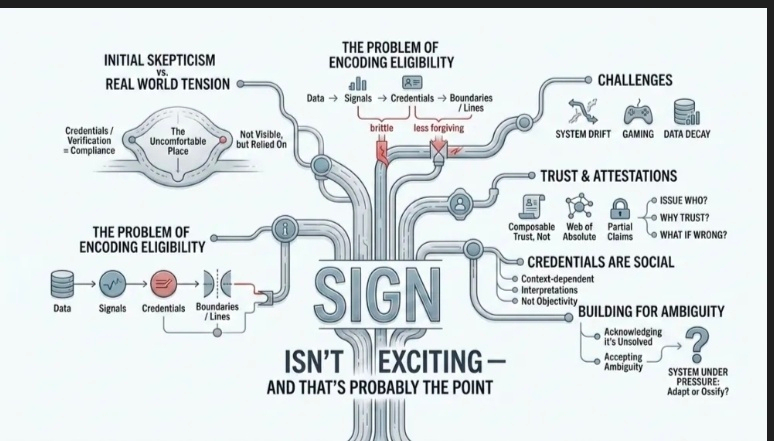
At the same time, sign acknowledges that transparency isn’t always the right answer. I’ve seen countless systems where full transparency ended up creating more problems than it solved. People’s private information gets exposed unnecessarily, or systems become targets because all the data is visible. $SIGN balances this by revealing only what is necessary to prove authenticity. I appreciate this nuance because it reflects an understanding of human behavior and risk, not just cryptography. Privacy and trust need to coexist, and $SIGN seems built with that in mind.
I’m also intrigued by how SIGN integrates tokenization. At first, I was skeptical—tokenizing credentials could easily be reduced to a gimmick. But as I dug deeper, I realized it isn’t about turning identity into a commodity. It’s about attaching verifiable, programmable utility to credentials. In my thinking, this opens possibilities I hadn’t fully appreciated before. For instance, a professional license could automatically signal eligibility for certain services or benefits without intermediaries. A certificate could carry a form of verifiable economic weight, allowing me to interact with systems in ways that previously required multiple checks. It’s subtle, but I can see how this could dramatically reduce friction in real-world processes.
As I consider scalability, I find myself asking tough questions. Any global infrastructure has to handle millions, potentially billions, of users and institutions. I wonder: can this system remain robust under global demand? From what I’ve seen, $SIGN’s design relies on a combination of decentralized verification and selective data exposure. This means it can theoretically scale without becoming a bottleneck, which is something I don’t take lightly. Scalability isn’t just a technical problem; it’s a question of whether a system can genuinely operate in the messy reality of human institutions.
I keep coming back to the real-world implications. I imagine a scenario where I, as an individual, can move across borders, institutions, or platforms, carrying credentials that are immediately verifiable. I no longer have to chase documents, wait for approvals, or worry about whether a verifier will accept what I present. And for institutions, they can verify claims almost instantly without maintaining endless back-and-forth with other organizations. I feel like this has the potential to transform the efficiency of work, education, and governance, all while keeping security and privacy intact.
Of course, I am aware that technology alone cannot solve everything. operates within a web of legal, regulatory, and cultural frameworks. No matter how elegant the system, it must interact with rules that vary by country, by institution, and sometimes by individual interpretation. I find it humbling to recognize that the infrastructure can only provide tools—it cannot enforce compliance or resolve all differences. Its success depends on how humans choose to use it, integrate it, and trust it.
I also reflect on how this work feels different from many other projects in crypto or digital identity. There’s no hype, no promises of instant wealth or fame. Instead, I see careful consideration of how trust actually works, how credentials are used, and how systems break when they are siloed or opaque. Reading about $SIGN, I get the sense that the builders are trying to solve a deeply human problem with patience and rigor. They are asking: how do people and institutions prove claims reliably, across borders and systems, without exposing themselves unnecessarily? And more importantly, they seem willing to grapple with the messy realities rather than oversimplify them.
I notice, too, that $SIGN’s approach is iterative and modular. It doesn’t attempt to replace everything in one go. Instead, it provides a framework that can grow as institutions and users adopt it. This feels right to me because trust, identity, and verification are not problems that can be solved overnight. They require careful evolution, feedback loops, and adjustments based on real-world experience. I imagine myself as a user or builder navigating this system, and the modularity gives me confidence that it can adapt to my needs without forcing me into rigid rules.
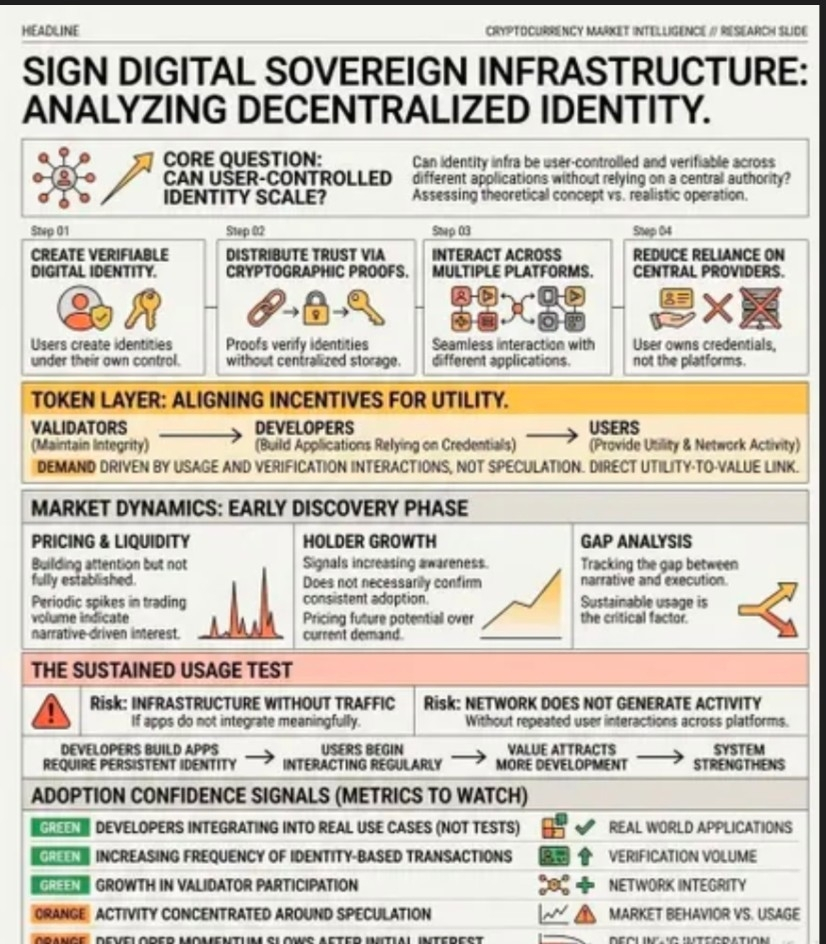
One of the most profound things I take away from studying sign is the human-centered design implicit in its architecture. It’s easy to focus on the blockchain, the tokens, or the cryptography, but what matters most is how people interact with the system. I feel that this focus on usability, reliability, and real-world integration is what sets it apart from many other technical projects. I think of it as creating invisible scaffolding—something that supports complex interactions without being intrusive, that underpins trust without replacing it, and that respects the complexity of human systems.
At the end of the day, I come back to a simple reflection: the problem sign addresses is fundamentally human. We need to prove who we are and what we’ve accomplished, but current systems make that unnecessarily difficult and risky. $SIGN isn’t a magic solution, and it doesn’t claim to be. What it offers is infrastructure—a way to streamline verification, protect privacy, and enable interaction between people and institutions in a more trustworthy way. In my mind, that’s both ambitious and realistic, and it’s the kind of thinking I respect.
I find myself imagining the broader implications. If this infrastructure is widely adopted, it could reduce fraud, increase efficiency, and enable new kinds of digital interaction that feel seamless yet secure. Credentials could move freely, institutions could trust claims without exhaustive manual checks, and I, as an individual, could navigate digital and physical systems without unnecessary barriers. I feel that this is the kind of thoughtful, foundational work that has a real chance to reshape how we understand trust in a digital world.
And while I acknowledge the challenges, I feel a quiet optimism sign doesn’t try to shortcut the problem; it addresses the underlying architecture of verification and trust. It provides tools that I can imagine being integrated across education, finance, professional licensing, and beyond. It doesn’t sell a vision—it builds the plumbing of a vision. That, to me, is more compelling than any flashy promise.
Ultimately, studying SIGN leaves me with a sense of respect for the complexity of trust and verification. I realize that real progress isn’t about hype or rapid adoption—it’s about creating systems that can quietly, reliably, and thoughtfully serve the needs of millions of people across diverse contexts. And I think $SIGN is one of those rare projects where I can trace the logic of its design and see that it aligns with that human reality, rather than an abstract ideal.
@SignOfficial #SignDigitalSovereignInfra $SIGN
