@SignOfficial $SIGN #SignDigitalSovereignInfra
The row looked smaller after I opened it.
Not the amount. The row itself.
Wallet on the left. Green eligibility badge in the middle. Allocation on the right. I had already been through half the preview table before this one slowed me down. Same clean TokenTable surface as the others. Nothing loud in it. Just enough structure to make everything feel settled before anything had actually moved.
I clicked into the record behind it because the amount felt a little too clean.
The Sign credential opened first.
Schema-linked. Issuer attached. Timestamp there. Structured fields sitting in that flat, tidy way attestations always do, where the object looks calmer than the work that produced it. I scrolled through it once, then back up, then sat there with the subject and wallet mapping longer than I meant to.
It still felt like verification.
That was the trick of it.
Not fake. Not wrong. Just light. The kind of step your brain files under earlier. Somebody checked a condition. Somebody issued the credential. Good. Administrative work. Now the real thing happens somewhere else.
I went back to TokenTable.
Same row. Same badge. Same amount.
Then I clicked the recipient list. Then the program settings. Then the allocation preview again, like one of those stupid little loops you do when the interface is telling you something you do not want to hear and you keep hoping another tab will restore the old hierarchy in your head.
It did not.
Nothing downstream was reopening the question.
The wallet was in because the Sign record had already let it in.
That sounds obvious once it lands, but it did not feel obvious staring at the table. The whole surface is designed to keep roles neat. Sign handles the credential. TokenTable handles the program. Verification upstream, distribution downstream. Clean handoff. Clean tools. Clean rows.
But the row only exists because that earlier answer came through the import alive.
The allocation logic can calculate whatever it wants after that. Percentages, cliffs, windows, schedules. It can shape the payout. It cannot shape the set from outside the set. That part was already closed by the time I was looking at the preview.
I clicked another row because I wanted the first one to feel accidental.
different wallet. Same shape. Same green badge. Same calm little middle column pretending to be less important than the number beside it.
Back to the first row again.
there is something especially annoying about the word eligible when it sits inside a payout table. Outside the table it feels provisional. Inside the table it stops sounding like a status and starts acting like a gate that has already swung open.
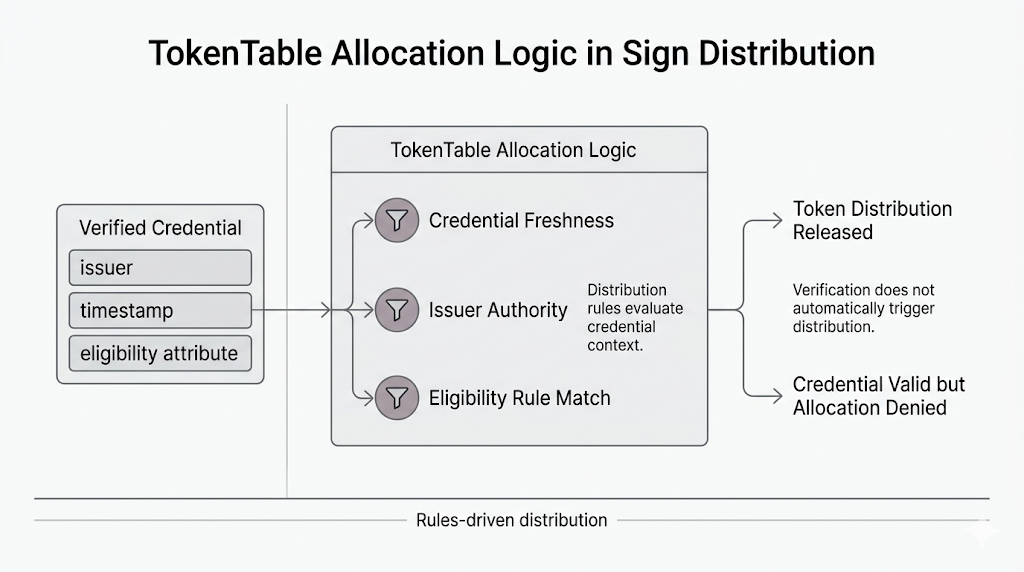
I kept hovering over the badge because there was so little else to look at. TokenTable wasn’t doing anything dramatic. It was doing exactly what it had been asked to do with imported credential data. The program read the accepted records and built the table from them. No second hearing. No separate human-shaped pause where the system admits that a verification object has become treasury consequence.
just row after row, looking reasonable.
that was the part I hated.
If the handoff had looked messier, I could have treated it like ordinary ops pain. Bad snapshot. Broken import. Wrong mapping. One of those workflow problems you can complain about while still believing the important decision is somewhere else.
This was worse. The row was clean enough to make the whole thing feel innocent.
I opened the Sign record again and looked at it more slowly.
The schema had done what schemas do. Fields defined. Claim shape fixed. The attestation had done what attestations do. The issuer’s answer bound into something structured enough for another system to read without guessing. All of it looked procedural. Almost modest. The record did not visually announce that it was carrying distribution power. It looked like evidence. It looked like a yes filed properly.
Then you return to the TokenTable preview and there is the amount, already hanging off it.
Not metaphorically. Not philosophically. Right there in the same row.
I stopped caring about the exact number after that. The number was downstream noise compared to the admission itself. However much the program was sending, the harsher thing had already happened earlier and quieter. This wallet was inside. Another wallet somewhere else was not. One record crossed the boundary. Another one did not. The table was only making that earlier cut legible in financial form.
I think that is why the row kept shrinking on me the longer I looked at it.
The interface still showed the same components. Nothing moved. But the center of gravity shifted. The amount started looking like an aftereffect. The green badge stopped looking administrative. Even the wallet on the left changed character a little. It was no longer just an address waiting to receive whatever the program decided. It was an address that had survived the only decision severe enough to matter to the person attached to it.
There is no dramatic screen in this workflow where Sign suddenly announces: this credential now decides who gets paid.
It stays polite the whole time.
The record stays a record. The import stays an import. The preview stays a preview. That is probably why the weight hides so well inside it. Nothing in the motion from credential to row asks for a bigger emotional register. The system keeps the same tone even after the consequence changes.
By then I was just moving between the attestation and the table, not because I needed more information but because I was trying to make the feeling smaller. Every pass through the loop made the same thing harder to ignore. The Sign side still looked like a clean proof step. The TokenTable side still looked like a clean distribution surface. And in the space between them, the lightest-looking object in the workflow had already decided who was allowed to become a payout row.
I left the preview open longer than I needed to.
The green badge stayed there in the middle column, calm as ever.
Small enough to miss if you were moving fast.
Heavy enough to decide who wouldn’t.