
@SignOfficial I was at my desk after 7 a.m. with a chipped white mug beside my keyboard and the hum of the AC in the room when I found myself reading Sign’s latest materials again. I cared because the argument felt less theoretical than it did a few months ago and I wanted to know whether it had finally become practical.
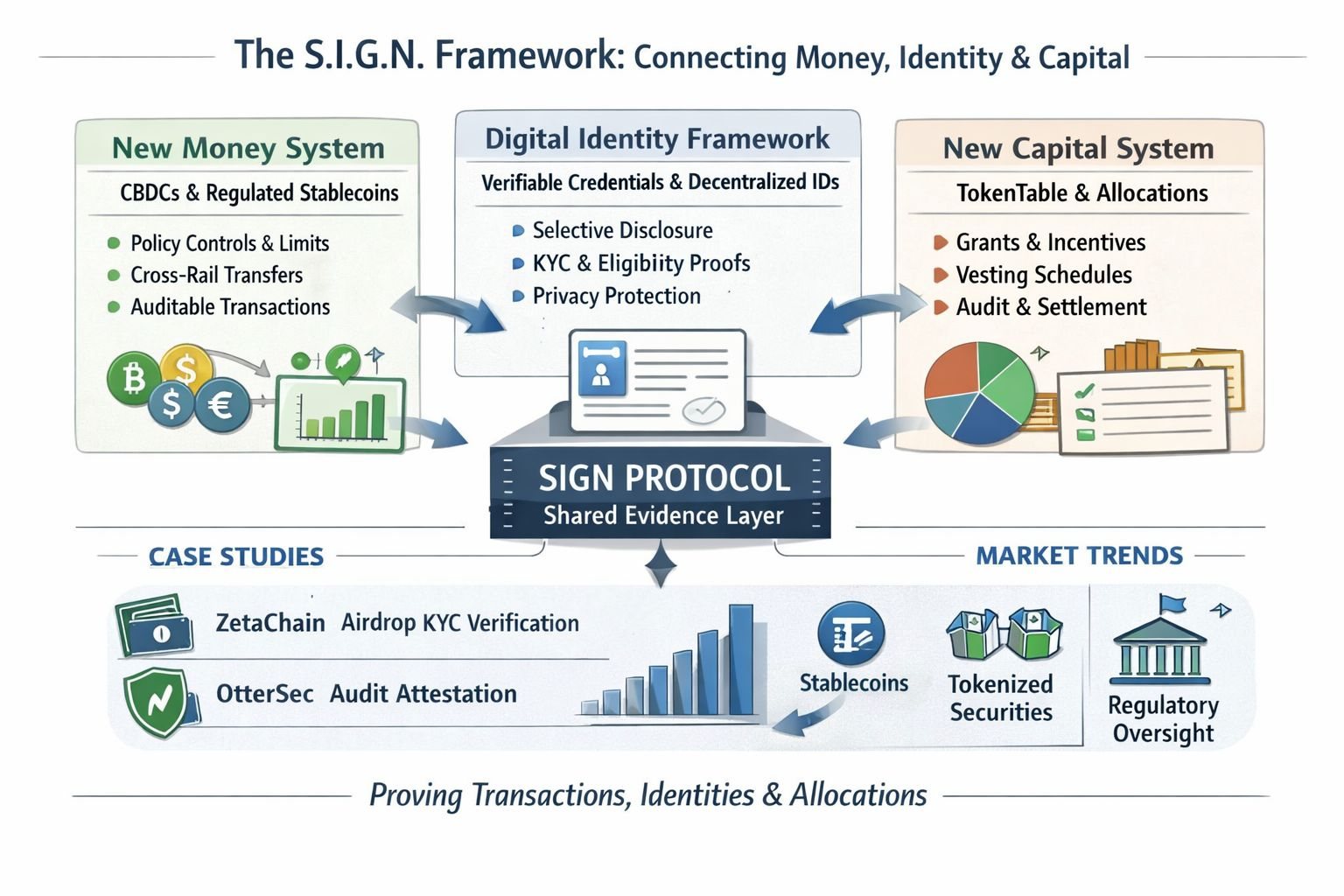
What caught me this time was not a flashy product claim but the way Sign now frames itself. In documentation updated in February 2026 the company presents S.I.G.N. as digital infrastructure for three connected systems which are money identity and capital while Sign Protocol sits underneath as the shared evidence layer. Around the same time the market began moving in a similar direction as stablecoin infrastructure attracted fresh investment the SEC issued new crypto guidance and tokenized securities moved closer to ordinary market plumbing. I do not think that timing is accidental.
When I look at money first I see Sign trying to solve a problem that sounds dull until it becomes urgent. It is trying to prove what actually happened. Its New Money System is built around CBDCs and regulated stablecoins that can operate across public or private rails and move between them under policy controls limits and logged approvals. That matters because digital money is not only about moving faster. It is also about leaving a usable record that supervisors auditors and counterparties can inspect later without making every payment fully public.
Identity sits right beside that and this is where the design becomes more realistic to me. I do not read Sign’s identity work as a replacement for every national ID database. I read it as a way to issue and verify claims about a person or institution through verifiable credentials and decentralized identifiers while still allowing selective disclosure and privacy preserving checks. In plain terms I may need to prove that I am eligible licensed or resident without exposing everything about myself. That feels more workable than the old swing between full anonymity and total surveillance.
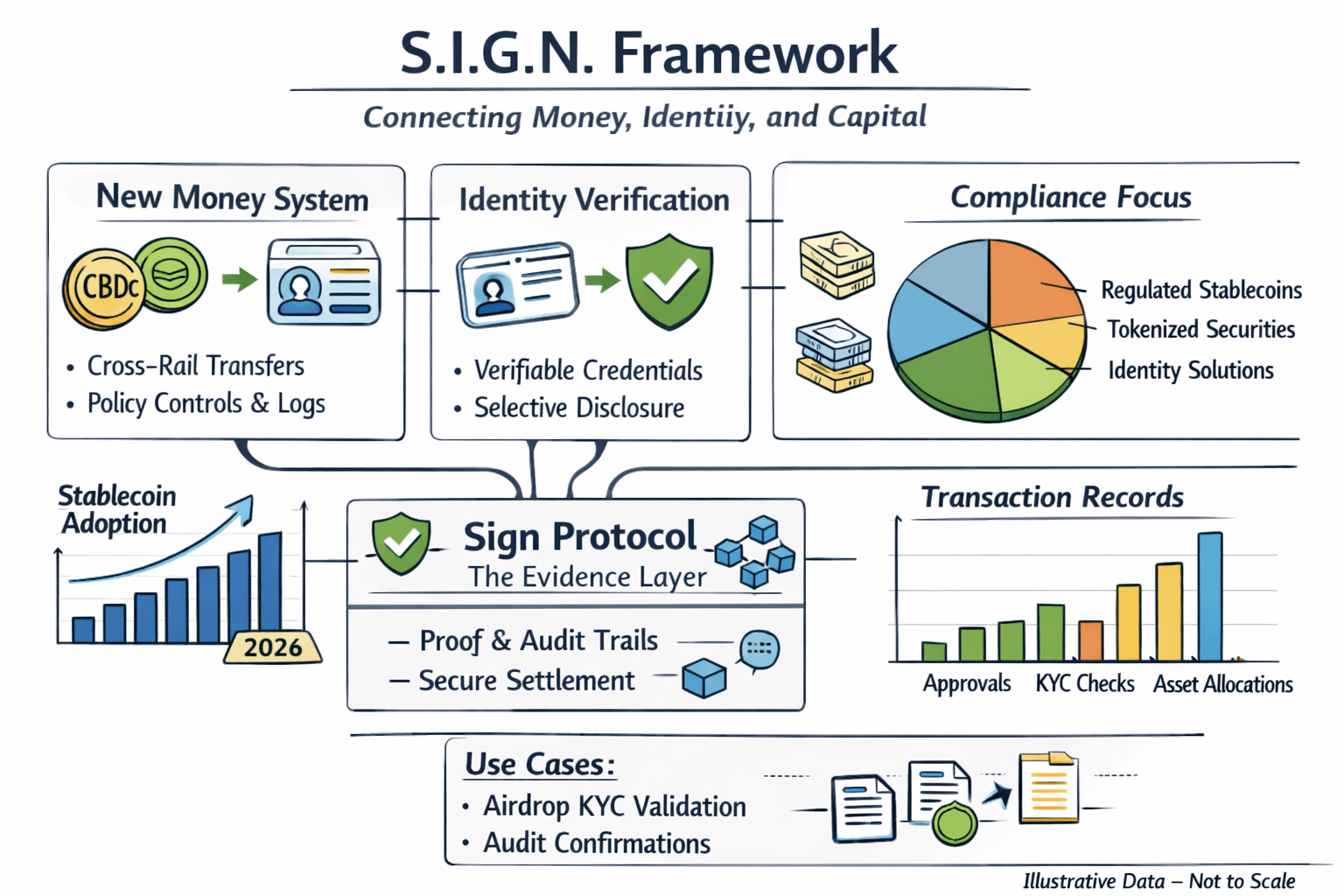
Capital is where the model starts to feel concrete. Sign’s New Capital System is not just another argument for tokenization. It deals with grants subsidies incentives vesting schedules and other distributions that are still often managed through spreadsheets manual reconciliation and slow audits. TokenTable handles who gets what when and under which rules while Sign Protocol anchors the eligibility proofs allocation manifests and settlement evidence. I find that split sensible because it treats capital as an operating process instead of reducing it to a token.
The case studies help because they keep the idea grounded. In ZetaChain’s 2024 airdrop flow Sign Protocol was used with Sumsub to connect wallet addresses to KYC status so TokenTable could enforce eligibility before funds were claimed. In another example Sign attestations were used to verify that an OtterSec smart contract audit had actually been completed. I like these examples because they are practical and easy to understand. They show Sign at its strongest when it works as a record and proof layer rather than as a vague promise about the future.
That is also why I think the topic is getting attention now. The market seems less interested in broad blockchain enthusiasm and more interested in compliance audit trails and institutional trust. If stablecoins are moving closer to major payment networks if tokenized securities are getting regulatory approval and if regulators are drawing clearer lines around digital assets then infrastructure that records identity authorization and execution together starts to look much more useful. I see Sign benefiting from that shift in mood because its pitch is closer to operations than ideology.
I still keep some distance from the stronger claims. No evidence layer can fix bad policy weak governance or sloppy data entry. Someone still has to decide who can issue an attestation who can revoke it and who gets access when there is a dispute. Even so I think Sign’s contribution is easier to see now than it used to be. I do not see it as one more chain or wallet story. I see it as a structured way to connect money movement identity checks and capital distribution to proof that can stand up to scrutiny.
@SignOfficial $SIGN #SignDigitalSovereignInfra #signDigitalSovereignlnfra