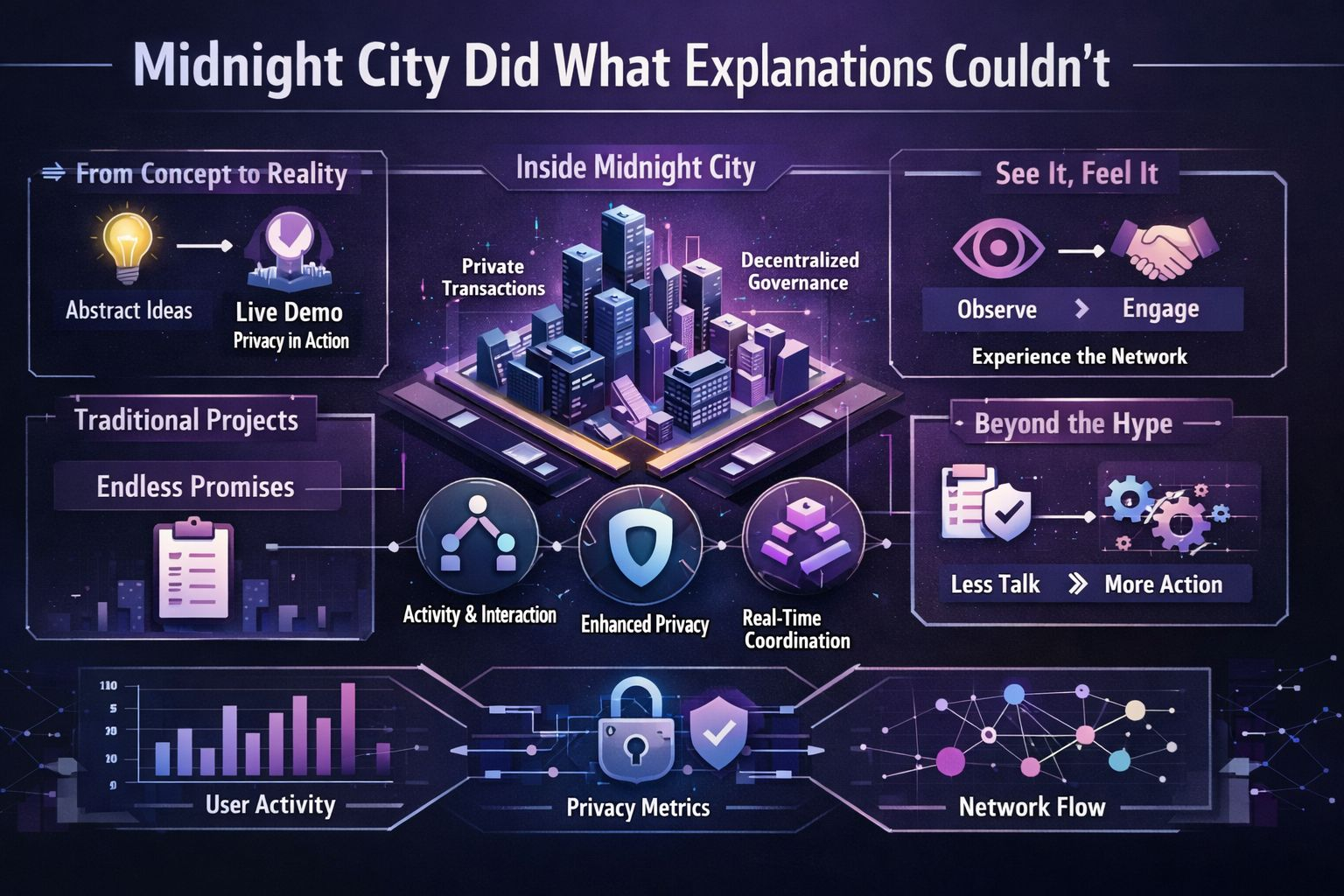
I did not find Midnight City interesting because it looked futuristic.
I found it interesting because it did something most crypto projects fail to do. It made the project easier to understand without making it feel smaller.
That difference matters.
A lot of projects spend months explaining themselves. They explain the architecture, the mission, the technology, the long-term vision. And honestly, most of them still end up sounding distant. You can read a lot and still not feel like you actually understand what the system is meant to be in practice.
That is where Midnight City changed the picture for me.
Instead of asking people to keep imagining what a privacy-focused network might look like, it gave that idea some form. Not in a shallow way, and not in a “look at this cool animation” way. What stood out to me was that it made Midnight feel less like a concept being defended and more like an environment being shaped.
That is a much stronger signal.
I think one of the hardest things about privacy infrastructure is that, when it is described only in technical language, it remains mentally distant for most people. Terms like selective disclosure, private computation, and verifiable privacy sound intelligent, but they do not automatically create understanding. They create interest, maybe. Curiosity, maybe. But not always clarity.
Midnight City creates a different kind of clarity.
It gives people something closer to behavior instead of theory. You stop thinking only in terms of “what the project says” and start thinking about “how this network is supposed to feel when it is alive.” That shift is important because it changes how the project gets judged. Once something becomes visible in motion, even as a simulation, the standard rises. At that point, the question is no longer whether the narrative sounds good. The question becomes whether the system looks believable.
That is why I think Midnight City matters.
To me, it shows that Midnight understands a problem many technically ambitious projects ignore. If people cannot picture what the infrastructure is for, they will never care enough to follow its details. Strong systems still need a bridge between architecture and perception. Otherwise they remain locked inside documentation, understood only by the few people already deep inside the subject.
And that is not enough.
A privacy-focused network cannot rely only on being correct at the technical level. It also has to become legible. Builders need to understand what they can do with it. Observers need to understand why it is different. Even skeptics need something more concrete than a series of claims. Midnight City helps with that. It does not simplify the project into nonsense, but it does reduce the distance between the idea and the observer.
That is what caught my attention.
What I also like is that it shifts the tone of the conversation. A lot of privacy discussions in crypto stay stuck in slogans. People say privacy is important, surveillance is bad, transparency has limits, and so on. Most of that is not wrong. It is just not enough. Those arguments have existed for years. What matters more now is showing how privacy can function inside a living system without turning the experience into something heavy, fragile, or impossible to follow.
That is where Midnight City becomes useful.
It suggests that Midnight is trying to show privacy as something operational, not just philosophical. Not just a principle, but a design environment. Not just a defensive feature, but part of how interaction itself can be structured. That is a more mature way to present the project, because it moves the focus away from ideology and toward implementation.
And that is the real dividing line in crypto.
There are projects that know how to sound ahead of their time, and then there are projects that start building things that make their direction easier to test. Midnight City feels closer to the second category. It does not prove everything, obviously. No simulation can do that. It does not guarantee adoption. It does not settle whether the network will perform under real pressure. It does not answer every hard question around scale, usability, incentives, or developer traction.
But it does something valuable before all of that.
It makes the project more accountable to its own story.
Once you show a living version of the direction you are aiming for, even in simulation form, you give people something to measure you against. That is riskier than staying abstract. It removes some of the safety that comes from endless explanation. And that is exactly why I respect it more. Projects that are weak usually stay vague for as long as possible. Projects that want to be taken seriously eventually have to let people see the shape of what they are building.
That is what Midnight City feels like to me.
Not a decorative side piece. Not a flashy distraction. More like a signal that Midnight does not want to live only inside language anymore.
It wants to become easier to picture.
And in a space full of projects that still expect people to believe before they can visualize, that is not a small thing. It is one of the clearest ways a project can start moving from “interesting on paper” to “worth watching closely.”
That is why Midnight City stood out to me.
Not because it looked impressive.
Because it made Midnight feel more real.
@MidnightNetwork $NIGHT #night