
Zero-knowledge gets talked about a lot, but most of the time it’s treated like a flashy label rather than something that actually changes how systems work. What makes it important here is not the term itself, but the shift in how trust is built. Instead of showing everything to prove something is valid, the system lets you prove it without giving away the details behind it. That’s a very different way of thinking compared to how blockchains have operated so far.
In most existing networks, verification and visibility go hand in hand. If a transaction is valid, everyone can see why. Midnight moves away from that pattern. It creates a gap between what is true and what is visible, and that gap is where privacy lives. You can confirm that rules were followed, balances are correct, or conditions are met without exposing the actual data involved. For things like financial activity, identity, or sensitive business logic, that difference matters more than it might seem at first.
It also changes how work gets done inside the network. Instead of every node repeating every step, a lot of the computation can happen elsewhere, with the result compressed into a proof. The chain only needs to verify that proof. So while people usually associate zero-knowledge with privacy, it’s also quietly reshaping efficiency. The network isn’t just hiding information it’s processing it in a different way.
But once you start hiding data, the environment around it shifts too. Markets rely heavily on visibility. Traders read flows, analysts study on-chain patterns, and participants react to what they can observe. When that information becomes limited, those привычные signals weaken. That can protect users from being exploited, especially in cases like front-running, but it also makes the system harder to read from the outside. It forces a different kind of awareness, where indirect signals and broader context matter more than raw transparency.
For developers, this flips the usual approach. Instead of building something open and then trying to layer privacy on top, they start with privacy and decide what needs to be revealed. That leads to more controlled designs. A system can confirm that someone qualifies for a loan or meets certain criteria without exposing their entire financial position. It feels closer to how things work off-chain, just without relying on a central authority to verify it.
Still, none of this comes easy. Zero-knowledge systems are complex, and that complexity introduces risk. If something goes wrong at the proof level, it’s not always obvious or easy to catch. On top of that, the user experience can feel abstract. People are being asked to trust outcomes they can’t directly see, which requires a different level of confidence in the underlying design.
This shift is happening at a time when the market is starting to care less about pure hype and more about whether systems can actually be used in the real world. Privacy isn’t just a niche feature anymore it’s becoming a requirement for anything that aims to scale beyond a small group of users.
The key is to look past the label and focus on how it’s actually applied. Not every system using zero-knowledge delivers meaningful privacy or efficiency. The real value shows up in how well it reduces unnecessary exposure while still holding everything together securely. For anyone building or investing in this space, that’s the difference between something that sounds advanced and something that actually moves the industry forward.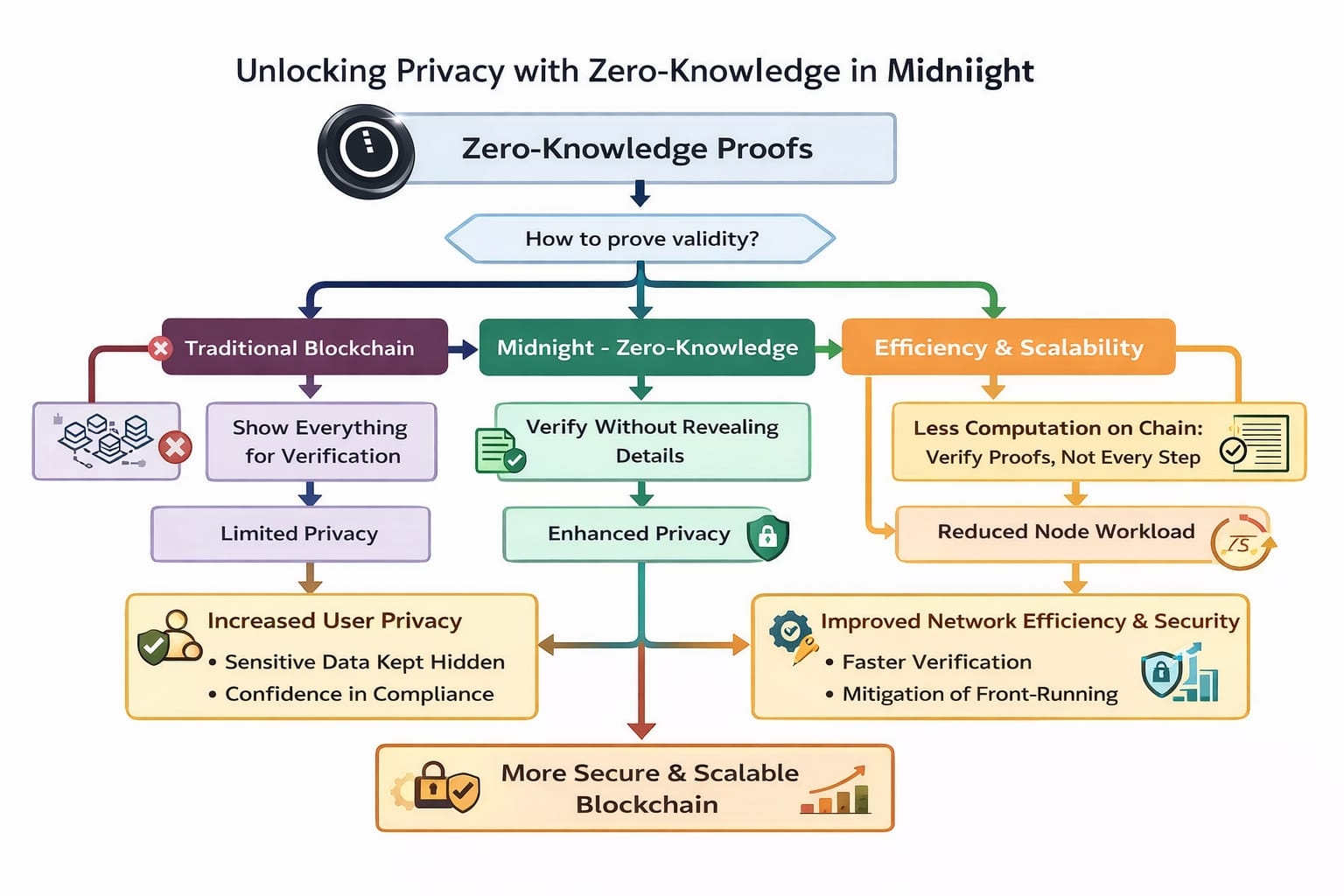
@MidnightNetwork #night $NIGHT
