
Most blockchains started with the same promise.
Total transparency. Total auditability. Total trust through exposure.
It sounded logical at the time. If everyone can see everything, nobody can cheat.
That was the theory.
The reality turned out different.
What the industry calls transparency often behaves more like permanent surveillance. Every wallet is public. Every transaction is permanent. Every interaction becomes part of a record that never forgets. Not just for verification, but for anyone who knows how to look.
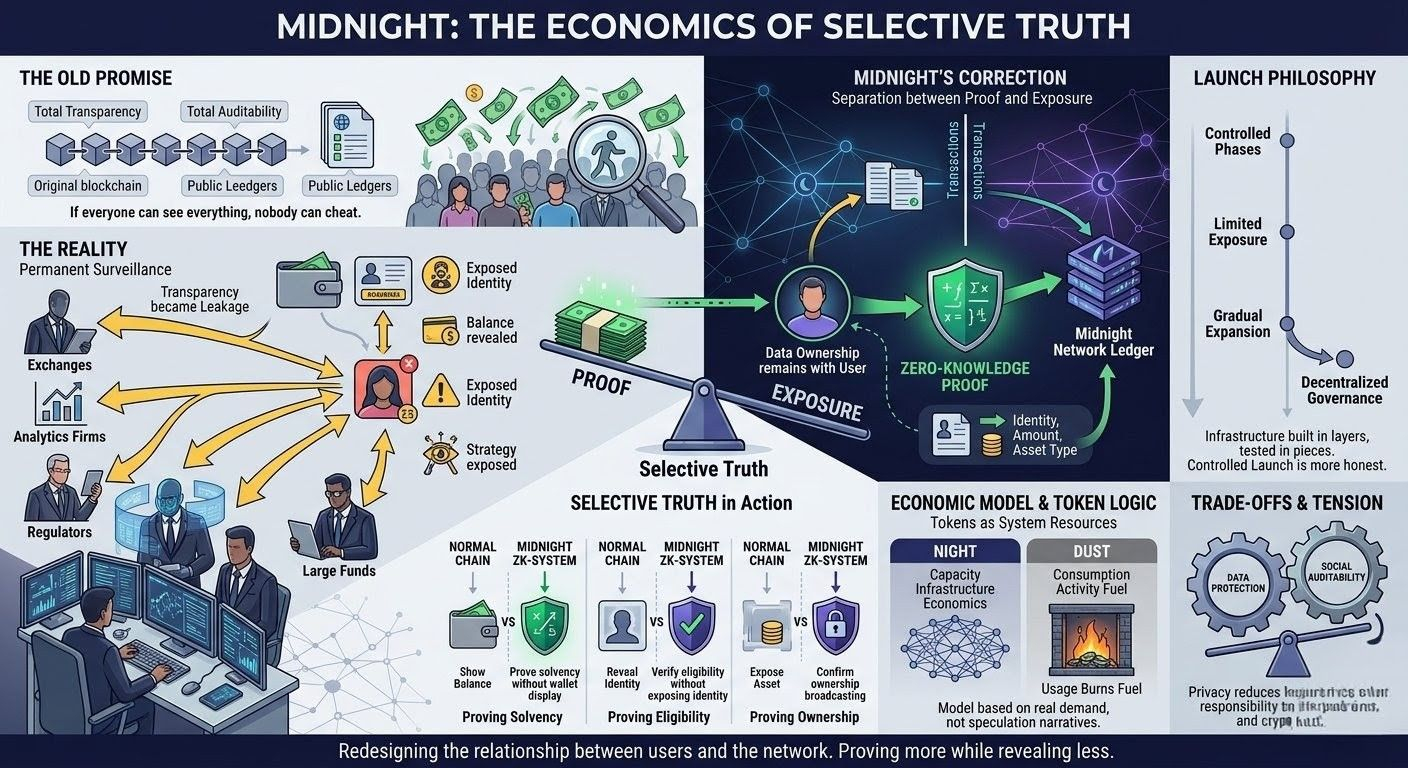
This created a strange situation where blockchains solved the problem of trust between machines, but made the problem of privacy between humans worse. People can prove ownership, but they also expose their behavior. They can verify balances, but they also reveal strategy. They can interact freely, but every move becomes data that someone else can analyze.
Transparency became leakage. Not accountability. Leakage.
And once leakage becomes normal, power shifts to whoever can read the data better than everyone else. Exchanges, analytics firms, regulators, large funds, anyone with better tools. The system stays open, but the advantage becomes uneven. That was never part of the original philosophy, but it is the natural result of putting everything in the public square.
This is the environment where Midnight starts to make sense, not as a privacy experiment, but as a correction to a design mistake that most chains never tried to fix.
The core idea behind Midnight is not secrecy. It is separation. Separation between proof and exposure. Separation between validation and visibility. Separation between what the network must know and what the world does not need to see.
Most blockchains assume these things must be the same. If the network needs to verify something, then the data must be public. Midnight does not follow that rule. It uses zero-knowledge proof systems in a way that changes the economic behavior of the chain, not just the technical architecture. The network can confirm that a statement is true without forcing the user to reveal the underlying information.
That sounds like a small difference, but it changes everything.
In a normal chain, proving solvency means showing balances.
In a zero-knowledge system, solvency can be proven without showing the wallet.
In a normal chain, proving eligibility means revealing identity.
In a zero-knowledge system, eligibility can be verified without exposing who you are.
In a normal chain, proving ownership means exposing the asset.
In a zero-knowledge system, ownership can be confirmed without broadcasting it.
This is what selective truth looks like. Not hiding, not lying, just limiting what needs to be public.
The interesting part is not the cryptography itself. Zero-knowledge proofs have existed for years. The interesting part is the decision to build an economic system around the idea that data ownership should stay with the user instead of automatically belonging to the network. Most chains never made that choice. They optimized for openness first and dealt with the consequences later. Midnight is doing the opposite.
This also shows up in the way the token model is described. Instead of framing tokens only as speculative assets, the design treats them as system resources. NIGHT represents capacity, and DUST represents consumption. That language matters, because it forces the conversation away from price and toward function. The network needs fuel to operate, and usage burns that fuel. Not as a marketing trick, but as a reflection of actual demand inside the system.
When activity increases, more resources are required. When the system grows, capacity must expand. That is closer to infrastructure economics than to typical crypto token narratives. Many projects talk about deflation, supply shocks, or scarcity stories, but the underlying mechanics often have little to do with real usage. Midnight at least tries to connect the token logic to what the network actually does. That does not guarantee success, but it makes the model easier to respect.
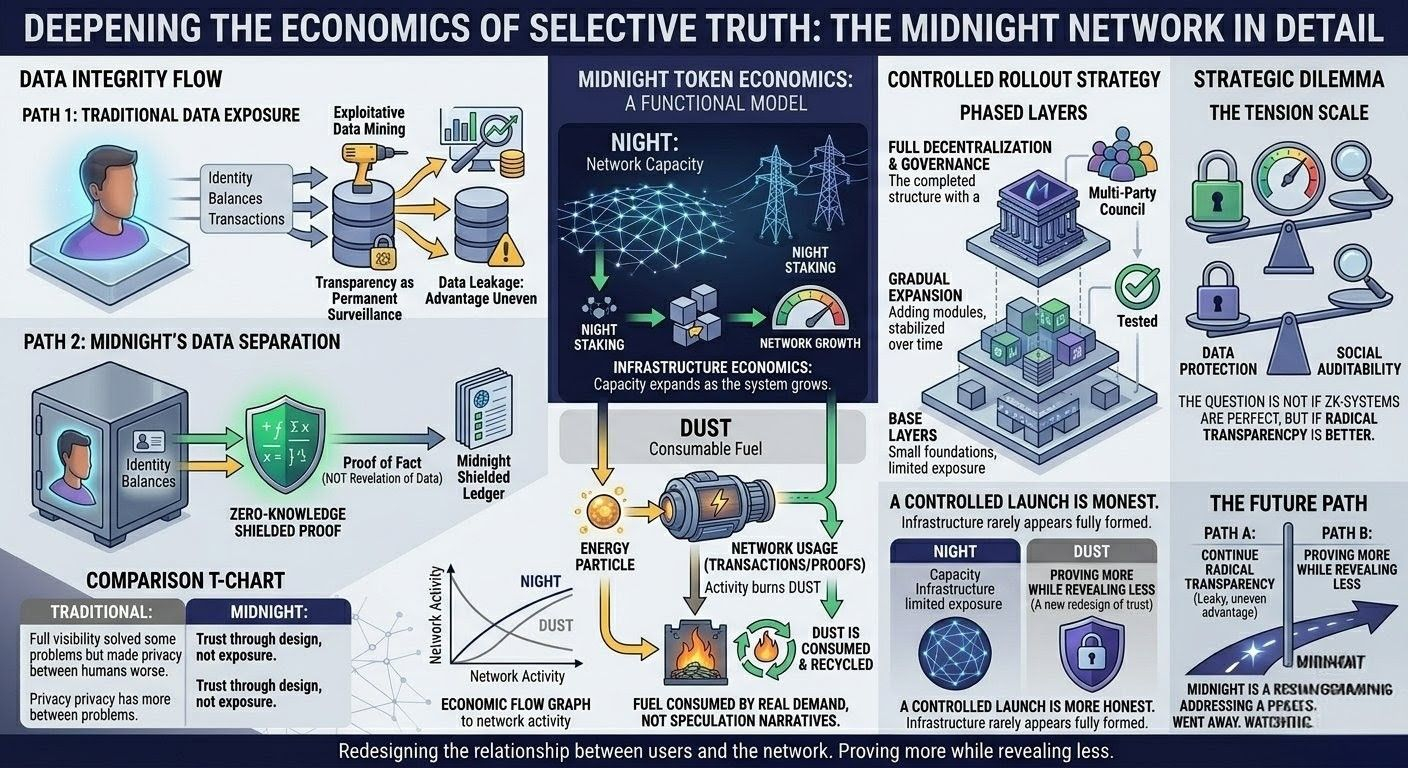
Another detail that stands out is the launch philosophy. Instead of pretending the system is fully decentralized from the first day, the rollout is structured. Controlled phases, limited exposure, gradual expansion. In the current market, that approach often gets criticized because people expect instant decentralization, instant governance, instant openness. But instant decentralization is usually performance, not reality. Most networks start with hidden control, informal coordination, or concentrated influence, even if they do not admit it.
A controlled launch is less romantic, but more honest. Infrastructure rarely appears fully formed. It is built in layers, tested in pieces, and stabilized over time. Midnight seems to accept that instead of trying to hide it behind slogans.
There are still trade-offs. Systems that protect data more carefully can also be harder to audit socially. When information is not visible, trust must come from the design itself, not from public observation. That shifts responsibility onto the protocol rules, the cryptography, and the governance process. If those fail, the damage may not be obvious immediately. Privacy reduces leakage, but it also reduces the amount of information outsiders can use to detect problems early. That tension never disappears. It only moves.
The question is not whether zero-knowledge systems are perfect. They are not. The question is whether the current standard of radical transparency is actually better. After more than a decade of public ledgers, the answer is not as clear as it once sounded. Full visibility solved some problems, but it created others that the industry still pretends do not exist.
Midnight is built on the assumption that the next phase of blockchain design will not be about showing more, but about proving more while revealing less. That assumption could be wrong. It could also be early. Markets often reject changes that make systems more complex, even when the complexity exists for a reason.
For now, the project sits in an unusual position. Not a pure privacy chain, not a standard transparent chain, not just a technical experiment, but an attempt to redesign the relationship between users and the network itself. The goal is not to remove trust from the system, but to reduce how much personal information must be sacrificed to get that trust.
That is a real problem, not a marketing one.
Whether this approach becomes the new standard or just another side path is impossible to know yet. The idea makes sense. The execution will decide everything.
I have seen too many projects promise freedom and deliver new forms of control to assume anything works just because the theory sounds clean. Midnight is trying to fix a flaw most people stopped questioning, and that alone makes it worth paying attention to.
Not because it will definitely succeed.
Because the problem it is addressing never went away.
I am watching, not convinced.
@MidnightNetwork #night $NIGHT
