
Most people are watching the AI race.
Very few are noticing what it is quietly changing outside of AI.
Over the last few years, one of the biggest technology stories has been the race to build faster and more efficient compute. Every new generation of GPU hardware delivers more performance for less cost. The improvements are not incremental — they are compounding. More throughput, better efficiency, lower cost per operation. #night @MidnightNetwork $NIGHT
The reason is obvious.
Artificial intelligence demands massive amounts of computation. Training large models, running inference at scale, optimizing performance — all of it depends on raw compute power. Companies are pouring enormous resources into making that compute faster and cheaper, because every improvement directly translates into better models and wider adoption.
But there is a second-order effect that almost nobody is talking about.
The same computational foundation powering modern AI systems is also deeply connected to how zero-knowledge proofs work.
And that connection is starting to matter.
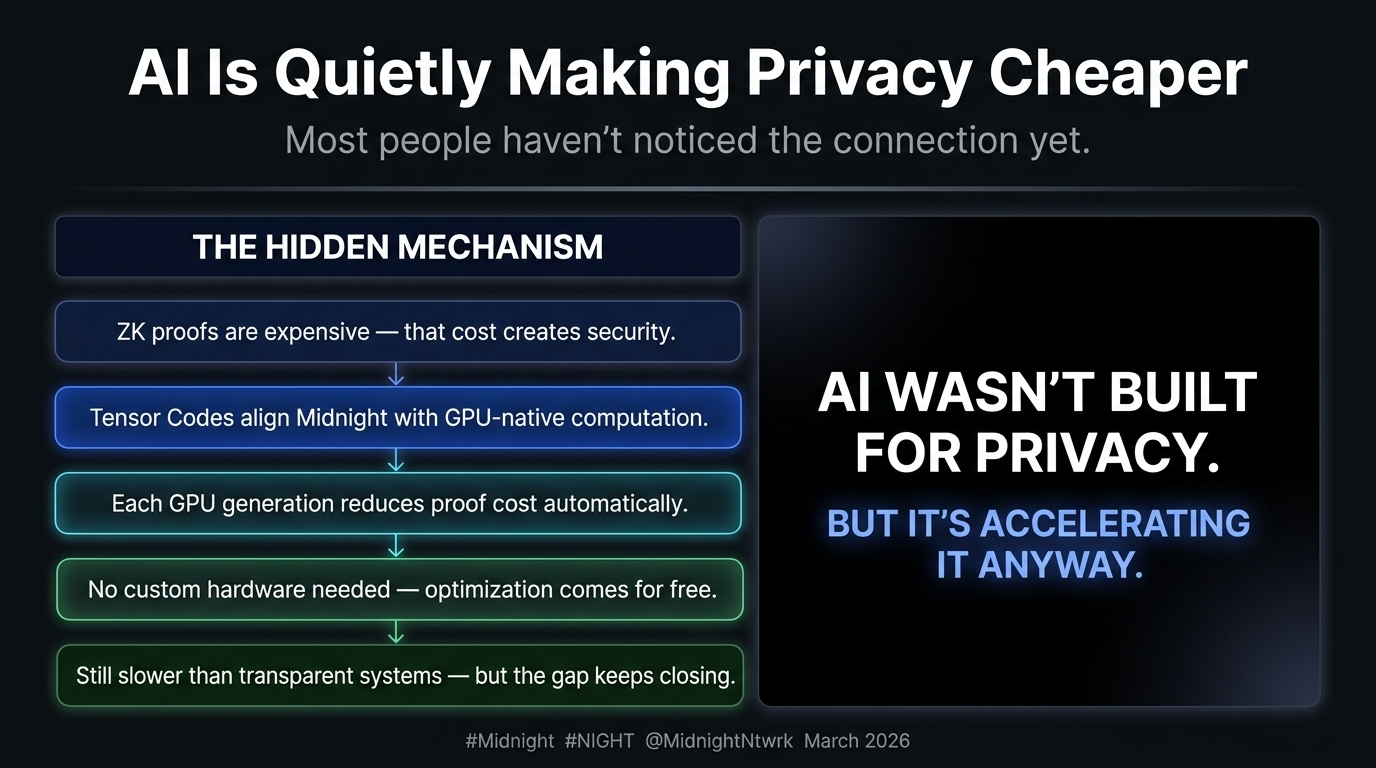
Zero-knowledge proofs, by design, are computationally intensive. That is not a weakness — it is part of what makes them secure. Generating a proof requires real work, and that work ensures that the result cannot be easily faked. It creates a system where something can be verified without revealing the underlying data, but at the cost of significant computation.
That cost has always been one of the main constraints.
It affects how fast proofs can be generated.
It affects how cheap private transactions can become.
And ultimately, it shapes how practical privacy-focused systems are at scale.
This is where architecture becomes important.
Because not all implementations approach this problem the same way.
Midnight introduces a design choice that changes how this constraint evolves over time.
Instead of building its proof system in isolation, it aligns it with the same mathematical structures that modern hardware is already optimized to process.
At the center of this approach is something called Tensor Codes.
Without getting lost in technical depth, the key idea is simple.
The operations required to generate proofs are structured in a way that maps efficiently onto tensor-based computation — the same type of computation that modern GPUs are designed to accelerate.
This is not accidental.
It is a deliberate decision to align cryptographic workloads with the direction hardware is already moving.
And that alignment has powerful implications.
Because the companies driving advancements in tensor computation are not small.
They are some of the largest technology players in the world, investing at a scale that no single blockchain project could realistically match. Their goal is to make AI faster and more efficient. But in doing so, they are also improving the exact type of computation that systems like Midnight depend on.
Every new generation of hardware improves performance.
Every optimization reduces cost per operation.
And every step forward in that curve indirectly benefits any system built on the same computational foundation.
This creates an interesting dynamic.
Midnight does not need to fund massive hardware research.
It does not need to wait for specialized blockchain chips.
It benefits automatically from progress that is happening anyway.
Not because it is directly targeted —
but because it is mathematically aligned.
The practical impact of this becomes clearer when you think about scale.
As compute becomes cheaper, the cost of generating proofs decreases.
As performance improves, the time required to process private transactions drops.
And as both trends continue, the gap between private and non-private computation begins to shrink.
This does not happen overnight.
Even today, generating zero-knowledge proofs is still more expensive than processing a standard transparent transaction. There are real constraints in terms of latency and throughput, especially for applications that require high-frequency interactions.
But the direction is what matters.
Each hardware cycle pushes the boundary further.
What was once expensive becomes manageable.
What was once slow becomes acceptable.
And eventually, what was once impractical becomes standard.
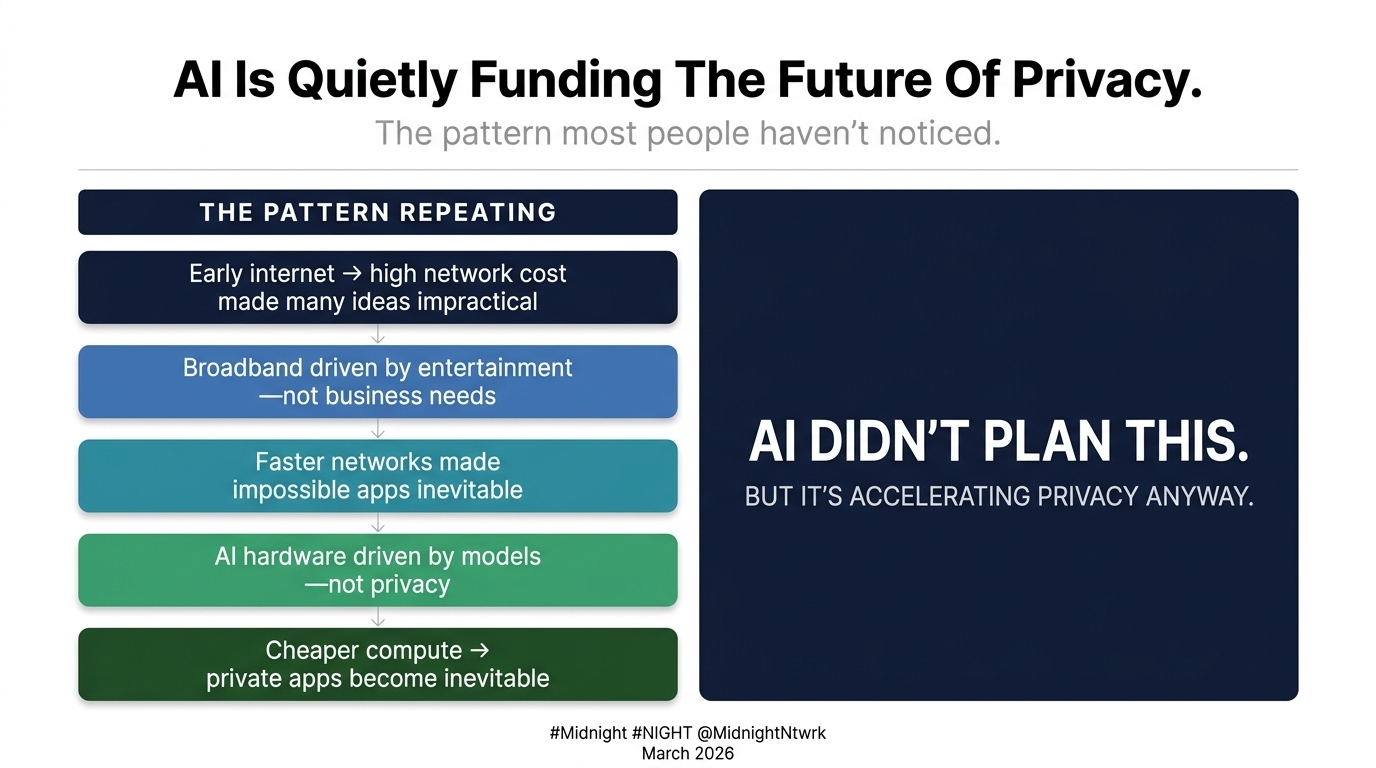
We have seen this pattern before.
Early internet applications struggled because infrastructure was limited. Connections were slow. Bandwidth was expensive. Many ideas that seem obvious today simply were not feasible at the time.
Then infrastructure improved — largely driven by demand from entirely different use cases.
Streaming, gaming, and consumer media pushed investment into faster networks. That investment was not made specifically to support new business applications, but it ended up enabling them anyway.
The same dynamic is playing out again.
AI is driving the demand.
Hardware companies are responding with better compute.
And as a side effect, new possibilities are opening up in areas that were previously constrained.
Privacy is one of those areas.
By aligning its architecture with tensor-based computation, Midnight positions itself to ride that wave.
Not through partnerships or direct dependency, but through design.
It builds on top of the same mathematical foundation that the rest of the industry is optimizing.
That means every improvement compounds.
Every new GPU generation contributes to making privacy more efficient.
Every reduction in cost makes private applications more accessible.
And over time, that changes the economics of what is possible.
Of course, it is important to stay realistic.
This does not eliminate all challenges.
There is still a performance gap between private and non-private systems. There are still engineering hurdles to overcome. And there are still trade-offs that developers need to consider when deciding how and where to use privacy features.
But those challenges are not static.
They are moving targets.
And they are moving in a direction that favors systems built with this kind of alignment.
That is what makes this dynamic interesting.
The improvement is not dependent on a single roadmap or a single team.
It is tied to a global trend that is already in motion.
The AI industry is pushing forward because it has to.
The demand for better models, faster inference, and more efficient compute is relentless.
And as that progress continues, its effects ripple outward.
Not always in obvious ways.
But in ways that matter.
In this case, it is quietly changing the cost structure of privacy.
Making something that was once expensive
a little more affordable each year.
Making something that felt complex
a little more practical over time.
Nobody planned this connection as a primary goal.

But it exists.
And it is already shaping the direction of the ecosystem.
Because in technology, the systems that succeed are often the ones that align with larger forces — not fight against them.
Midnight is not trying to create a completely separate path for privacy.
It is aligning with the path that the industry is already taking.
And if that trajectory continues, the long-term outcome becomes clearer.
Privacy will not remain expensive forever.
It will follow the same curve as compute.
And systems designed to take advantage of that curve
will benefit the most. 🌑