
Applying for a visa today is often described as a necessary evil, but in reality, it is one of the most opaque and corrupt processes any government runs. Millions of people worldwide submit documents, pay fees, and then enter a system that no one can fully see. Weeks can pass. Months can go by. Throughout this waiting period, applicants have no insight into what stage their application has reached. They cannot confirm that officials are applying rules consistently or fairly. They have no recourse if a rejection comes without explanation. Worse yet, there is no way to know if the fees they paid actually reached the government or ended up in someone’s pocket. #Sign @SignOfficial $SIGN
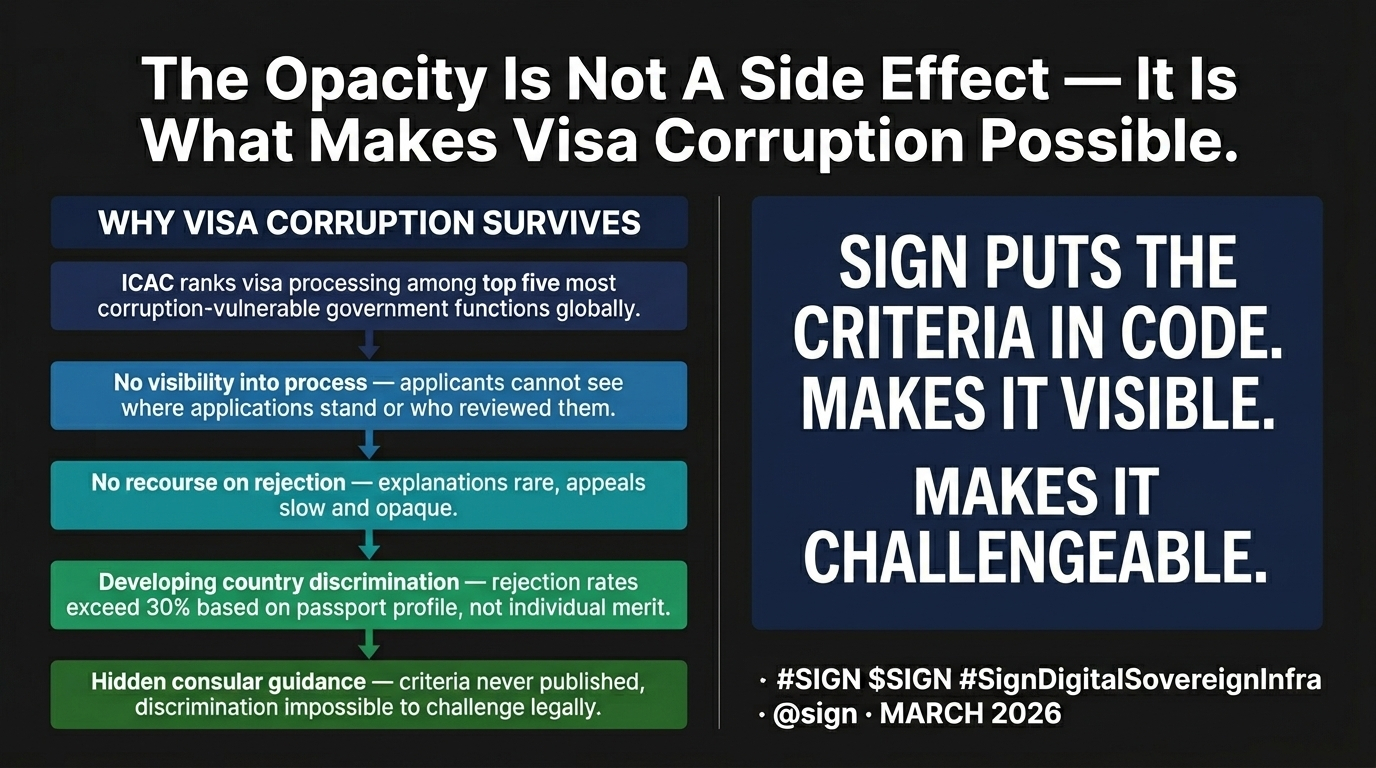
This is not just anecdotal. The International Anti-Corruption Resource Center consistently ranks visa and immigration processing among the top five government functions most vulnerable to corruption. The opacity of the system is not accidental—it is the environment that allows bribery, favoritism, and arbitrary decision-making to flourish. When nobody can observe the process, nobody can prove wrongdoing, and the cycle continues unchecked.
Sign Foundation’s e-Visa system was created specifically to address these deep structural flaws. At its core, it reimagines visa processing from the ground up, starting with identity verification. Instead of relying on human reviewers to visually inspect documents, the system uses zero-knowledge passport proofs stored on-chain. In simple terms, an applicant can prove that they hold a valid passport from an eligible country without ever revealing sensitive details unnecessarily. This proof is cryptographically verified, meaning it cannot be forged. The verification is mathematical and absolute, eliminating the need for manual inspection.
Once identity is securely established, smart contracts take over the entire processing workflow. Traditional visa systems depend on humans moving papers between departments, making subjective judgments, and sometimes soliciting unofficial payments. In contrast, Sign’s approach automates each step: the verified application is evaluated against pre-coded eligibility criteria, including nationality, travel history, purpose of visit, and supporting documentation. If the application meets all the conditions, it automatically progresses to the next stage. If it fails, the system provides a precise explanation of which condition was not met. There is no discretion. There is no ambiguity. There is no opportunity for bribery or favoritism.
Every action within this system generates an immutable on-chain record. Submission, processing milestones, decisions, and issuance are all logged in real-time. Once recorded, these entries cannot be altered or deleted. This ensures that no one can later claim a document was submitted when it wasn’t or that processing took longer than it actually did. The transparency is dual-sided: applicants can track the real-time status of their applications, while governments gain a complete, auditable record proving the integrity of their visa operations to international partners and oversight organizations.
The benefits of this system extend beyond transparency and anti-corruption. Visa processing is inherently cross-border, and every country traditionally has to verify documents issued by others. This usually requires bilateral agreements, authentication chains, and trusted intermediaries, all of which add time and cost. Sign’s on-chain identity framework allows a passport attestation to be instantly verifiable by any participating country’s system without the need for additional agreements. The verification happens on the blockchain and is publicly verifiable by anyone with access, drastically reducing bureaucratic friction and speeding up approvals.
Financial inclusion is another critical dimension. Current visa systems often discriminate against passport holders from developing countries. Individuals may face high rejection rates not because their applications are weak, but because historical population-level data marks their nationality as higher risk. Overstay rates, immigration violations, and other aggregated statistics influence individual decisions, sometimes unfairly. While Sign’s system does not magically remove all statistical biases, encoding eligibility criteria into smart contracts makes these rules transparent. Civil society, international observers, and applicants themselves can see exactly which rules are applied, and challengers now have the possibility to question discriminatory practices. Hidden consular guidelines are replaced with public code, creating accountability where none existed before.
Of course, this approach has its challenges. Visa issuance is a deeply political process, and automating it means governments must encode their policies in transparent, public code. Some nations may hesitate because policies that were once opaque now become visible. Decisions that were easily defended behind closed doors are now open to scrutiny. Sovereignty concerns and political sensitivities cannot be ignored, even if the technology offers immense benefits.
Nonetheless, the system is fundamentally broken, and the technology to repair it already exists. Sign’s e-Visa demonstrates that a combination of blockchain, smart contracts, and cryptographic proofs can transform visa processing from a slow, opaque, and corrupt process into one that is fast, transparent, and accountable. By automating repetitive tasks and providing immutable, auditable records, the system removes human discretion where it is most dangerous. Applicants can trust that their applications are processed fairly, governments can prove integrity, and international travel can become more predictable and secure.
Moreover, Sign’s approach introduces a new level of trust in international travel. Imagine an application where every step is visible, every decision is explainable, and every verification is mathematically guaranteed. Applicants no longer have to rely on intermediaries, local agents, or opaque consular offices. Governments can demonstrate compliance to global partners. Errors, favoritism, and corruption are no longer hidden in plain sight—they are eliminated.
The broader implications are significant. By setting a global standard for transparent visa processing, this model could reshape how governments think about all highly sensitive bureaucratic functions. Financial systems, immigration workflows, and other high-stakes processes could adopt similar frameworks. The key is not just technological adoption, but political willingness to accept transparency as a priority over maintaining opaque discretion.
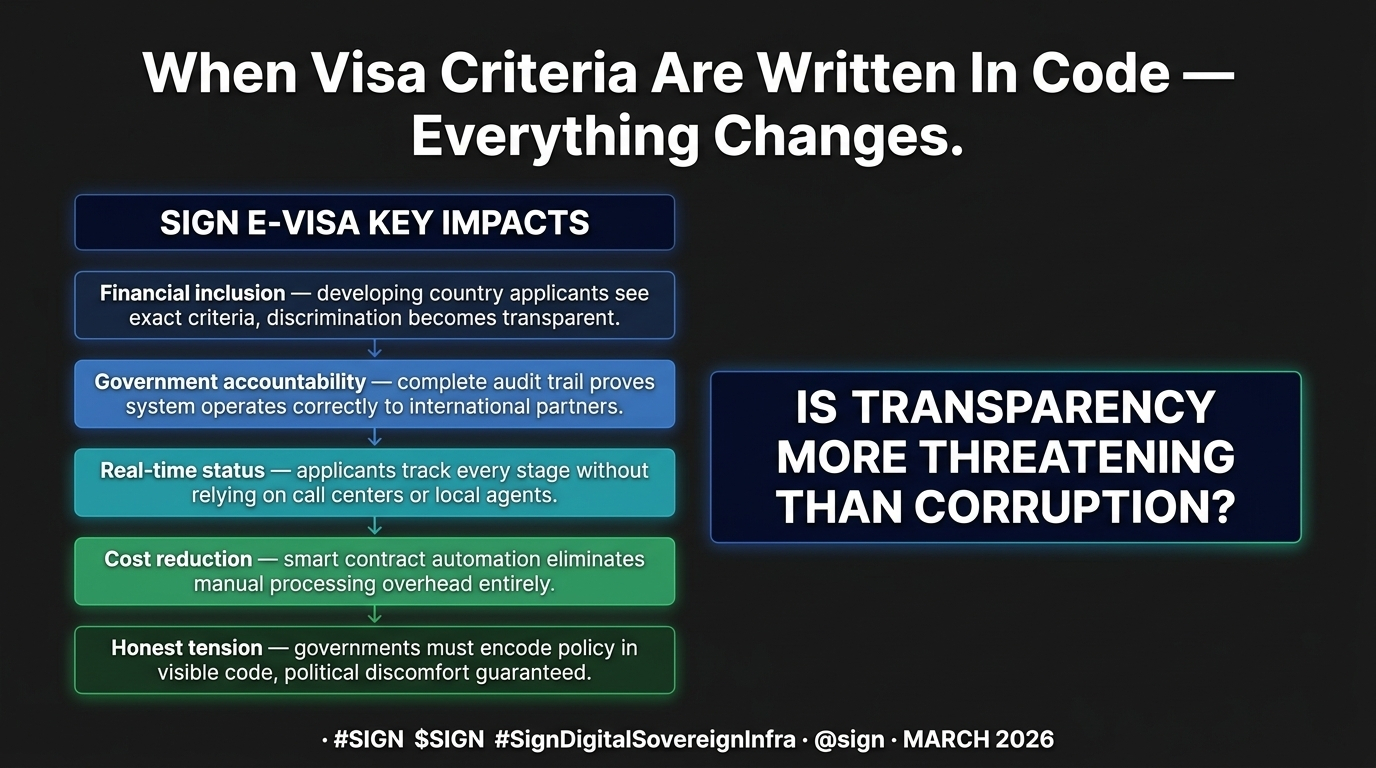

In conclusion, visa processing has long been a source of frustration, inequity, and corruption. The Sign e-Visa system shows that technology can restore fairness, accountability, and trust. Every step from identity verification to decision issuance is recorded, immutable, and transparent. Applicants gain insight, governments gain auditability, and the possibility of corruption diminishes dramatically. The choice is now in the hands of policymakers: embrace this transparent model or continue to tolerate the shadows where corruption thrives. With Sign’s e-Visa, the path forward is clear — a visa system that is honest, efficient, and auditable in every way.