
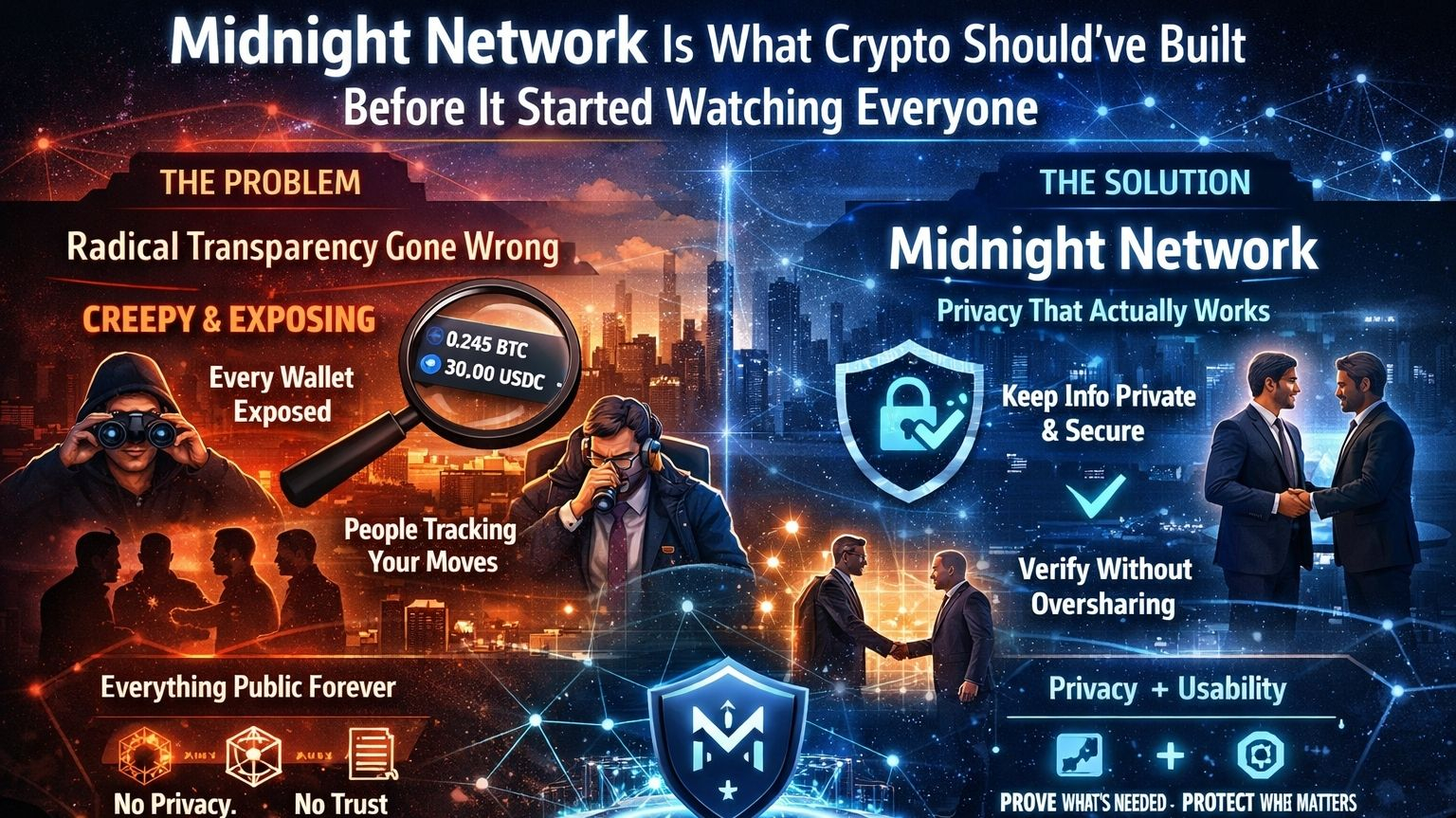
Midnight Network finally clicked for me when I stopped looking at it like “another privacy project” and started looking at it as a reaction to one of crypto’s dumbest habits: pretending radical transparency is somehow noble.
It isn’t noble. It’s creepy.
That’s the part people dance around. They use softer words. “Open.” “Verifiable.” “Trustless.” Fine. Great. But in practice? You’ve got a system where people can watch wallets like stalkers, map behavior, connect dots, track spending patterns, sniff out relationships, and build a disturbingly detailed picture of someone’s activity just because the industry decided permanent exposure was a fair trade for public verification.
Why exactly was that supposed to be normal?
And no, this is not just some edge-case complaint from privacy diehards. For regular people, it’s unsettling. For businesses, it’s an absolute dealbreaker. No serious company wants its transactions, counterparties, workflows, or timing patterns hanging out in public for competitors, analysts, bots, and random weirdos to inspect. That’s not transparency. That’s self-sabotage with a blockchain wrapper.
That’s why Midnight Network matters.
Not because it says “privacy” louder than everyone else. Plenty of projects have done that. Usually with a lot of chest-thumping and very little realism. Midnight Network feels different because it starts from a much less delusional premise: people want systems they can trust without being forced to live naked on-chain.
That’s the aha moment.
You can prove something without showing everything. Obvious, right? Apparently not obvious enough, because crypto spent years acting like the only way to build trust was to expose every action to the entire internet forever. Midnight Network is built around the idea that this trade-off was broken from the start. Some information should stay private. Some should be provable. Some should only be disclosed when there’s an actual reason. Not as ideology. As basic system design.
Because real life works that way.
People don’t walk around publishing their bank statements to prove they’re honest. Businesses don’t open the books to every stranger in the room just to show they’re legitimate. Normal systems have layers. Boundaries. Context. Crypto, for a long time, behaved like all of that was optional. Or worse, like privacy itself was vaguely suspicious.
That mindset poisoned a lot of otherwise smart technology.
Midnight Network seems to get that. It doesn’t treat privacy like a bolt-on feature for paranoid users. It treats it like infrastructure. Something foundational. Something you build into the system at the start if you want the thing to be usable by adults in the real world.
And honestly, that alone makes it more interesting than a huge chunk of the market.
Look, the industry loves inventing fake binaries. Privacy or compliance. Transparency or trust. Openness or practicality. As if you always have to pick one and sacrifice the other. Midnight Network pushes back on that nonsense. It is saying, more or less: maybe the system was just designed badly. Maybe the reason so many blockchain applications feel awkward, exposed, and commercially unserious is because they were built around the wrong assumption — that visibility should always win.
But why should it?
Why should a user have to leak their behavior just to participate? Why should a builder have to choose between verifiable logic and confidentiality? Why should a serious organization accept a system that turns every meaningful interaction into public metadata for someone else to study?
They shouldn’t. That’s the point.
Midnight Network feels like one of the few projects that looked at this mess and said, no, this is not a tolerable default. Not if you want real adoption. Not if you want useful products. Not if you want something other than an ecosystem full of hobbyist speculation and performative openness.
And that “performative” part really gets under my skin.
A lot of crypto transparency is fake virtue. It sounds principled until you imagine living with it. Then it just feels invasive. Imagine every payment, every asset movement, every connection between addresses becoming part of a permanent public trail. Not because you chose to share it. Because the system assumed you should. That’s not empowering. It’s weird. Midnight Network seems to understand that weirdness in a way most projects either missed or pretended not to notice.
But it’s not just about discomfort. It’s about usefulness.
A network can be technically brilliant and still be socially broken. Crypto has done that over and over. Built systems that engineers admire and normal people instinctively recoil from. Midnight Network at least appears to be trying to close that gap. Not by dumbing anything down. By rethinking the premise. Privacy isn’t the enemy of trust. Constant exposure is not the price of legitimacy. Verification does not require public spectacle.
That’s a much more mature way to think about blockchain infrastructure.
And it lands because it aligns with how people actually behave when stakes are real. When money is real. When business relationships are real. When consequences are real. Suddenly the old “everything visible all the time” model stops sounding clean and starts sounding unserious. Or worse, naive.
Because it is naive.
Midnight Network doesn’t strike me as naive. It feels like a project designed by people who have noticed that blockchain systems become a lot less impressive once you ask a very simple question: would any sane person want to use this under normal conditions? If the answer is no, then the architecture is not some bold act of honesty. It’s bad product design.
That’s the thing. Midnight Network is not interesting because it’s dramatic. It’s interesting because it’s correcting something embarrassingly basic. Crypto built a bunch of systems that made being watched feel normal. Midnight Network is one of the cleaner rejections of that idea I’ve seen.
And once you see that, it’s hard to unsee it.
The really strange part is that the industry ever convinced itself that radical transparency was the future, when for most people it would be a total nightmare the second it touched real life.
Midnight Network feels compelling because it starts there. With the nightmare. And says maybe we should stop pretending it’s a feature.