
Sign Protocol is one of those projects I almost want to dismiss on instinct.
Not because it sounds bad. More because crypto has trained a lot of us to be suspicious anytime a project starts talking in big terms about trust, systems, and the future of digital coordination. Usually that kind of language is doing a lot of heavy lifting for something pretty thin underneath.
But this one is a little harder to brush off.
What I actually like about Sign Protocol is that it seems focused on the boring but important stuff. The plumbing. The part most people ignore because it is not flashy enough to carry a hype cycle on its own.
And honestly, that is usually where the real value sits.
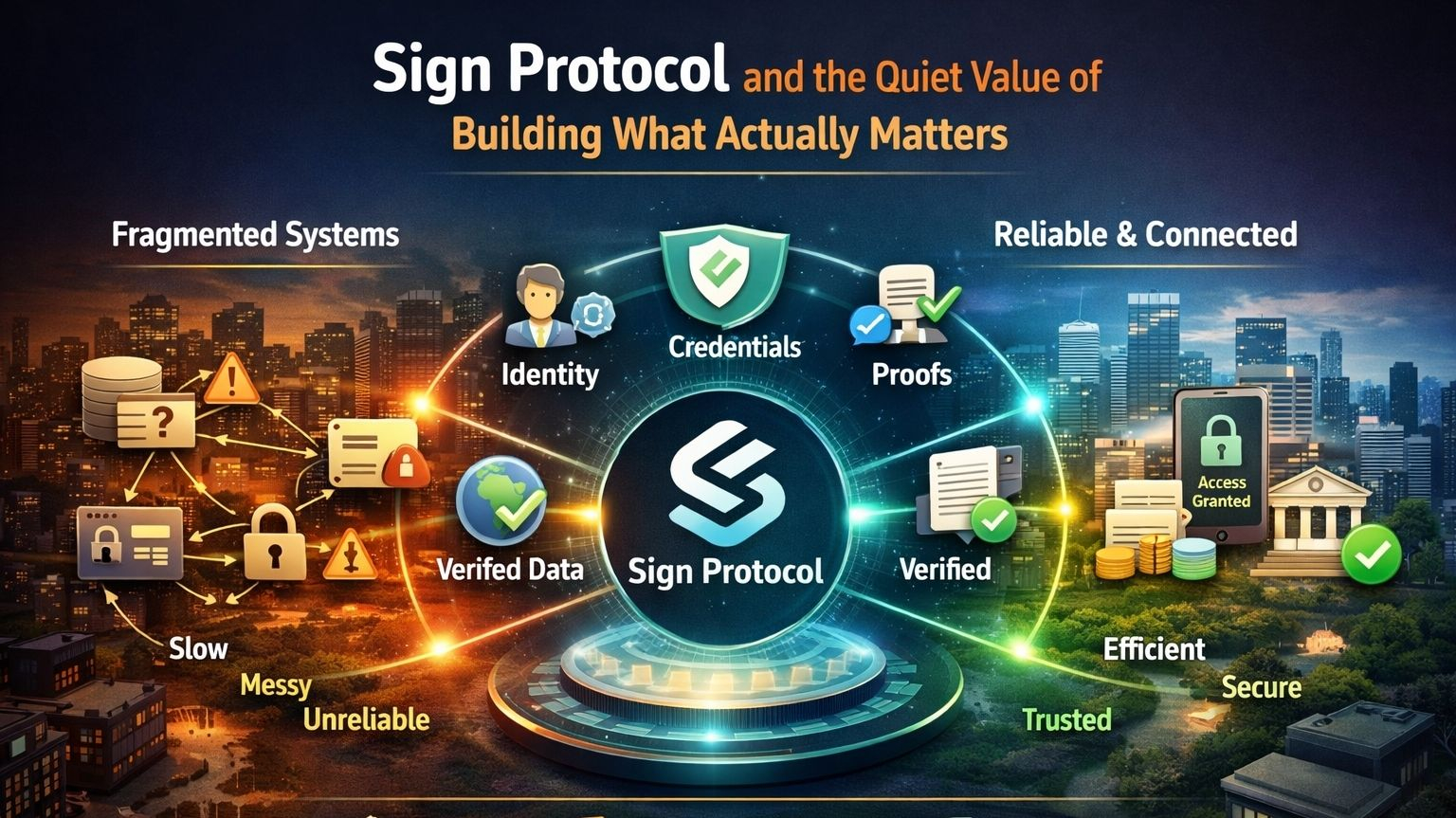
The basic idea behind Sign Protocol is not even that complicated once you strip away the crypto wording. A lot of online systems depend on proving that something is true. That a person is who they say they are. That they qualify for something. That a credential is real. That a certain action actually happened. Most of the time, those records live in separate places, under separate rules, and talking to each other is messy at best.
So trust ends up fragmented.
That is the problem Sign Protocol seems to be going after.
Not with some grand consumer app. Not with another shiny product people will forget in six months. More with a framework for making claims, records, and attestations easier to issue, check, and carry across different systems without everything turning into a bureaucratic headache.
That might sound dry. Because it is dry.
But dry does not mean unimportant.
The thing is, a lot of crypto projects chase attention first and usefulness later. Sign Protocol feels like it is trying to do the opposite. That alone makes me pay closer attention. It is not selling pure excitement. It is building around a problem that actually exists, and a pretty annoying one too.
Because let’s be honest, digital trust is still a mess.
Everywhere.
You sign up for something here, prove something there, verify yourself again somewhere else, and half the time the systems do not line up. Important information gets stuck in silos. Institutions rely on clunky records. Users keep repeating themselves. Everyone acts like this is normal because we have gotten used to it, but it is still a bad setup.
Sign Protocol feels like a response to that.
What makes it more interesting to me is that the project does not seem confused about its lane. A lot of teams in this space try to be everything at once. Payments, identity, creators, AI, gaming, real-world assets, social. You see the pitch and it reads like someone dumped every trend from the last two years into one deck and hoped nobody would notice.
Sign Protocol feels narrower than that.
Which is good.
It seems to know that its value, if it is going to have real value, comes from helping people prove things and trust those proofs without relying on the same old disconnected systems. That is a much cleaner story. Also a harder one. You cannot fake your way through this kind of work for very long because eventually people start asking whether the thing is actually useful or whether it just sounds smart.
And that is where I think Sign Protocol has a shot.
Not because the project has already won. It has not. Not because every big idea around it is proven. Also no. But because the core problem it is trying to solve is real enough that even a partial win here would matter.
That is the part people miss.
They look at projects like this and immediately judge them by whether they are exciting enough. Wrong filter. The better question is whether they are working on the stuff that actually matters once the noise dies down. Identity, proof, records, permissions, claims that need to be checked and trusted. None of that is sexy. It is just necessary.
Anyway, that is why Sign Protocol keeps standing out to me.
Not in a loud way. More in that annoying way where you keep coming back to it because the use case makes too much sense to ignore. You do not have to buy into every ambitious claim to see why the project is worth watching. You just have to recognize that the internet still handles trust in a clumsy, fragmented way, and that fixing even part of that would be a bigger deal than most token chatter ever is.
But here’s the catch.
A project like Sign Protocol has to prove itself in the real world, not just in theory. This is where things get harder. It is easy to describe a better trust layer. It is a lot harder to build one that people actually rely on, especially when the systems involved are messy, slow, and full of edge cases.
That is why I am not in the “this changes everything” camp.
Not even close.
I just think Sign Protocol is more serious than the average project people try to lump it in with. The foundation feels more intentional. The problem feels more grounded. The direction makes more sense than a lot of the trend-chasing nonsense that usually gets attention first.
And maybe that is enough for now.
Because sometimes that is how genuinely interesting projects look in the early stages. Not obvious. Not universally understood. Just quietly solid in a space that tends to reward noise over depth.
So no, I would not call Sign Protocol just another hype story.
I would call it one of the few projects working on the boring layer that everyone depends on and almost nobody talks about properly. The records. The proof. The trust part. The stuff sitting underneath everything else.
That is why it feels different.
Not perfect. Not proven. But different in a way that makes me want to keep watching.