
I used to think the hardest part in crypto was figuring out what is real and what is noise. Now I’m starting to think the harder part is something else entirely… recognizing something real while the market is actively treating it like it doesn’t matter.
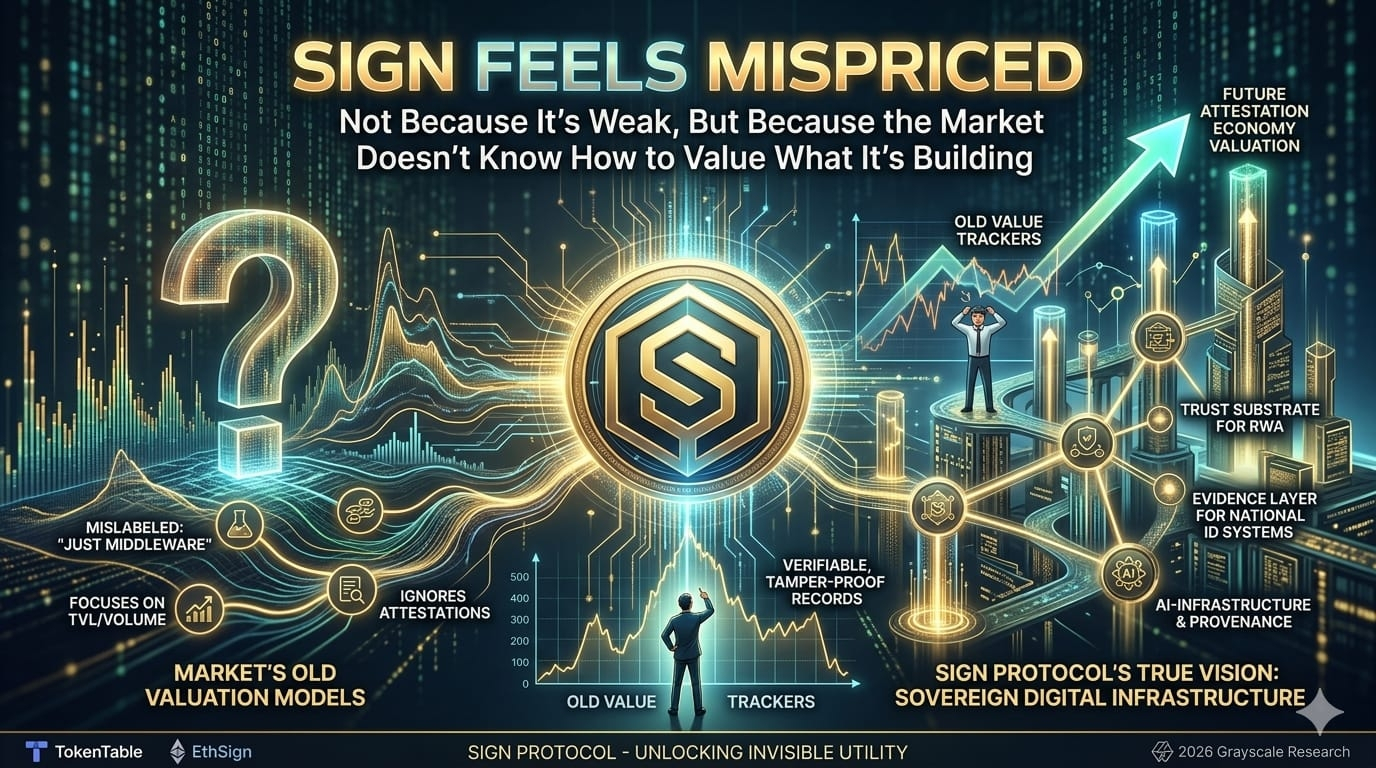
That’s the uncomfortable place I keep landing with $SIGN .
Because if I’m honest, my first reaction was not curiosity. It was dismissal. I saw the usual pattern post-TGE weakness, unlock pressure, supply overhang and I categorized it quickly. I’ve seen that setup too many times. It rarely rewards patience early. Most of the time, it just slowly drains attention until only long-term believers are left explaining why “the fundamentals are strong.”
So I almost moved on.
But the more I looked, the less that simple explanation held up. Not because the supply issue disappeared it didn’t but because the layer underneath it started to feel heavier than the market was acknowledging.
And that’s where the tension begins.
Because SIGN isn’t just pitching an idea. It’s quietly inserting itself into a part of the system most people don’t spend time thinking about the layer where trust gets decided before anything actually happens.
Not transactions. Not liquidity. Not user interfaces.
The step before all of that.
The moment where a system asks: Do I accept this data as real, or do I need to question it again?
That question sounds small. It isn’t.
Most systems today don’t trust each other. They verify, re-verify, and then verify again. Not because they want to, but because they have to. Every boundary between systems introduces friction. Every new environment resets trust back to zero. And over time, that constant resetting becomes invisible… even though it keeps slowing everything down.
The more I think about it, the more I realize that this is where a lot of “infrastructure” conversations fall apart. They focus on speed, cost, scalability .but ignore the fact that none of those matter if trust itself isn’t transferable.
That’s the gap SIGN is trying to sit inside.
Not by replacing systems, but by giving them a shared reference point they don’t need to keep rebuilding.
Sign Protocol makes credentials persistent instead of repetitive. TokenTable turns distribution into something structured instead of chaotic. EthSign anchors agreements so they stop depending on memory or reputation.
Individually, none of these feel like breakthroughs.
Together, they start to look like something else… a system trying to remove the need for re-checking things that should already be known.
And that’s where it gets interesting.
Because infrastructure only becomes valuable when people stop noticing it. When it becomes the default path, not the optional one. When switching away feels riskier than staying.
TokenTable already hints at that dynamic. Once a project relies on it mid-distribution, leaving is not just inconvenient .it’s operationally dangerous. That kind of stickiness doesn’t show up in narratives, but it shows up in behavior.
And behavior is usually where the truth is.
Then there’s the part most people are still underestimating the dual environment design. A public layer for open usage, and a private track for systems that can’t operate in full transparency.
That’s not a design choice you make for optics.
That’s a response to constraints.
Because the reality is, institutions don’t reject blockchain because it’s inefficient. They reject it because it doesn’t fit how they’re allowed to operate. Privacy, control, compliance those aren’t features you can bolt on later. They shape the system from the beginning.
So when I see a private network being built alongside the public one, I don’t read it as less decentralized.I read it as an attempt to meet the world where it actually is… not where crypto wants it to be.
And that’s where the story starts to diverge from how the market is pricing it.
Because the market is still looking at SIGN like a supply curve.
Unlocks. Circulating ratio. Sell pressure.
All of that is real. All of that matters.
But it’s also the easiest part of the story to model.
What’s harder and what the market seems to be avoiding is modeling what happens if this infrastructure actually embeds itself into systems that don’t move quickly, but once they move… don’t move back.
That kind of adoption doesn’t spike.
It settles.
And once it settles, it becomes extremely difficult to displace.
But here’s the part I keep coming back to, and it’s what stops me from leaning too far in either direction.
None of this matters if it stays at the edge.
If it remains a tool projects experiment with but don’t depend on… if it lives in pilot programs instead of real workflows… if usage doesn’t compound over time…
Then the market is right to ignore it.
Because infrastructure that isn’t embedded is just potential.
And potential doesn’t absorb supply.
That’s the risk most people are not fully respecting.
This isn’t a narrative that runs on attention. It runs on integration. Slow, difficult, often invisible integration across systems that are not designed to change quickly.
And that introduces a different kind of uncertainty.
Not whether it works.
But whether it gets used enough, deeply enough, consistently enough… before the market loses patience.
So I find myself stuck in that same middle ground, just with more clarity than before.
On one side, there’s something here that feels structurally real. Not loud. Not exaggerated. Just… deliberate in a way most projects aren’t.
On the other side, there’s a token that is still fighting its own mechanics. Supply doesn’t wait for adoption. It moves on its own schedule.
And markets usually side with what they can see immediately, not what might emerge later.
Maybe that’s the opportunity.
Or maybe that’s the warning.
I don’t think this is one of those cases where conviction comes easily.
It’s one of those situations where you keep watching, not because you’re convinced… but because ignoring it feels like a mistake.
And sometimes, that’s the earliest signal you get that something deeper is forming before the market is willing to admit it.