
The daily reality we accept feels almost broken.
Not in the dramatic, everything-is-on-fire way. More like that slow, annoying kind of broken you get used to because you deal with it every day. And honestly, that’s worse. When something explodes, you fix it. When something just keeps working badly, people adapt. They stop questioning it.
Fresh friction every time you move.
New wallet. New login. New verification. New allowlist. New bridge.
Again. And again. And again. 💔
Let’s be real we keep calling this interoperability, but half the time it feels like rival islands pretending to be a continent. Every chain has its own rules. Every app has its own identity layer. Every token distribution has its own weird spreadsheet logic running somewhere off-chain that nobody wants to talk about. I’ve seen this before. Different cycle, same mess.
And here’s the thing people don’t say enough: the problem isn’t speed.
It isn’t fees either.
It’s trust. Or more specifically… where trust lives.
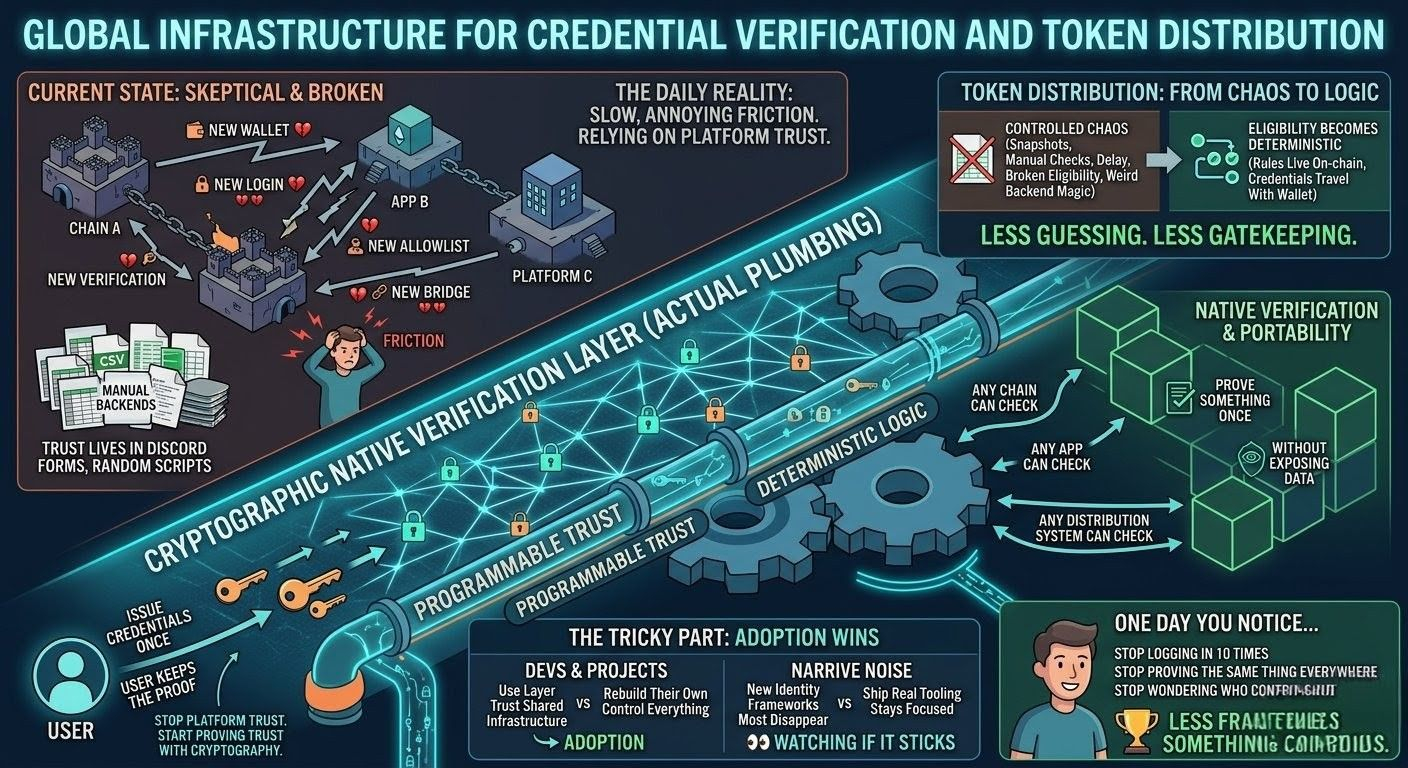
Right now trust lives in backends, dashboards, Discord forms, manual approvals, and random scripts someone wrote at 3 AM before a launch. That’s not infrastructure. That’s survival mode.
What’s missing is native verification. Actual plumbing. The kind of layer nobody tweets about because it’s not exciting, but everything breaks without it.
That’s where this whole idea of a global infrastructure for credential verification and token distribution starts to get interesting. Not as a flashy product. Not as another UI. As underlying logic. The stuff that sits under everything whether people notice it or not.
Look, the shift is simple to explain, hard to build.
Stop storing trust in platforms.
Start proving trust with cryptography.
Instead of every protocol building its own whitelist, its own KYC flow, its own reputation system, you issue credentials once with real cryptographic backing. The user keeps the proof. Not the platform. That alone changes the power balance more than most people realize.
And once you have that, native verification starts to make sense.
You don’t re-verify every time.
You don’t re-enter data every time.
You don’t rebuild logic every time.
You prove something once, and any chain, any app, any distribution system can check it without exposing the data behind it. That’s where programmable trust actually means something, not just a nice phrase in a thread.
Token distribution changes too. A lot.
Right now distribution feels like controlled chaos. Snapshots here, CSV files there, manual checks, delayed claims, broken eligibility rules. People act like this is normal. It’s not normal. It’s just what we got used to.
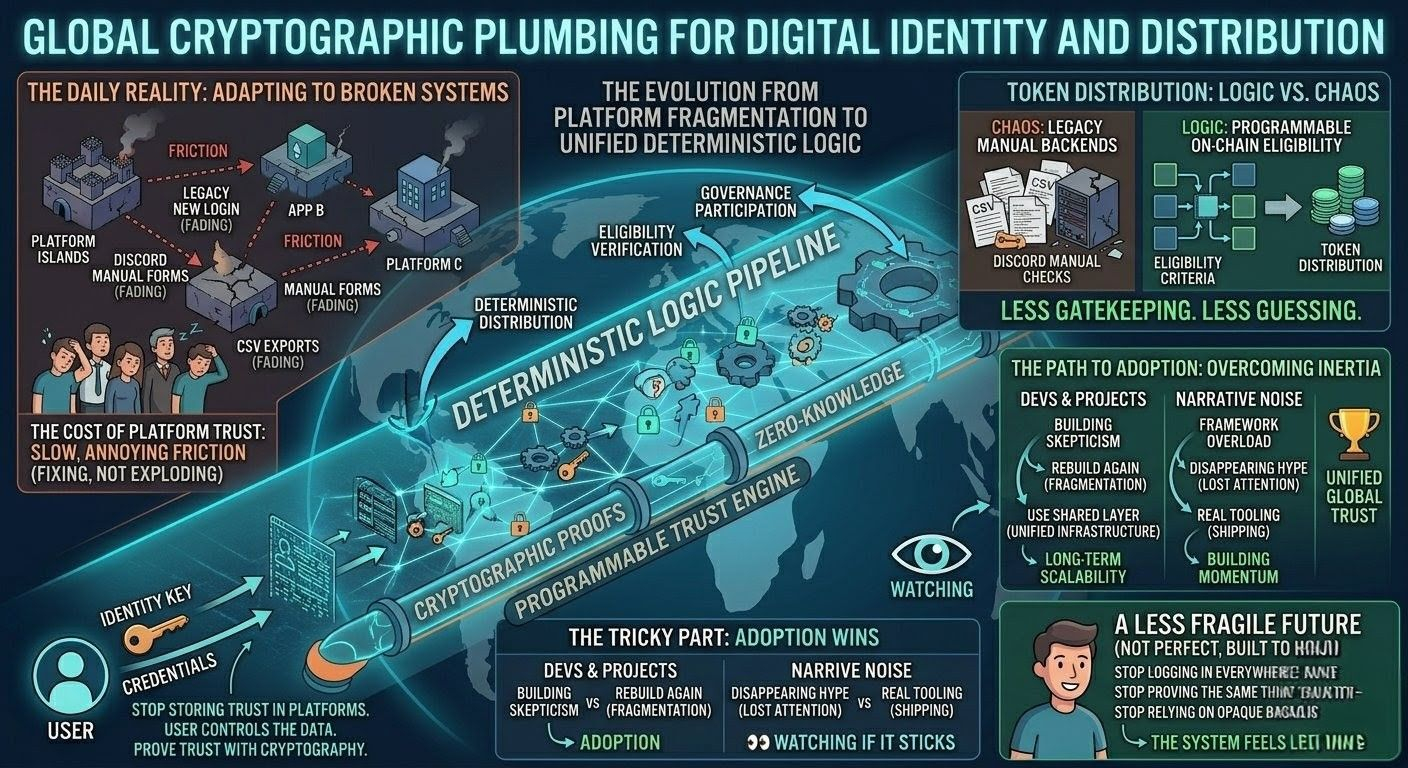
With native verification and cross-chain portability, distribution stops being coordination and starts being logic. Rules live on-chain. Credentials travel with the wallet. Eligibility becomes deterministic instead of discretionary.
Less guessing.
Less gatekeeping.
Less weird backend magic nobody wants to explain.
Sounds clean, right? Yeah. This is where things get tricky.
Good architecture doesn’t win by default.
Adoption wins. Always.
Developers have to actually use the layer instead of rebuilding their own version again. Projects have to trust shared infrastructure instead of controlling everything themselves. And that’s hard, because control feels safe even when it makes the system worse.
And then there’s narrative noise. Every week there’s a new identity framework, a new distribution model, a new trust layer. Most of them disappear before anyone ships real tooling. People stop paying attention. Can you blame them?
That’s why I’m not in hype mode on this.
I’m watching. 👀
Watching if credentials really become portable.
Watching if verification actually moves on-chain.
Watching if token distribution finally stops depending on spreadsheets and private scripts.
Because if this kind of infrastructure actually sticks, the change won’t feel explosive. No big moment. No dramatic switch.
Things will just… stop breaking as much.
You’ll stop logging in ten times.
You’ll stop proving the same thing everywhere.
You’ll stop wondering who controls the backend this time.
And one day you notice the system feels less fragile.
Not perfect.
Not finished.
Just finally built on something that holds. 🏆
@SignOfficial #SignDigitalSovereignInfra $SIGN
