
@MidnightNetwork is not something I look at and feel instant excitement.
If anything, I feel cautious first.
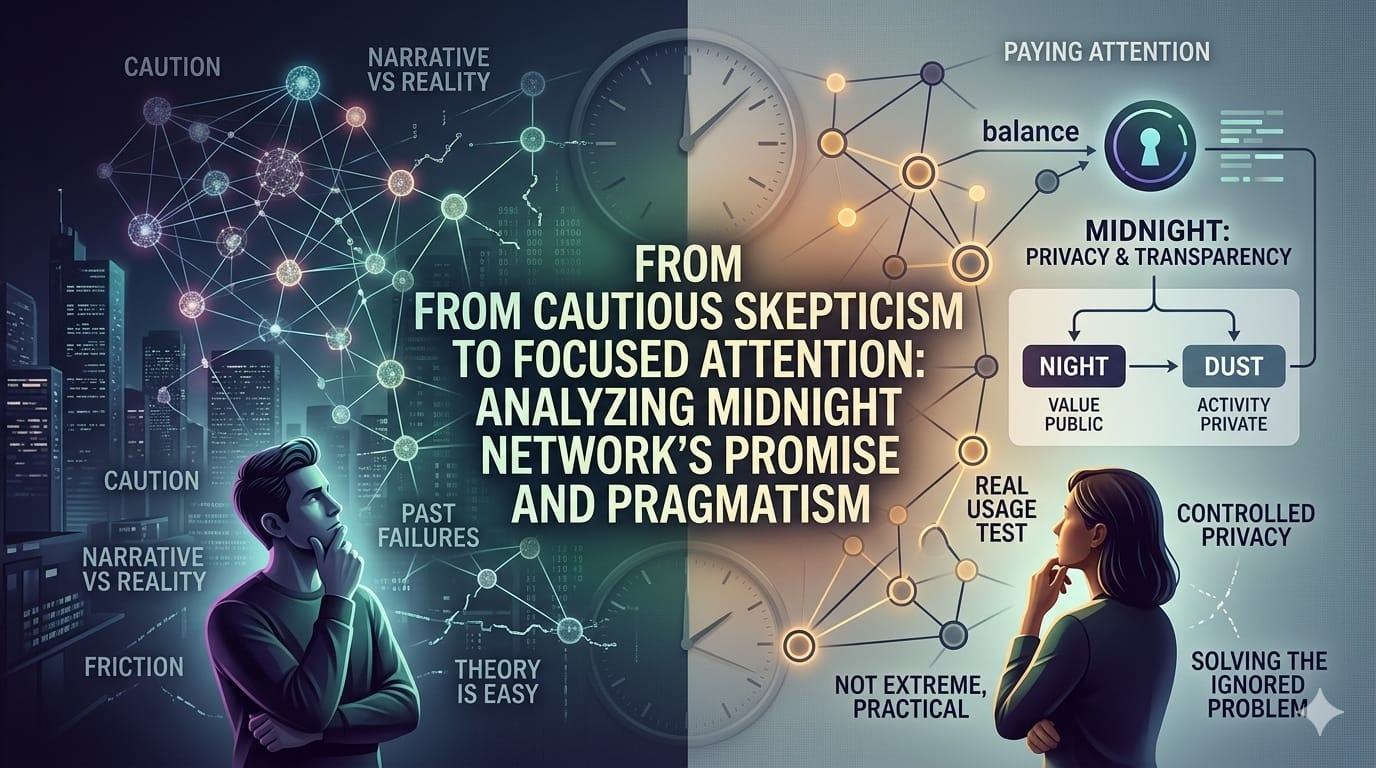
Maybe that comes from watching this space for too long. I’ve seen too many projects start with strong narratives privacy, better design, new architecture and still end the same way. Good story at the start, weak reality later. So now, instead of getting pulled in, I naturally start looking for what might go wrong.
That’s how I approached Midnight too.
But the more I think about it, the harder it becomes to ignore.
Most blockchains still follow one basic rule: if you use the network, you give up your privacy. Your wallet becomes visible, your activity stays on record, and everything you do can be traced back forever. We’ve accepted that as “normal,” even though it clearly doesn’t fit how people behave in real life.
Midnight seems to question that from the beginning.
Not in an extreme way like hide everything, but in a more practical way how much actually needs to be public for the system to work? That feels like a better starting point. Because in reality, people don’t want full exposure. They just want enough transparency to make things function, nothing more.
That’s the balance Midnight is trying to build.
You prove what needs to be proven, and the rest stays private. Not hidden for hype, not complicated, just controlled. That idea sounds simple, but in this market, it’s actually rare.
Even the $NIGHT and DUST setup shows a bit of thought behind the design. Instead of forcing one token to do everything, they split the roles. One handles value on the public side, the other supports activity in the private layer. It doesn’t solve every problem, but it avoids the usual mess where everything gets overloaded into a single system.
And that’s probably why it stays on my radar.
Not because I think it’s guaranteed to work. It’s not.
I’ve seen well-designed projects fail just as easily as bad ones.
The real test hasn’t happened yet.
At some point, this will move beyond ideas and into real usage. Developers will build on it. Users will interact with it. Friction will show up. And that’s where things usually break not in theory, but in practice.
That’s the phase I’m waiting for.
Because privacy as a concept is easy to support.
But making it work in a live system, under real pressure that’s something very few projects actually manage.
So I’m not fully convinced. I’m just paying attention.
Because if Midnight holds up, it’s solving a problem that’s been ignored for years.
And if it doesn’t, then it becomes another example of how even good ideas can fail once reality kicks in.