
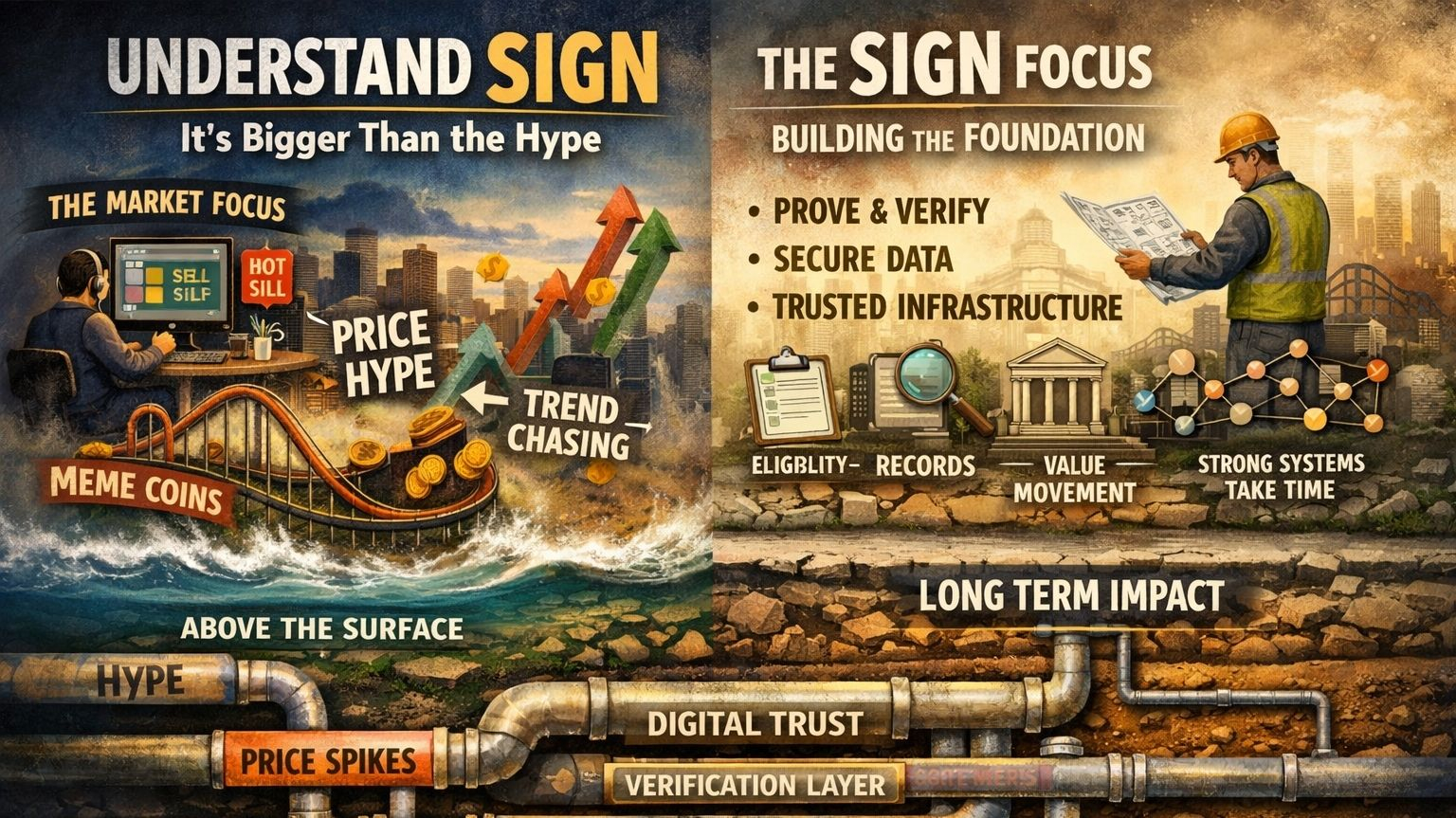
SIGN gets misread for the same reason a lot of serious projects do: people keep looking at the surface and calling it the structure.
They see the token first. The noise around it. The chatter, the mood swings, the endless habit the market has of reducing everything into a trade before it even bothers to understand what’s being built. And once that happens, the entire conversation starts leaning the wrong way. You’re no longer asking what the project is for. You’re asking whether it’s getting enough attention. Those are not the same question. Not even close.
Because SIGN, at least to me, doesn’t read like a project built for spectacle. It reads like a project built for systems.
That distinction matters.
A system doesn’t care whether people are excited this week. A system cares whether records hold up, whether claims can be verified, whether value moves cleanly, whether decisions can be traced back to something firmer than trust and memory and a half-broken spreadsheet living in somebody’s folder. That’s the territory SIGN is moving in. Not the glamorous part of the digital economy. The part underneath it. The part that people ignore right up until it fails.
And when it fails, it fails in ugly ways.
Not theoretical ways. Real ones.
A person who should qualify for something gets excluded because the record isn’t clear. A distribution turns messy because nobody can verify who met the conditions. A process slows to a crawl because three different parties are working off three different versions of the truth. Suddenly everyone’s on calls, everyone’s forwarding files, everyone’s trying to reconstruct what happened after the fact. That’s what weak infrastructure looks like. It doesn’t announce itself dramatically at first. It just starts producing friction everywhere. Quietly, then all at once.
That’s why SIGN is more interesting than the average market read gives it credit for.
It’s trying to solve a problem most people don’t spend much time thinking about until the consequences land in their lap: how do digital systems establish trust in a way that can actually scale? Not trust as a slogan. Trust as a working mechanism. Trust that can be checked, carried across environments, and used without constant manual cleanup. Once you start seeing the project through that lens, the whole thing changes shape.
It stops looking like a narrow token story.
It starts looking like infrastructure.
And infrastructure is a funny thing. It’s almost always underappreciated early because it doesn’t perform well in a market built on adrenaline. It doesn’t make itself easy to package. There’s no instant emotional payoff. No clean little headline. No cheap thrill. It asks for a longer attention span, which, let’s be honest, is not exactly the market’s strongest muscle.
People love saying they want projects with substance. What they usually want is substance that pumps on schedule. Something they can call long-term while still getting short-term reassurance every few days. Real infrastructure doesn’t always give you that. Sometimes it just keeps laying brick after brick while everyone else is chasing fireworks.
That’s where SIGN sits, I think. In that uncomfortable zone where the build is deeper than the conversation around it.
And you can feel that in the way people talk about it. They often describe it from the outside inward. Price, sentiment, momentum, positioning. Fine. Those things exist. They matter. But they don’t explain the project. They explain the market’s reaction to the project, which is a different thing altogether.
If you want to understand SIGN, you have to flip the lens.
Start with the function. Start with the need. Start with the fact that digital systems get messy the moment value, identity, permissions, and proof begin interacting at scale. That mess doesn’t solve itself. It usually gets patched over for a while, then patched again, then eventually becomes so inefficient that everyone is forced to deal with the root problem they were avoiding in the first place.
SIGN looks like a response to that root problem.
That’s what gives it weight.
Not the kind of weight that screams. The kind that sits there and becomes harder to ignore the longer you think about it. Because once you move beyond the market’s usual appetite for noise, you start to see what the project is actually brushing up against: the need for digital trust to become structured, usable, and portable. Not assumed. Not improvised. Built into the rails.
That’s a bigger idea than people realize at first.
Most systems can get away with loose coordination when they’re small. A few participants, limited complexity, manageable stakes — sure, people can patch things together and call it a process. But scale changes the mood. Scale exposes every lazy assumption. Suddenly the gaps matter. Suddenly unclear records matter. Suddenly weak verification matters. Suddenly “we’ll figure it out later” becomes a liability.
And that’s exactly where projects like SIGN start making sense.
Not as accessories. As load-bearing pieces.
There’s a world of difference between the two.
An accessory can ride a trend. A load-bearing piece has to survive pressure. It has to work when the room gets crowded. It has to keep functioning when the margin for error gets thinner and the number of moving parts keeps growing. That’s a much harder standard. It’s also why these kinds of projects often look slower from the outside. They’re solving for durability, not applause.
Which, admittedly, can make them easy to underestimate.
The market has a bad habit of confusing what is quiet with what is minor. That’s one of its oldest tells. If something isn’t creating enough immediate drama, people assume it lacks significance. But some of the most consequential layers in any system are the least theatrical. They don’t announce themselves every day. They just keep becoming more necessary.
That’s the feeling SIGN gives me.
Not noise. Necessity in slow motion.
And slow motion is hard for people. It tests whether you actually know what you’re looking at or whether you just know how to react to movement. Those are different skills. Plenty of market participants are good at the second one. Much fewer are patient enough for the first.
Because patience sounds noble until you’re the one being asked to practice it.
Then it’s irritating. Then it feels like doubt. Then it feels like the market is ignoring your thesis on purpose. That’s usually the phase where weaker conviction starts dressing itself up as cynicism. People begin saying the project is too quiet, too technical, too hard to value. Sometimes that criticism is fair. Sometimes it’s just frustration in a smarter outfit.
What makes SIGN compelling is that the project doesn’t feel built around the hope of being endlessly interpreted. It feels built around eventually being used. There’s something very different about that. Used projects get judged by whether they hold up under real conditions. Whether they remove friction. Whether they make coordination cleaner. Whether they reduce ambiguity. Whether they create a version of trust that isn’t dependent on somebody playing administrator in the background forever.
That’s not the end of the market. I know. But it’s the end that tends to matter once systems mature.
And maybe that’s the real point here.
SIGN isn’t interesting because it can be squeezed into a narrative. It’s interesting because it’s trying to build beneath narratives — beneath attention cycles, beneath sentiment swings, beneath the market’s endless search for the next thing it can simplify badly and trade aggressively. It’s operating in a layer where the work is less visible, but the consequences are more durable.
Ignore that layer, and you don’t just miss a project. You miss the machinery that decides whether bigger digital systems can function without collapsing into confusion.
That’s the kind of mistake markets make all the time. Not because they’re stupid. Because they’re impatient. Because they like visible motion more than hidden structure. Because a chart is easier to react to than a foundation is to understand.
Still, foundations have a way of getting the last word.
Not loudly. That’s the thing.
Just inevitably.