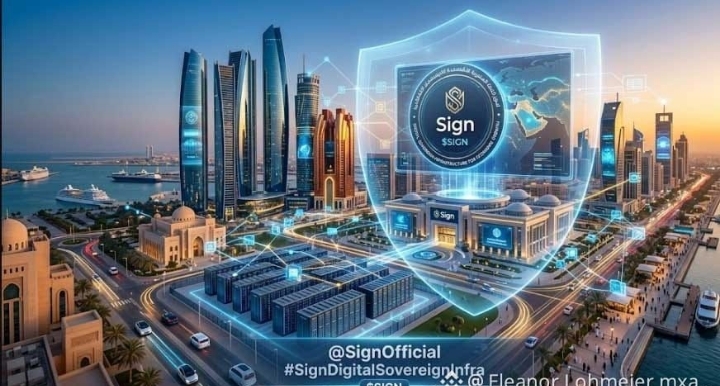
Sign: The Digital Sovereign Infrastructure Powering Middle East Economic Growth
The Middle East is undergoing one of the most ambitious economic transformations in modern history. Countries like the UAE, Saudi Arabia, Qatar, and Bahrain are rapidly moving beyond traditional oil-based economies toward diversified, technology-driven futures under their respective Vision 2030 and 2031 plans. At the heart of this shift lies a critical need: secure, sovereign, and verifiable digital infrastructure that can support cross-border trade, digital identity, compliant capital flows, and innovation at national scale.
This is exactly where Sign Protocol stands out as a game-changer. Far from being just another cryptocurrency project, Sign is building the foundational digital sovereign infrastructure that nations in the region can rely upon for trust, transparency, and independence in the digital age.
With its omni-chain attestation layer (Sign Protocol) and smart token distribution capabilities (TokenTable), Sign enables governments, businesses, and individuals to create tamper-proof digital credentials, verifiable identities, and compliant on-chain attestations. This technology allows seamless yet secure data exchange across different blockchains while maintaining full regulatory control — something extremely valuable for Middle Eastern economies that prioritize sovereignty alongside global integration.
Imagine a future where:
A Saudi entrepreneur can instantly verify business credentials across GCC borders without relying on slow, centralized intermediaries.
UAE smart cities can issue tamper-proof digital IDs and certifications that work across multiple chains.
Governments can distribute incentives, subsidies, or even CBDC-related assets in a transparent, auditable, yet privacy-preserving manner using zero-knowledge proofs.
Sign’s dual-layer architecture — combining public blockchain transparency with enterprise-grade private layers — makes it ideal for sovereign use cases. It acts as a “digital lifeboat” that helps nations reduce dependency on foreign centralized systems while still accessing global liquidity and innovation.
The native token $SIGN plays a central role in powering this entire ecosystem. It fuels governance, network operations, attestation creation, and incentive mechanisms. As adoption grows in the Middle East, $SIGN is positioned to become the utility backbone for verifiable trust systems that drive real economic activity.
What makes Sign particularly relevant for the region is its focus on digital sovereignty. In an era where data is the new oil, Middle Eastern nations want control over their digital infrastructure rather than depending on foreign tech giants. Sign delivers exactly that — secure, interoperable, and sovereign-grade tools that align perfectly with national strategies for blockchain adoption.
@SignOfficial has been consistently highlighting how such infrastructure can accelerate economic growth, foster innovation, and build resilient digital economies across the Middle East. By enabling verifiable credentials and programmable token distribution, Sign is not just supporting crypto — it is laying the groundwork for the next phase of regional prosperity.
As the Middle East continues its journey toward becoming a global hub for technology, finance, and innovation, projects like Sign will be remembered as the quiet but powerful infrastructure layer that made it possible. Early supporters and builders who understand this vision today may well be participating in something far bigger than a token narrative — they are backing the digital rails of tomorrow’s Middle Eastern economy.
The future is sovereign. The future is verifiable. And for the Middle East, the future is being built on Sign.
$SIGN
#SignDigitalSovereignInfra
@SignOfficial (https://www.binance.com/en/square/profile/signofficial)