
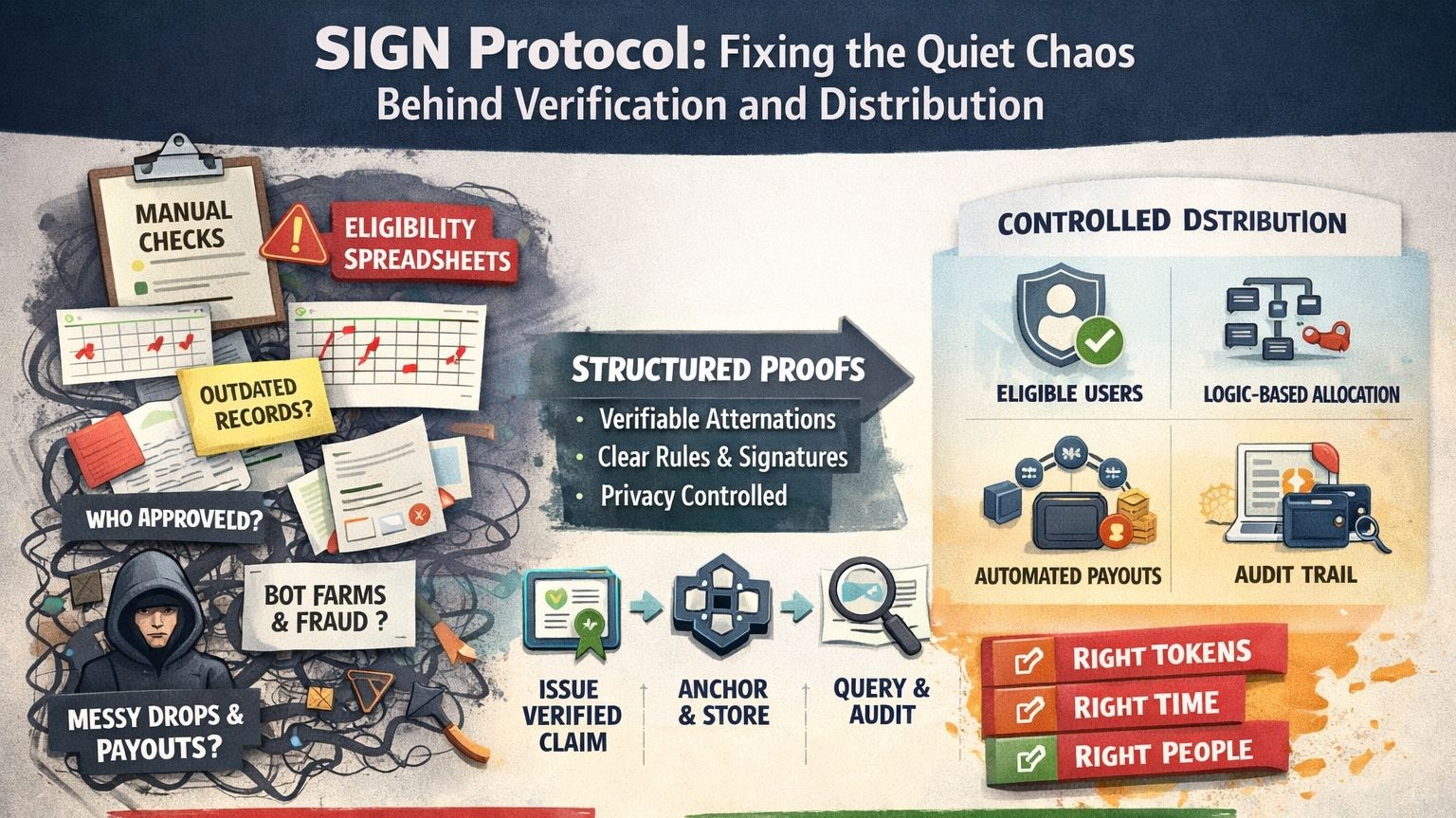
SIGN Protocol is one of those projects that sounds simple until you’ve actually worked around the kind of mess it’s trying to clean up.
Look, the real problem is not some grand philosophical shortage of trust. The problem is boring. Ugly, even. Spreadsheets break. Manual checks get sloppy. Eligibility rules get interpreted differently by different people. Wallet lists get outdated. Airdrops go to the wrong accounts. Verification gets repeated five times because nobody wants to be the person who missed one bad record. That is the actual battlefield.
SIGN Protocol is basically trying to give that chaos a more disciplined shape.
It does this through attestations — which is a cleaner way of saying “verifiable claims.” Someone authorized says something is true, in a structured format, and that statement can be checked later without relying on memory, screenshots, or whatever half-finished spreadsheet someone was using at 1:00 a.m. That part matters. A lot. Not because it is magical. Because it is less stupid than the usual process.
And honestly, that is the selling point here.
Not “revolutionary.” Not “world-changing.” Just useful.
A system like this is trying to solve a very specific kind of pain: proving eligibility, ownership, approval, or identity without turning every workflow into a manual mess. If a user already passed a verification step once, why should the whole thing be rebuilt from scratch every time? If a grant program has a set of rules, why should the admin team keep re-checking the same details in three different places? If distribution depends on conditions, why should those conditions live in someone’s inbox instead of inside the actual process?
That is where SIGN Protocol starts to make sense.
It gives projects a way to define what a valid claim looks like, issue it properly, and verify it later. Clean enough to be useful. Flexible enough to not force everything into one ugly format. Some records can stay private. Some can be public. Some can be anchored without exposing the whole story. That is not a luxury. For real businesses, radical transparency is usually a bug, not a feature.
People love to say “put it on-chain” as if that automatically solves everything. It usually does not. Sometimes it just makes bad data more permanent. Sometimes it makes sensitive information too visible. Sometimes it creates a public trail that nobody actually wanted in the first place. SIGN Protocol seems to understand that. At least more than most.
The interesting bit is how it connects proof with action.
Verification by itself is fine, I guess. But verification that can feed into actual distribution logic is where things get practical. That is where the project stops being an abstract infrastructure story and becomes a tool. A real one. The kind that can sit behind access control, token allocation, rewards, compliance checks, or whatever other workflow keeps falling apart because humans are still doing too much of the heavy lifting.
And humans are terrible at that, by the way. Not morally. Just operationally. We drift. We forget. We copy the wrong column. We approve the same address twice. We say “this looks right” when what we really mean is “I want to go home.”
A system like SIGN Protocol tries to reduce that kind of damage.
Not eliminate it. That would be fantasy. Just reduce it.
That is also why the privacy angle matters. A lot of projects treat openness like a virtue by default, which is cute right up until you have to deal with user data, eligibility records, or anything remotely sensitive. In the real world, you do not always want every proof exposed to every participant. You want enough transparency to verify the process, and enough privacy to keep the data from becoming creepy, noisy, or weaponized. SIGN Protocol leans in that direction, and it’s the correct instinct.
The best version of this kind of infrastructure is invisible when it works. Nobody applauds a verification layer for existing. Nobody writes a victory thread because a distribution completed without drama. But that is kind of the point. Good plumbing rarely gets attention. Bad plumbing gets screenshots.
So, yes, SIGN Protocol is technical. It is also pretty unglamorous in the best possible way. It is trying to make claims structured, checks repeatable, and distribution less chaotic. Not exciting. Just necessary.
And in this space, necessary usually beats flashy.