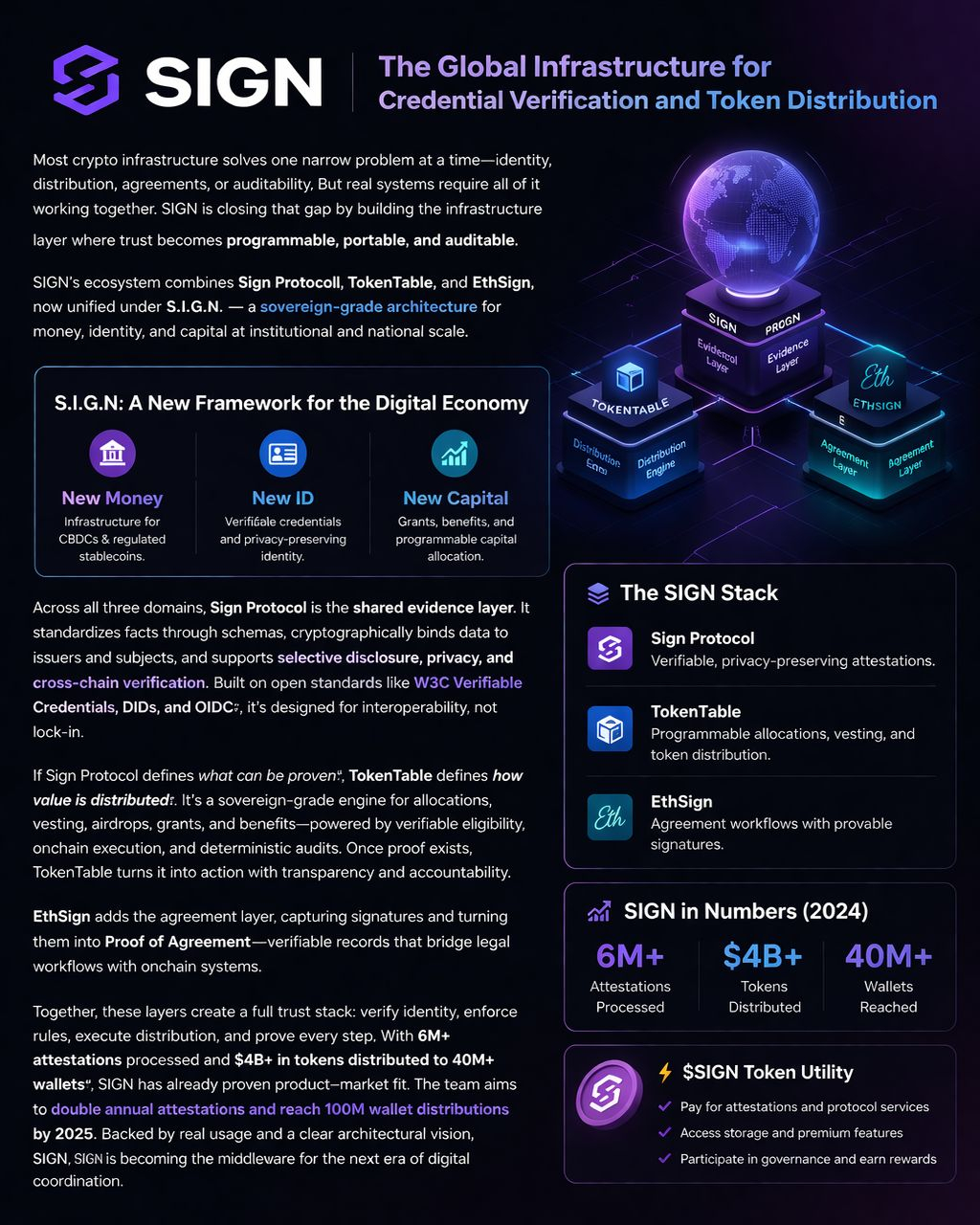
Most crypto infrastructure still solves one narrow problem at a time. One protocol handles identity, another handles distribution, another handles agreements, and yet another handles auditability. In practice, real systems do not work in isolated layers. A government benefits program, a token airdrop, a compliance workflow, or a digital capital platform all need the same thing: a reliable way to prove who is eligible, what rule was applied, what action was taken, and whether that action can be verified later. That is the gap SIGN is trying to close.
At its core, SIGN is building infrastructure for credential verification and token distribution. But that description only captures the surface. The stronger way to understand the project is this: SIGN is designing a system where trust becomes programmable, portable, and auditable. Its stack combines Sign Protocol as the evidence layer, TokenTable as the allocation and distribution engine, and EthSign as the agreement and signature workflow layer. In the project’s newer documentation, that stack is framed within S.I.G.N., a broader sovereign-grade architecture for national systems of money, identity, and capital. That framing matters because it shows the team is no longer positioning itself only as a Web3 toolset; it is positioning itself as infrastructure that can support institutional and even national-scale digital systems.
That shift is one of SIGN’s most important recent developments. The newer framework presents S.I.G.N. as a model for three foundational domains: a new money system for CBDCs and regulated stablecoins, a new ID system for verifiable credentials and privacy-preserving identity, and a new capital system for grants, benefits, incentives, and programmable capital. Across those three domains, Sign Protocol serves as the shared evidence layer. This is a major strategic evolution because it takes attestations from being a developer primitive and turns them into a governance primitive. In simple terms, SIGN is betting that the future of digital coordination will depend less on blind trust in databases and more on verifiable records of actions, permissions, and outcomes.
One of the clearest strengths of Sign Protocol is that it treats attestations as real operational infrastructure rather than just blockchain data objects. It standardizes facts through schemas, cryptographically binds data to issuers and subjects, supports selective disclosure and privacy, and allows public, private, hybrid, and cross-chain attestations. That is important because most real-world verification systems cannot publish everything openly. A credential system needs portability, but it also needs privacy and controlled disclosure. SIGN’s design tries to preserve both. Instead of forcing builders to choose between transparency and confidentiality, it creates a framework where evidence can be verifiable without making every payload public.
This becomes even more important in credential verification. A useful credential system is not simply a badge or a certificate stored onchain. It needs machine-readable schemas, issuer credibility, revocation checks, and the ability to present proof across different applications. SIGN’s standards-first posture is one of its better qualities. It suggests the project is not trying to trap users inside a closed ecosystem. Instead, it is trying to become the verification substrate that interoperable systems can build on top of. For governments, enterprises, and serious builders, that matters more than hype. Closed systems can scale fast in the short term, but open systems usually survive longer because they are easier to integrate, audit, and govern.
If Sign Protocol answers the question, “What can be proven?”, TokenTable answers the question, “How is value distributed once that proof exists?” TokenTable is one of SIGN’s clearest differentiators because it connects eligibility and evidence directly to execution. It works as an allocation, vesting, and distribution engine that can handle benefits, subsidies, grants, ecosystem incentives, tokenized assets, regulated airdrops, and unlock schedules. It is designed around allocation tables, vesting parameters, claim conditions, and revocation or clawback rules. In other words, TokenTable is not just a token drop tool. It is a rules engine for programmable distribution.
That distinction is exactly why SIGN deserves attention. Many projects can distribute tokens. Far fewer can prove, in a deterministic and audit-friendly way, why a recipient was eligible, which rules governed the payout, and how the execution result can be verified later. TokenTable strengthens SIGN’s architecture because it links eligibility proofs to attestations, anchors allocation logic as evidence, and creates a verifiable trail for execution and settlement. This gives SIGN a stronger product logic than projects that treat identity and distribution as separate modules. In real systems, those two layers are inseparable. Distribution without reliable eligibility proof creates fraud risk. Verification without distribution logic creates operational friction. SIGN’s architecture understands that both must work together.
EthSign adds a third layer that is easy to overlook. On the surface, it looks like a contract-signing product. But its importance goes beyond digital signatures. Agreements created through EthSign can become reusable evidence through Proof of Agreement, an attestation confirming that an agreement exists between parties. That turns private execution into verifiable proof that can later support business, compliance, or programmatic actions. This is a meaningful bridge between legal workflow and onchain coordination. It shows that SIGN is not merely building infrastructure for crypto-native identity. It is also building a pathway for legally meaningful real-world events to become verifiable digital evidence.
The project’s real-world usage makes the thesis more credible. SIGN has reported processing more than 6 million attestations and distributing more than $4 billion in tokens to over 40 million wallets. It has also pointed to ambitions for much larger distribution reach as adoption expands. These figures matter because they show the system has already been tested in meaningful credential and distribution environments. In crypto, many projects promise infrastructure relevance, but far fewer can point to actual scale in attestations, credentials, or token delivery. Whether one approaches the numbers conservatively or optimistically, they still suggest that SIGN is operating beyond theory.
That leads naturally to token utility, which is where many infrastructure stories start to weaken. SIGN’s token utility is stronger than the average governance-only narrative because it is tied to product usage across the ecosystem. The $SIGN token is positioned as a native utility asset used across Sign Protocol and related applications. It can support ecosystem services such as attestations, storage-related interactions, and access to protocol-level operations or features. It is also tied to governance participation, ecosystem coordination, and community incentives. This matters because the token is not being framed only as a speculative wrapper around the brand. It is being framed as the economic connector for the network’s evidence, storage, operations, and governance layers.
There are also ecosystem signals that show the team is thinking about holder alignment. Programs tied to staking and rewards indicate an effort to create recurring participation rather than purely transactional demand. I do not think reward programs alone make a token strong, but they do reveal how a team thinks about network behavior. A protocol built around trust, proof, and distribution cannot rely only on short-term speculation. It needs recurring usage, committed builders, and holders who see the token as connected to system growth. In that sense, SIGN appears to be trying to build an economy around utility rather than just attention.
From an analytical perspective, SIGN’s biggest strength is that it sits at the intersection of four major trends: verifiable identity, compliant digital money, programmable capital, and auditable distribution systems. Most projects participate in only one of these markets. SIGN is trying to sit underneath all four. That gives it a broader addressable market, but it also raises the standard it must meet. To succeed, the project has to prove that its products can serve developers, enterprises, and sovereign institutions without becoming too abstract for each audience. The good news is that its current architecture looks more coherent than ever. Sign Protocol handles evidence, TokenTable handles distribution, EthSign handles agreement workflows, and S.I.G.N. provides the top-level system blueprint.
My own view is that SIGN becomes compelling when we stop thinking of it as just another Web3 identity project. That framing is too limited. A more accurate way to describe it is as trust infrastructure: a system in which credentials can be verified, benefits can be distributed, capital can be allocated, agreements can be proven, and every critical action can leave behind evidence that is portable and auditable. That is a much larger and more durable category. If the team executes well, SIGN could become one of the more important middleware layers connecting digital identity, policy-aware money, and programmable incentives.
The risk, of course, is execution complexity. Sovereign-grade ambition sounds powerful, but it is much harder than launching a consumer dApp. Regulatory expectations, privacy requirements, interoperability demands, and operational resilience all become stricter at institutional scale. That said, the current direction looks coherent. The project has a live product stack, a strong attestation thesis, a practical distribution engine, measurable usage, and a token with ecosystem-linked utility. That combination gives SIGN more substance than most infrastructure narratives in the market.
What makes SIGN stand out is not simply that it helps verify credentials or distribute tokens. Plenty of tools can do parts of that. What makes it interesting is that it tries to unify both into one verifiable system. In a digital economy where trust is increasingly fragmented across chains, apps, institutions, and jurisdictions, that is not a minor problem. It is foundational. And that is why SIGN deserves serious attention
@SignOfficial #SignDigitalSovereignInfra $SIGN