
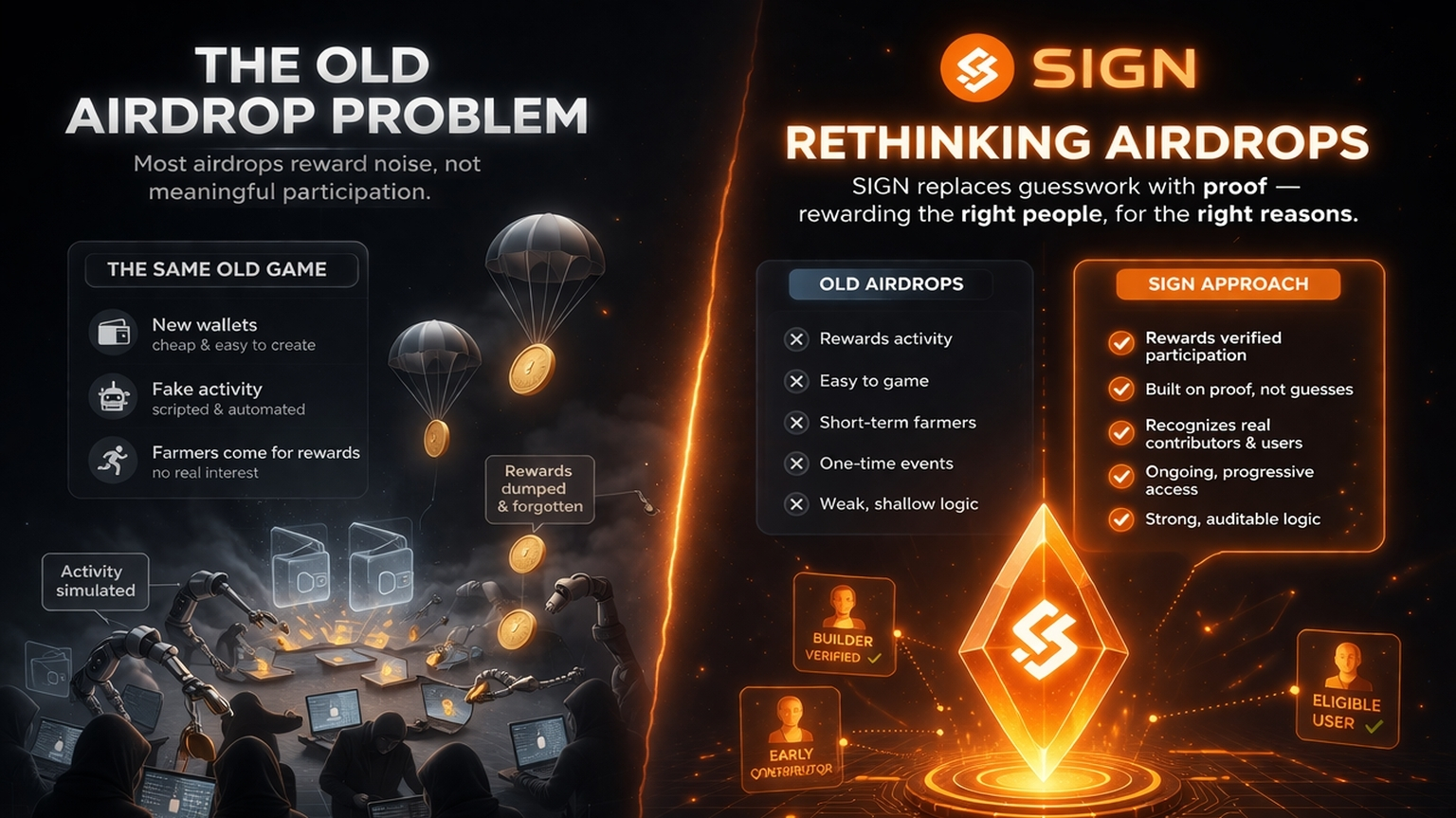
SIGN isn’t trying to make airdrops prettier. It’s trying to make them make sense.
That alone separates it from most of the space.
For years, airdrops have followed a predictable script. Projects track activity, reward wallets, and hope the numbers translate into real communities. On the surface, it looks like growth—more users, more transactions, more noise. But underneath, it’s often the same pattern: short-term engagement driven by incentives, not genuine interest.
People show up, do what’s required, collect rewards, and leave. The system works exactly as designed—it just doesn’t create anything lasting.
SIGN starts from a different premise. Instead of asking how to distribute tokens broadly, it focuses on a more important question: who actually deserves access?
That shift changes everything.
Because the reality is, most of the signals used in traditional airdrops are weak. Wallet creation is trivial. Activity can be scripted. Even complex interaction patterns can be replicated by people who have no real connection to the project. The result is a system that rewards behavior, but not necessarily meaningful participation.
SIGN moves away from that model by introducing something stronger: proof.
Not hype. Not guesswork. Proof.
At its core, this means eligibility is no longer based on surface-level actions alone. Instead, it’s tied to verifiable conditions—things that actually indicate a user’s role, contribution, or relevance within a system. That might sound like a small adjustment, but in practice, it’s a fundamental redesign.
Airdrops stop being random distributions and start becoming structured access systems.
That distinction matters. A lot.
Because when you rely on weak signals, you end up making arbitrary decisions. Projects draw lines based on incomplete data and hope users accept the outcome. Sometimes they do. Often they don’t. And when they don’t, it’s usually because the logic behind the distribution doesn’t feel convincing.
SIGN addresses that by strengthening the foundation. It gives projects a clearer way to define eligibility—based on reasons that can actually be explained and defended.
That leads to better outcomes.
Instead of rewarding whoever optimized the system best, projects can prioritize participants who have demonstrated something real. Not just activity, but relevance. Not just presence, but purpose.
And that opens the door to something most airdrops lack: differentiation.
Communities aren’t uniform. They’re made up of different types of participants—builders, contributors, long-term users, and opportunists. Treating them all the same might seem fair, but in practice it flattens the ecosystem and rewards the least meaningful behavior.
SIGN allows projects to recognize those differences.
It enables more precise distribution models. Some users might gain early access. Others might unlock benefits over time. Participation can become progressive instead of instantaneous. That creates a system that evolves, rather than one that peaks on a single claim day and fades immediately after.
Because that’s another flaw in the current model—it’s too focused on the moment.
Snapshots, eligibility checkers, claim deadlines. Everything builds toward a single event. It’s loud, chaotic, and short-lived. Once it’s over, attention drops, tokens get sold, and the supposed “community” often disappears.
A more effective system doesn’t rely on one moment. It builds over time.
SIGN supports that kind of structure. It allows participation to accumulate, to mean something beyond a single interaction. Users can establish a track record, gain recognition within a system, and unlock value gradually.
That’s much closer to how real ecosystems function.
There’s also a cultural layer to this.
Distribution isn’t just about who gets tokens—it’s about what behavior gets encouraged. If a project rewards shallow engagement, it will get more of it. If it rewards meaningful contribution or verified participation, it sets a different tone entirely.
SIGN leans into that idea.
It treats distribution as a way to shape the ecosystem, not just grow it. And that’s a much more intentional approach than what most projects take.
Of course, there are trade-offs.
A system built around proof can become too rigid if it’s not handled carefully. Too many conditions, too much control, and it risks feeling restrictive. The challenge is finding balance—using strong signals where they matter, without turning the entire experience into a gated process.
SIGN doesn’t eliminate that challenge, but it provides better tools to navigate it.
And that’s where its real value lies.
It doesn’t just improve the mechanics of airdrops—it redefines their purpose. Instead of acting as mass distribution events, they become structured entry points. Access is earned through clear criteria. Participation is recognized in a way that actually reflects its value.
That’s a cleaner system. A smarter one.
And in a space that often prioritizes noise over substance, that alone makes SIGN worth paying attention to.