
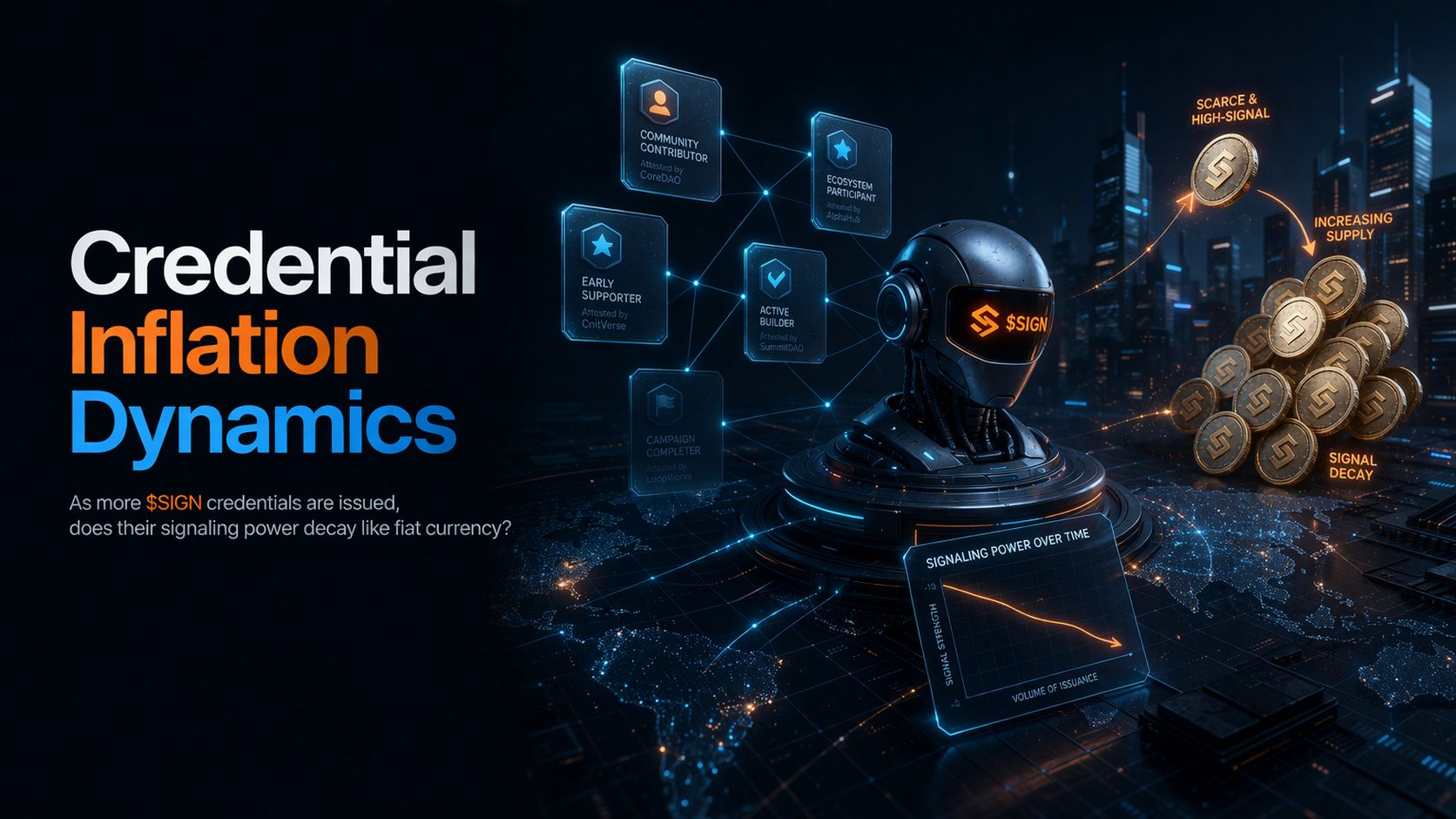
Credential Inflation Dynamics
→ As more $SIGN credentials are issued, does their signaling power decay like fiat currency?
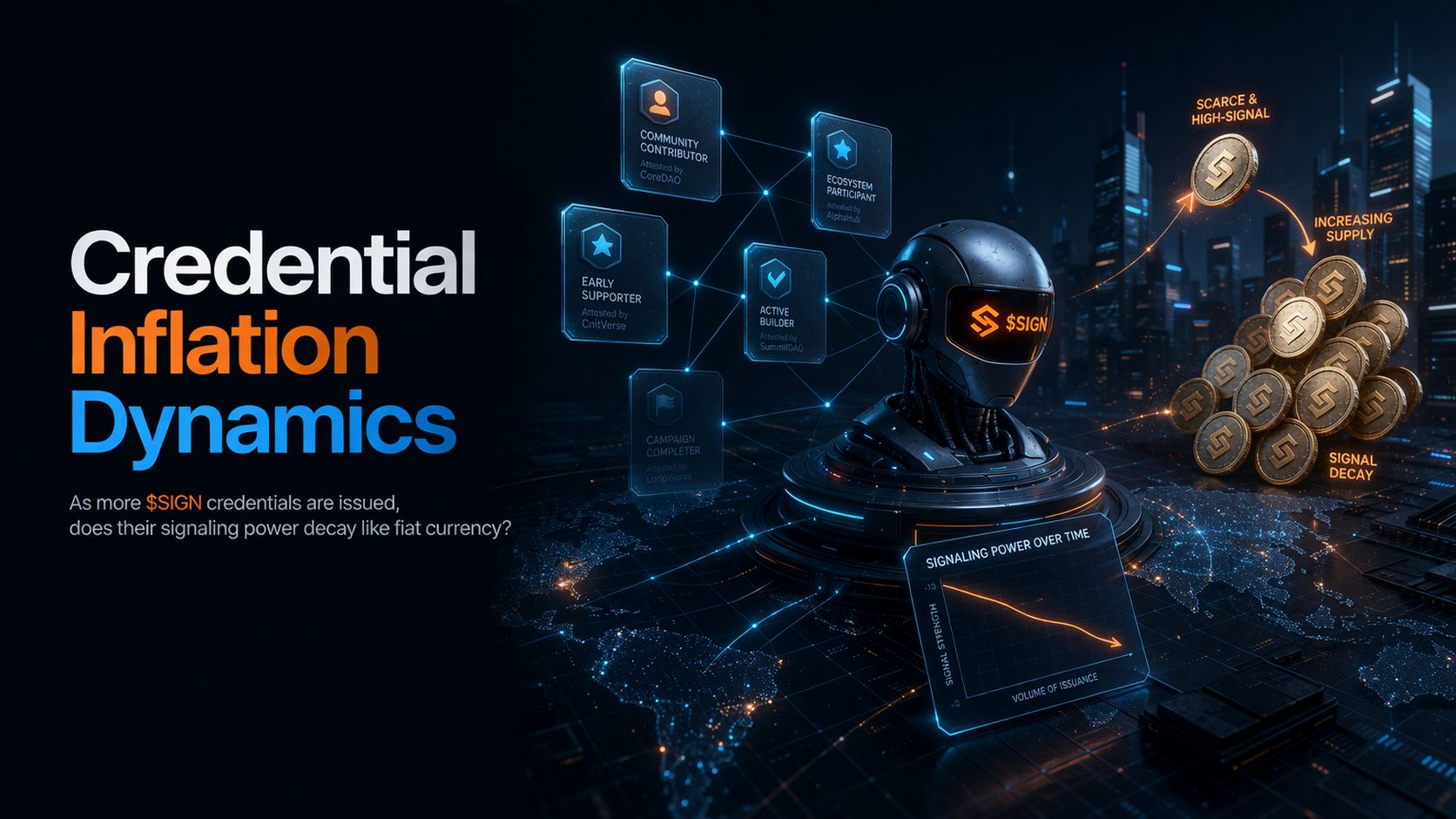 I keep noticing something weird when I look at credential systems: the more “verified” people there are, the less I actually care about the verification. It starts strong—rare, meaningful, hard to fake. Then suddenly everyone has a badge, and the badge stops saying anything.
That’s the uncomfortable direction SIGN might be drifting toward.
At first glance, credential systems feel like the fix for the mess of anonymous participation. Instead of guessing who’s legit, you attach signals—on-chain proofs, participation records, attestations. Clean. Trackable. But the problem isn’t just proving identity or activity. It’s what happens after scale kicks in.
Think about it like college degrees. When only a small percentage of people had one, it signaled something real—effort, capability, scarcity. Now? In many fields, it’s just baseline. The signal didn’t disappear, but it got diluted. Employers started looking for additional filters—experience, networks, brand names. The degree inflated.
Credentials don’t fail because they’re fake. They fail because there are too many of them.
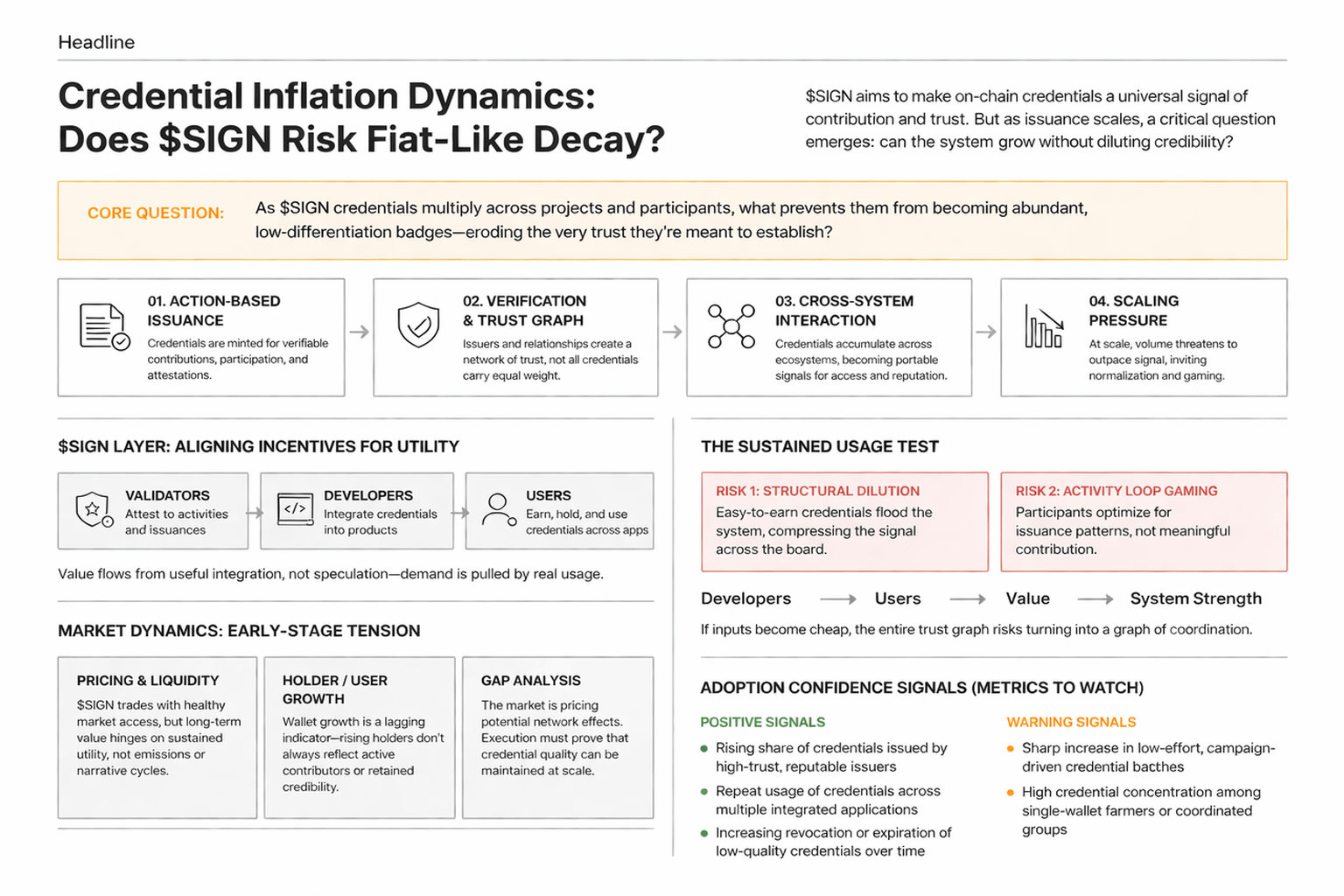
$SIGN tries to structure this better by anchoring credentials to verifiable actions and relationships. Two mechanisms stand out.
First, issuance isn’t supposed to be random. Credentials are tied to specific behaviors—participation in ecosystems, contributions, interactions that can be attested by other entities. It’s not just “I exist,” it’s “I did X, validated by Y.” That layering matters.
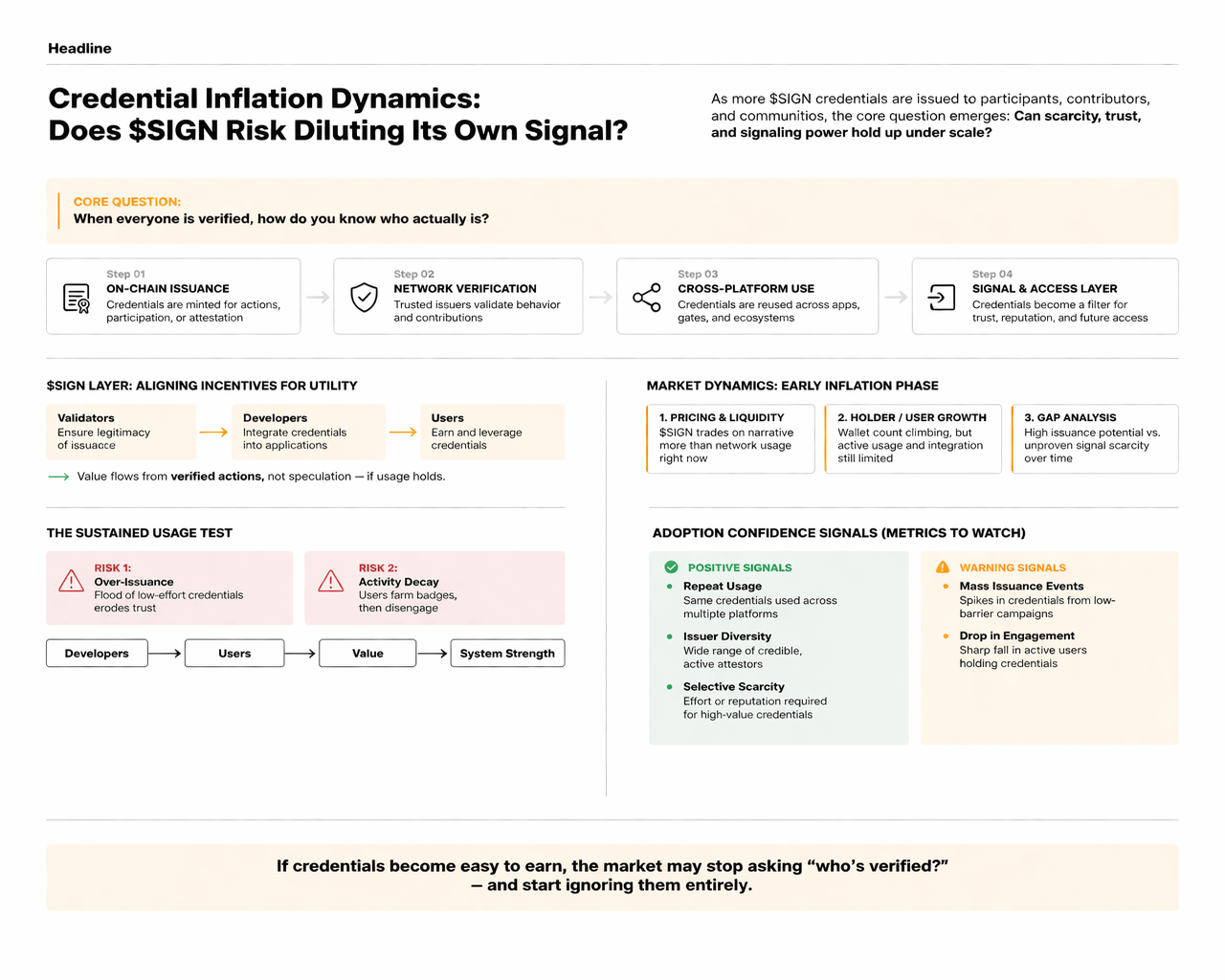
Second, there’s an implicit graph forming underneath. Credentials aren’t isolated badges—they’re nodes in a network of trust. Who issued them, who holds them, how they connect. In theory, this makes it harder to inflate value blindly because not all credentials are equal. A signal from a high-trust issuer should carry more weight than one from a random participant.
That’s the design intent.
But here’s where it gets tricky—and honestly, more interesting than the pitch.
Inflation doesn’t need to be careless to happen. It can emerge from success.
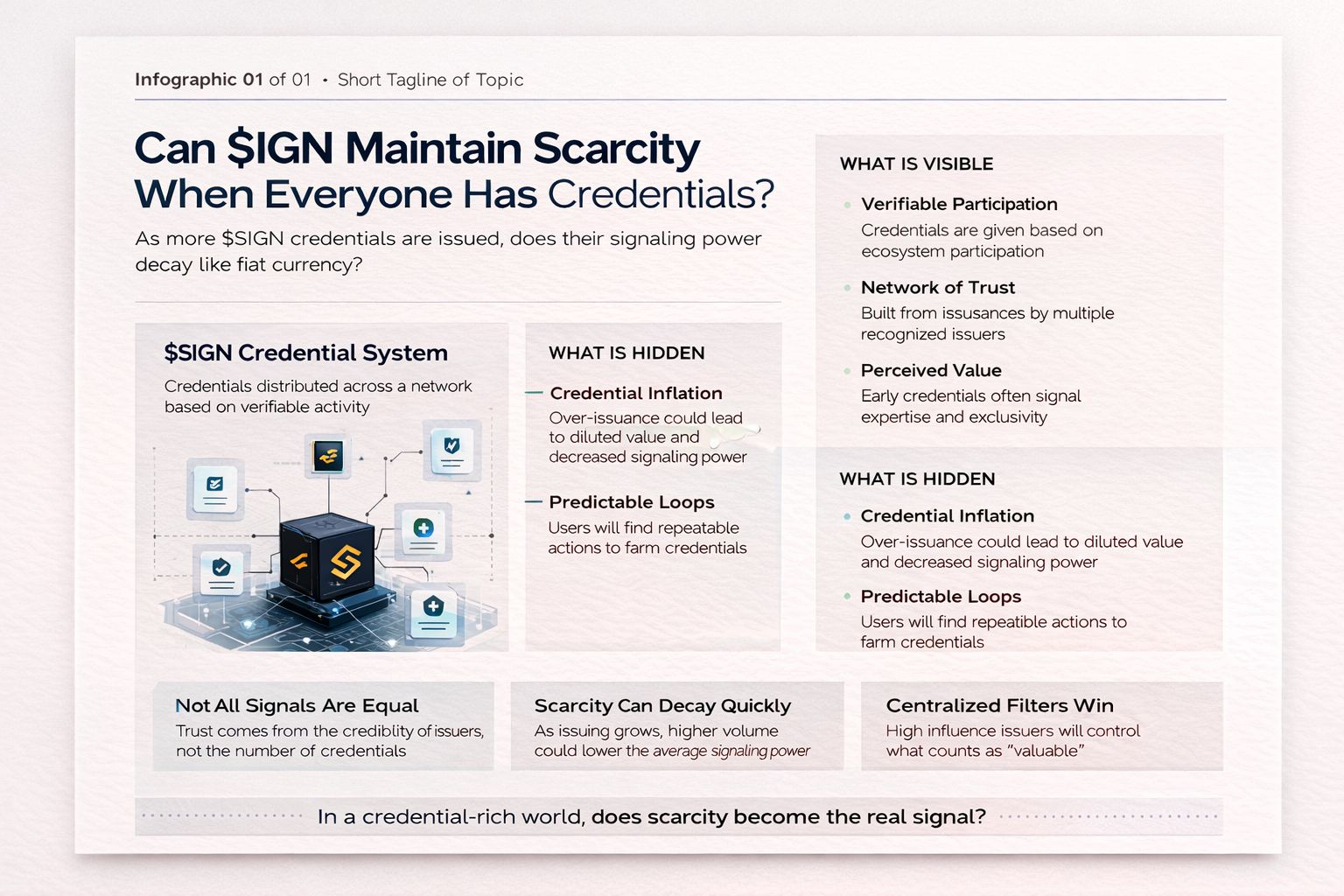
If SIGN works, more projects will issue credentials. More users will collect them. More interactions will be recorded. The system grows. But as it grows, the average value of any single credential starts to compress unless there’s a strong filtering mechanism on top.
And most people underestimate how fast this compression happens.
It’s not linear. It’s more like social media engagement. Early followers matter. Then you hit a point where an extra 1,000 followers barely changes perception. The curve flattens, but the noise keeps increasing.
So now the question isn’t “Are credentials real?” It’s “Which ones matter?” And that’s a completely different problem.
One subtle shift I’ve been thinking about: credentials might start behaving less like proof and more like liquidity.
Not in the financial sense exactly, but in how they circulate and accumulate. If users can stack credentials across ecosystems, reuse them for access, or leverage them for opportunities, they begin to act like portable assets. And just like assets, their value depends on scarcity, demand, and context.
That’s where inflation creeps in quietly.
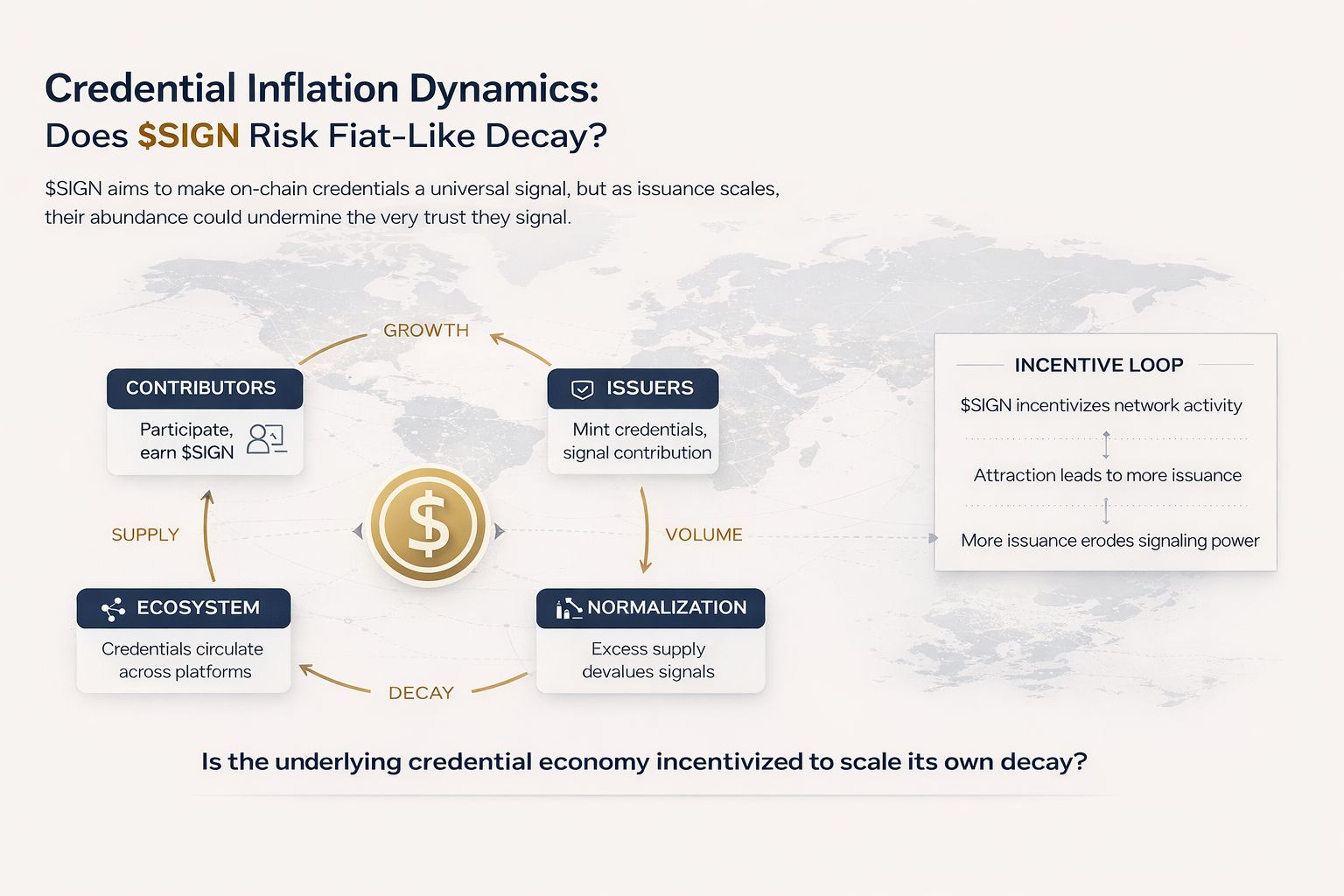
If everyone can earn similar credentials through repeatable actions—campaigns, quests, participation loops—then the system starts rewarding activity patterns rather than meaningful contribution. You get optimized behavior, not necessarily valuable behavior.
It’s the difference between someone attending 50 networking events versus building something that actually changes the ecosystem. Both generate signals. Only one creates lasting value.
And here’s the part most people ignore: systems like this tend to be gamed not by breaking rules, but by mastering them.
Once participants understand how credentials are issued, they’ll optimize for accumulation. Not maliciously—just rationally. The same way traders optimize for incentives, or creators optimize for algorithms. Over time, you get clusters of users who look highly “credentialed” but are essentially running efficient loops.
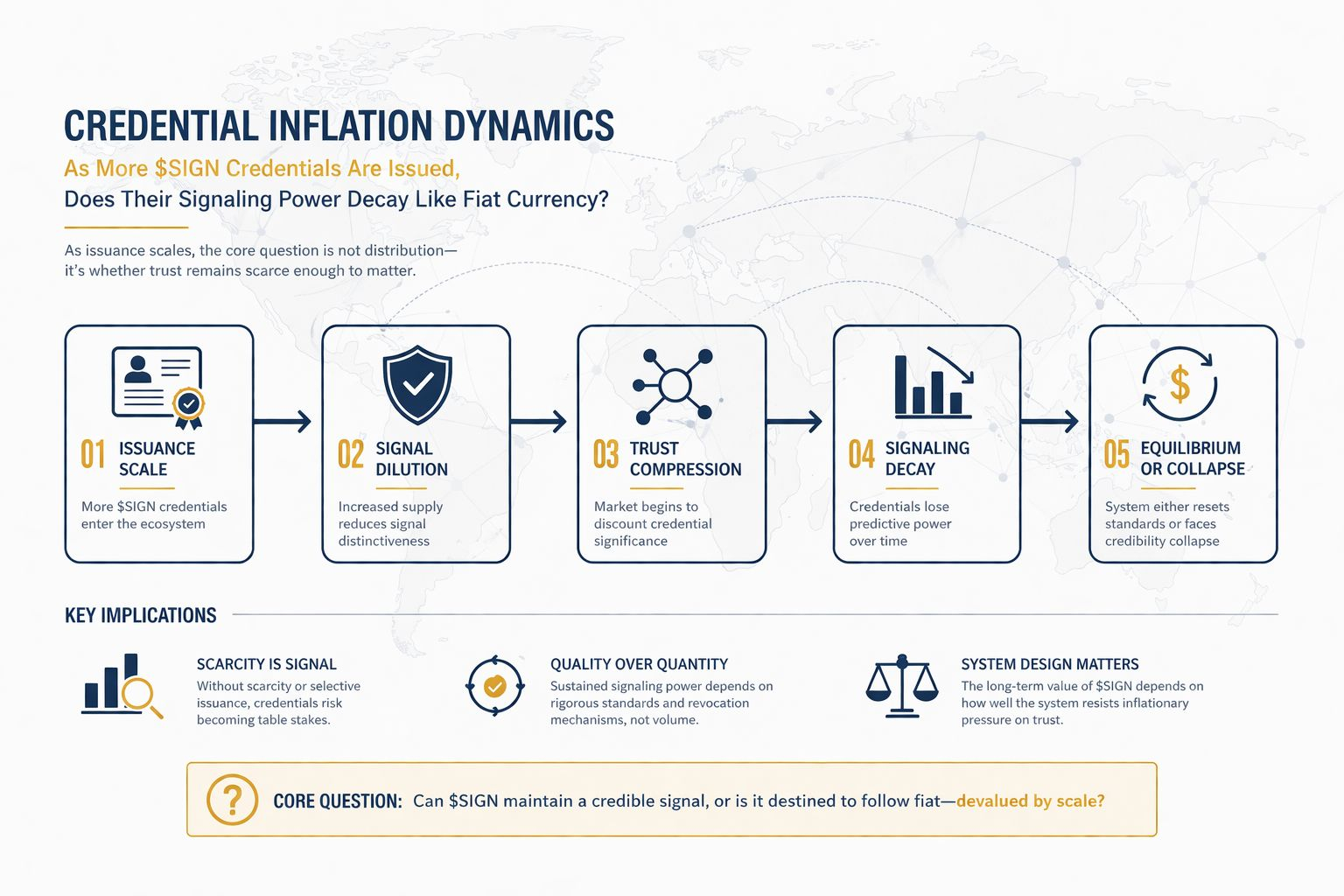
At that point, the graph of trust risks turning into a graph of coordination.
Does that mean SIGN fails? Not necessarily. It just means the real challenge isn’t issuance—it’s differentiation.
Who gets to define what’s high-signal versus low-signal?
How does the system avoid flattening all credentials into the same tier of meaning?
And more importantly, can it adapt fast enough when users start exploiting predictable patterns?
Because they will.
If there’s one thing worth sitting with, it’s this: credibility doesn’t disappear when systems scale—it fragments. The signal doesn’t die, it just hides behind layers of noise.
And the uncomfortable possibility is that in a world full of credentials, the rarest thing might not be verification…
…it might be discernment.
#SignDigitalSovereignInfra @SignOfficial $SIGN
