
when i try to understand what Sign Protocol is doing with identity, I don’t start from the tech side. I start with a simple thought:
Every country already has identity systems so what is Sign actually trying to build?
Because in reality, nothing is starting fresh. There’s already a mix of systems national IDs, bank KYC, government records, welfare data, border systems. They’re all there, just not really connected in a clean way.
So the problem isn’t “let’s build a better database.”
It’s more like… how do you make all these existing systems work together without creating more chaos?
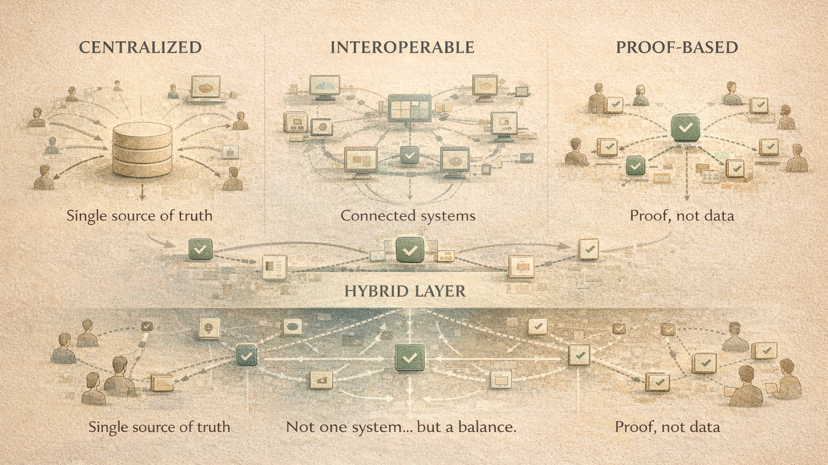
From what I’ve seen, there are usually three ways this gets handled.
First is centralization. One system becomes the main source of truth. Everything goes through it. It’s simple, easy to control… but also risky. One failure point, one place everything depends on.
Second is interoperability. Systems stay separate but connect through a shared layer. That sounds better, and it is in some ways. But then that connecting layer starts holding power. It doesn’t store everything, but it sees everything. And over time, it can become a bottleneck.
Then there’s what Sign is trying to do.
Instead of starting with data, it starts with proof.
That shift is small on the surface, but it changes the whole approach.
With Sign, a credential isn’t something you keep going back to a database for. It’s something issued as a signed proof. The issuer creates it, the user holds it, and anyone verifying it can check it directly without needing to call the original system again.
So instead of “give me your data,” it becomes “show me proof.”
And honestly, that feels like a cleaner way to think about it.
But the more I thought about it, the more I realized this isn’t about choosing one model over another.
No single approach solves everything.
A real system needs control from institutions, coordination between different parts, and some level of control for users themselves. Those are three different needs, and they don’t fit into one simple design.
So hybrid isn’t a compromise… it’s just reality.
At the same time, this model isn’t perfect either. If there’s no clear control over who can issue credentials, or if verification rules aren’t defined properly, things can get messy quickly. Systems that talk about privacy without strong structure usually end up going back to old habits.
And that’s where Sign starts to make more sense.
It’s not trying to replace everything.
It’s trying to sit in between.
A layer where proof can move, but data doesn’t have to. Where systems keep their own authority, but still connect through something verifiable. Where you don’t need to expose everything just to prove something is true.
And I think that’s the part that stuck with me.
Maybe the real question isn’t “which system is better?”
Maybe it’s this:
Can we build something that scales, protects data, and still allows people to verify things independently without creating another central point of control?
Because if that part is solved, everything else starts to fall into place.