

I’ve been thinking a lot about this whole Sign Protocol idea lately… and honestly, it just clicks.
At the end of the day, money on-chain isn’t as complicated as we make it sound.
It’s just signed claims.
That’s it.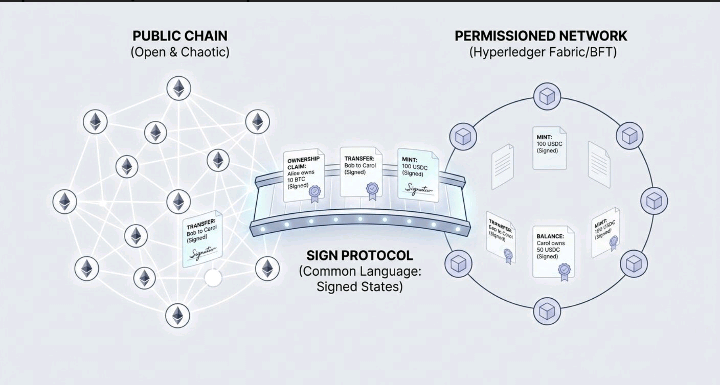
Who owns what.
Who sent what.
What’s valid… and what isn’t.
When you strip away all the noise the token hype, the branding, the narratives it all comes back to signatures.
And I actually like that.
Because suddenly, things feel simpler.
You’re not really “running a financial system.” You’re just keeping track of signed states and making sure everyone agrees on them.
On public chains, this is pretty straightforward. Every transaction is signed. Every balance update is signed. Anyone can verify it.
You don’t have to trust anyone you can just check.
That’s real trust.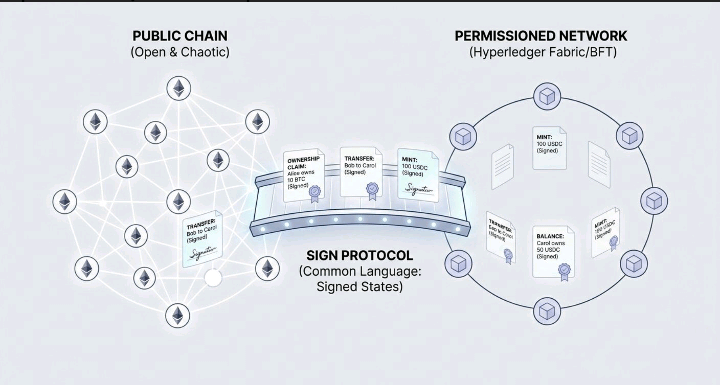
Now when you look at permissioned systems, it seems different at first. There are rules, access controls, not everyone can participate.
But if you look closer… it’s the same idea.
Still signed state changes.
The only difference is who’s allowed in.
And this is the part I find really interesting Sign Protocol kind of sits in the middle as a shared language. Whether it’s public or private, everything still revolves around signed data.
That consistency matters more than people realize.
Because it means you’re not jumping between completely different systems you’re working with the same logic in different environments.
Public for openness.
Permissioned for control.
Same foundation.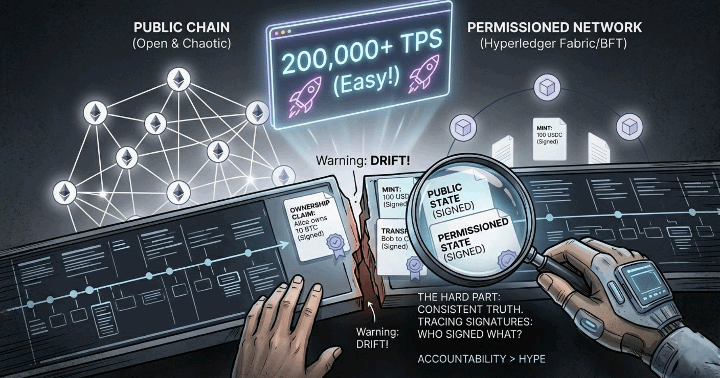
Now about those big TPS numbers people throw around like 200K+.
I’ve seen enough of this space to not get impressed by numbers alone.
If you treat transactions as simple signed messages instead of heavy computation, then yeah… of course it scales better.
But speed isn’t the hard part.
Keeping everything in sync That’s the real challenge.
Because if the public side and the permissioned side ever stop agreeing on what’s true even slightly that’s where things break.
And once trust is gone, it’s really hard to get back.
That’s why I appreciate this approach.
It’s not trying to reinvent everything or sound overly complex. It’s just saying: focus on signatures. Make them the core. Let everything else build around that.
It feels… grounded.
Also more honest.
If something goes wrong, you don’t hide behind complexity. You just trace it: Who signed it?
When
Why
Simple.
I’m not saying it’s perfect nothing is. But this way of thinking feels like a solid foundation to build on.
Not chains. Not hype.
Just signatures.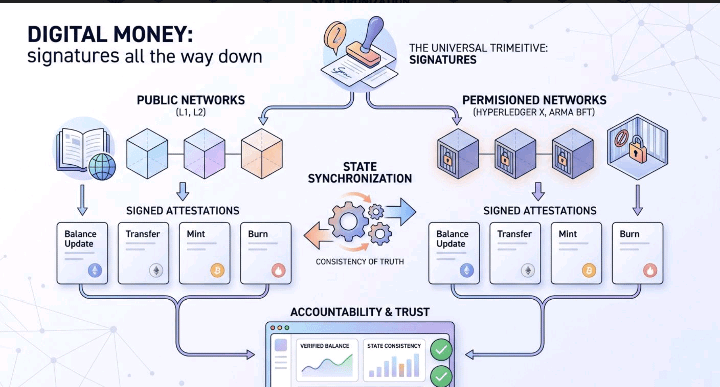
And honestly, the more I think about it, the more I feel like that’s what everything in this space comes down to anyway:
Who signed what… and do we all agree on it
@SignOfficial #SignDesignSovereignInfra $SIGN
