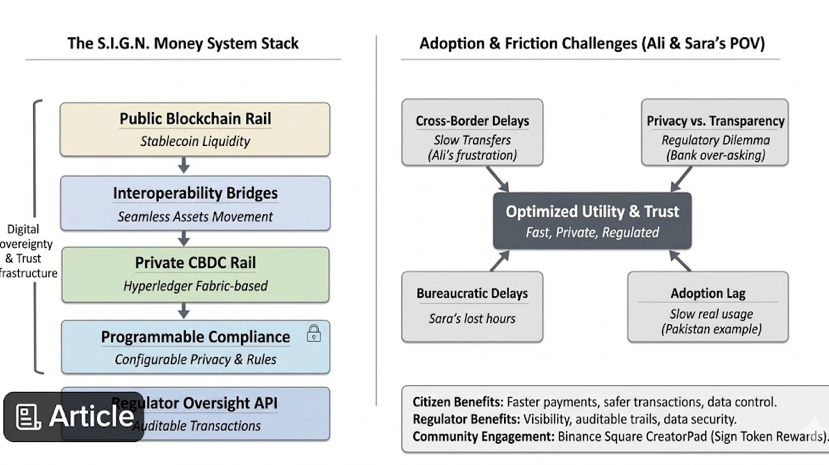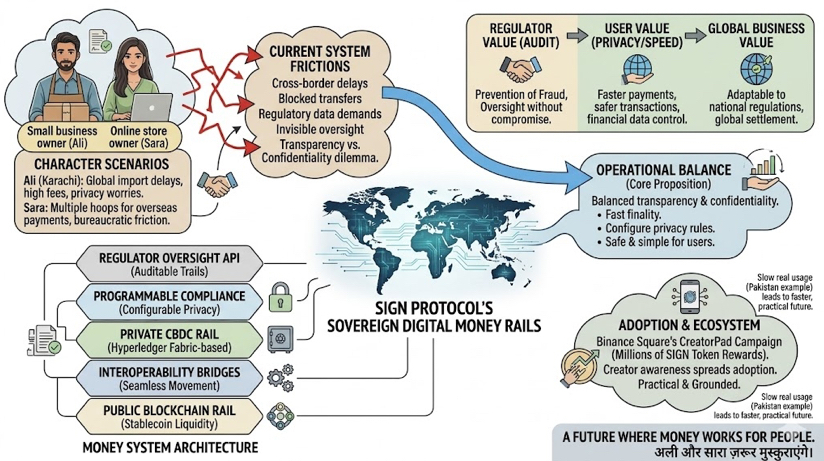
creating a unified, policy-controlled infrastructure that lets nations issue and manage Central Bank Digital Currencies (CBDCs) and regulated stablecoins across both private (confidential) and public (transparent) blockchains—while maintaining full sovereign control, auditability, and interoperability.
The Challenge of Sovereign Digital Money
Traditional financial systems struggle with slow cross-border settlements, limited privacy controls, high intermediation costs, and fragmented oversight. Pure public blockchains offer transparency and global liquidity but lack the confidentiality and policy enforcement many governments demand for retail CBDC flows. Conversely, fully private systems can feel isolated from broader digital ecosystems.
Sign Global’s S.I.G.N. (Sovereign Infrastructure for Global Nations) framework tackles this with a dual-rail architecture under the New Money System. It supports:
• Privacy-sensitive, permissioned CBDC on private rails (e.g., Hyperledger Fabric-based).
• Transparent, composable regulated stablecoins on public blockchains (L1 smart contracts or sovereign L2s).
These rails operate under one national infrastructure, bridged in a controlled manner, and tied together by Sign Protocol—the shared cryptographic evidence and attestation layer.
Core Architecture of the New Money System
The system offers two complementary deployment paths:
1. Public Blockchain Approach (Transparent Mode for Stablecoins)
• Sovereign L2: Governments control block production, validators/sequencers, and consensus (e.g., PoA/PBFT variants) while inheriting security from an underlying L1. Features include sub-second block times, high TPS (~4000), and exit mechanisms for resilience.
• L1 Smart Contracts: Simpler integration into existing ecosystems with inherited L1 security and direct composability.
• Ideal for public finance reporting, global liquidity access, and open verification.
2. Private Blockchain Approach (Confidential CBDC Mode)
• Based on Hyperledger Fabric with Arma BFT consensus, delivering immediate finality and 100,000+ TPS.
• Uses namespaces for tiered privacy (e.g., wCBDC for RTGS-like visibility, rCBDC for high retail privacy with optional ZK proofs).
• Token model supports UTXO-style operations, X.509 identity via MSP, and ISO 20022 compatibility for seamless integration with legacy systems.
• Central bank or designated operators retain governance over consensus nodes and permissioning.
Controlled Bridging and Interoperability
A key innovation is the atomic, policy-enforced bridge between private CBDC and public stablecoin rails:
• Conversions require compliance checks (AML/CFT, limits, eligibility, sanctions) linked to identity.
• Burn/lock on the source rail triggers mint/release on the destination, with full evidence logging (request ID, approvals, ruleset hash, settlement references).
• This enables hybrid flows: e.g., a private CBDC payment for sensitive domestic use converts instantly for cross-border settlement on public rails.
The system aligns with ISO 20022 for messaging and reporting, supporting real-time settlement, deterministic finality, and programmable execution.
The Role of Sign Protocol: The Evidence Glue
Sign Protocol is not a blockchain itself but the cryptographic evidence and attestation layer that unifies the entire S.I.G.N. stack (New Money, New ID, and New Capital Systems). It allows structured schemas for data and attestations—signed, verifiable claims such as:
• “This citizen meets eligibility criteria for disbursement.”
• “This conversion complied with policy ruleset v3.”
• “This payment executed under authority X at time Y.”
Features include:
• Selective disclosure and zero-knowledge (ZK) options for privacy.
• Public, private, or hybrid attestations.
• Omni-chain anchoring and querying via SignScan (REST/GraphQL APIs, SDKs, explorer).
• Immutable audit trails that bind actions to issuers, subjects, rulesets, and timestamps.
In the New Money System, attestations power:
• Compliance logs and audit packages.
• Identity-bound execution (tying payments to verifiable credentials from the New ID System).
• Programmable controls in the New Capital System (e.g., via TokenTable for batch distributions, vesting, or conditional releases).
This shared evidence layer ensures actions are repeatable, attributable, and inspection-ready without central query bottlenecks, enabling seamless interoperability across agencies, vendors, and networks.
Practical Flows and Use Cases
• Government-to-Person (G2P) Disbursements: Verify identity/eligibility → select rail (private CBDC for privacy or public for transparency) → generate batch via TokenTable → settle with audit manifest.
• Merchant Acceptance: Supports wallet integration, finality expectations, governed refunds, and evidence for disputes.
• Cross-Border Settlement: Private CBDC → bridge to public stablecoin for instant, low-cost global movement with supervisory visibility.
• Programmable Money: Rules (limits, approvals, emergency pauses) enforced on-chain or via attestations, with real-time reporting.
Benefits for Sovereign Nations
Sign’s New Money System delivers:
• Sovereignty: Full control over keys, upgrades, consensus (in L2/private modes), and policy enforcement.
• Privacy with Auditability: Tiered confidentiality for retail users alongside lawful supervisory access and tamper-proof evidence.
• Efficiency: Real-time settlement, high throughput, and reduced intermediation compared to legacy rails.
• Interoperability & Resilience: Bridges public/private rails, inherits security where needed, and supports hybrid deployments.
• Scalability & Inclusion: Integrates with national ID and capital systems for large-scale, conditional programs (welfare, grants, incentives) while unlocking global liquidity.
• “Digital Lifeboat” Potential: As a robust alternative infrastructure, it preserves access and records amid geopolitical or systemic risks.
Sign Global positions this as part of a broader push toward digital sovereignty, aiming to onboard hundreds of millions through practical government collaborations in money, identity, and tokenized assets.
Why It Matters in 2026
As central banks advance CBDC pilots and stablecoins gain traction for payments, the tension between privacy/control and transparency/composability intensifies. Sign Protocol’s New Money System offers a pragmatic synthesis: sovereign-grade rails that respect national priorities while embracing blockchain’s speed, programmability, and verifiability.
By making money movement conditional on verifiable evidence (not just discretionary trust), it moves beyond simple digital cash toward truly programmable, auditable sovereign money infrastructure. This could reshape how nations handle domestic disbursements, cross-border flows, and even crisis resilience—positioning blockchain as core public infrastructure rather than an add-on.
For nations, builders, and institutions exploring digital money rails, Sign’s dual-rail + attestation model provides a blueprint that balances innovation with governance. The system is documented openly, with resources for deployment and integration available via Sign Global’s docs.
As adoption grows—evidenced by community discussions and SIGN token momentum—this framework may influence how the next generation of digital sovereign money actually operates in practice.