
Last night, just after the @SignOfficial attestation snapshot window closed, I found myself still looking at the screen.
Not because of price. Not because of volatility. But because something about the system itself didn’t let me move on.
Earlier, I had been tracking BTC and SIREN both reacting almost exactly as expected based on liquidity patterns. Clean moves, predictable behavior. But this felt different. This wasn’t about market reactions. It was about how the underlying system was behaving.
So I started digging a bit deeper.
On-chain, I noticed a small cluster of attestation interactions moving through a contract. Nothing dramatic. Gas fees didn’t spike aggressively, but they increased just enough within a tight window to suggest coordination rather than randomness.
What caught my attention wasn’t the size of activity — it was the structure.
There were repeated low-value attestations, followed by consolidation into a single wallet. It didn’t feel accidental. It felt intentional. Almost like someone was testing the edges of the system in a controlled way.
Out of curiosity, I ran a simple test myself. I issued a mock credential and pushed it through verification.
The result wasn’t what I expected.
It didn’t fail. It didn’t revert.
It paused.
That moment — small as it was — changed my perspective.
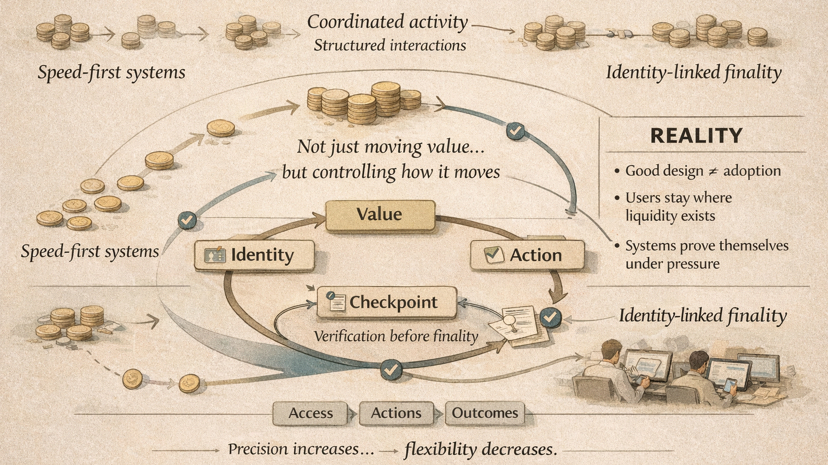
In most blockchain environments, speed is everything. Delays are seen as inefficiencies. But here, that pause didn’t feel like a flaw. It felt like a checkpoint. As if the system was prioritizing certainty over speed.
And that’s when something clicked.
This isn’t a system optimized purely for throughput. It’s designed around finality tied to identity. And that distinction matters more than it first appears.
The more I mapped it out, the less it looked like a simple stack of layers. It behaved more like a loop.
Value flows through the system, but it’s not neutral. It’s conditioned. Identity determines access. Access defines actions. Actions generate attestations. And those attestations feed back into identity again.
Everything is connected.
And that creates a level of precision that is both impressive and, in some ways, unsettling.
Because when a system becomes this precise, ambiguity starts to disappear. And with that, a certain kind of flexibility disappears as well.
When identity is tightly linked to every action, the system gains clarity. But it also gains a form of control.
I understand the appeal.
Legacy systems are fragmented, slow, and difficult to coordinate. A structure like this could simplify entire national or institutional processes. It could make verification faster, distribution cleaner, and accountability easier.
But it also introduces a quiet trade-off.
The same mechanisms that improve efficiency can also reshape how participation works — not through restriction, but through design.
And that’s the part I keep coming back to.
Because for most users, this shift won’t feel dramatic. Things will just seem smoother. More reliable. More seamless.
But underneath, the logic is changing.
And that leaves me with a question I haven’t been able to shake since that moment when the transaction paused.
If identity becomes the gateway to everything on-chain, and that identity is ultimately issued or controlled somewhere…
are we still building permissionless systems?
Or are we simply redefining what permission looks like in a more structured form?
#SignDigitalSovereignInfra