
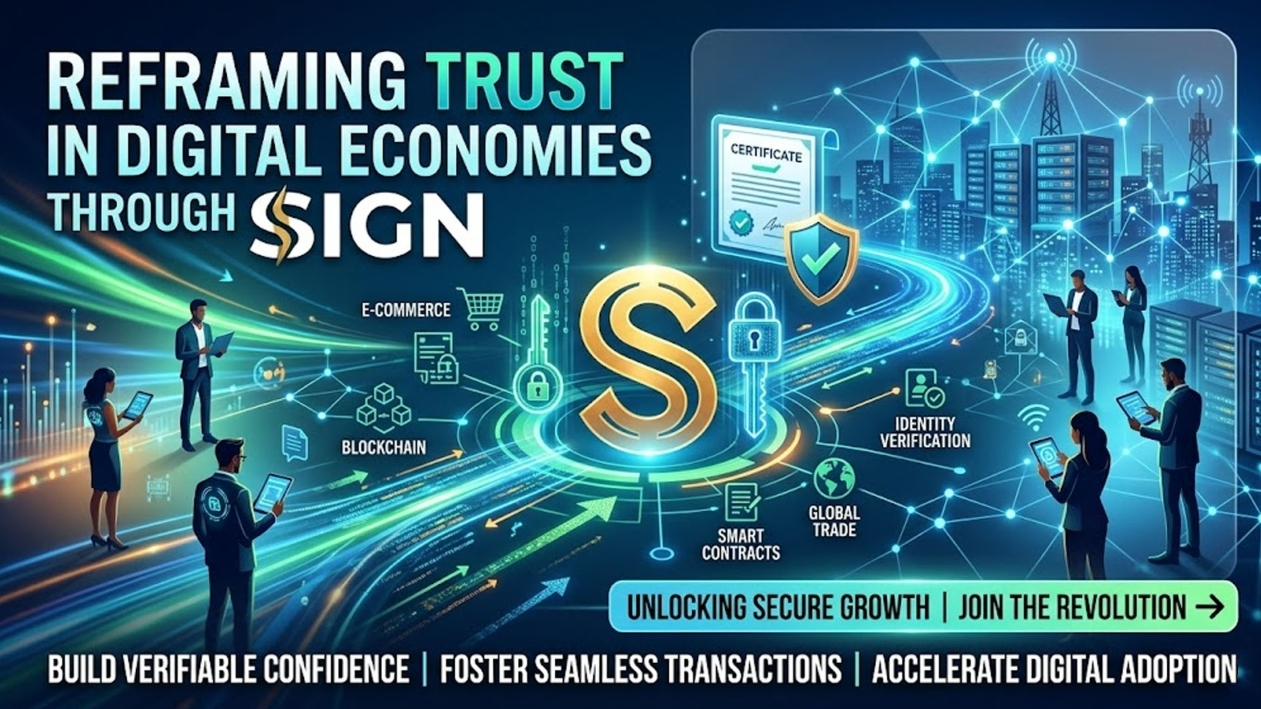
i don’t see S.I.G.N. as a product.
it’s not an app i download.
not a dashboard i log into.
it feels more like a blueprint — the kind i’d expect governments or big systems to use if they were rebuilding everything from scratch.
money. identity. public spending.
all of it.
the way i see it, everything starts with one simple thing:
claims.
“i’m eligible.”
“this is verified.”
“that payment happened.”
and most systems just… accept that.
that probably worked before.
when everything stayed inside one system.
but now i’m looking at a world where systems overlap, data moves around, and different players keep changing.
that’s where trust starts breaking — not loudly, but quietly.
and this is where S.I.G.N. starts making sense to me.
it doesn’t rely on claims.
it forces them to become proof.
something i (or anyone with permission) can verify.
not trust.
not assumptions.
proof.
at the center of this is Sign Protocol.
and honestly, this is the part that made it click for me.
the idea is simple:
i take a claim.
i attach it to who made it.
i sign it cryptographically.
now it’s verifiable — anytime.
it sounds small.
but once i imagine every system working like this…
things start changing.
i don’t need to re-check the same data everywhere.
systems don’t need to keep syncing broken records.
i move with proof instead of raw data.
from there, everything branches into three parts:
money. identity. capital.
money
when i think about digital currency systems, most of them feel incomplete.
here, it’s different.
there are controls — real ones.
limits. approvals. fallback options.
but at the same time, transactions settle fast, with clear finality.
no confusion.
and still, i can see the tension:
visibility vs privacy.
that problem doesn’t go away — it just gets handled better.
identity
this is the part i feel is overdue.
instead of checking a central database every time…
i carry proof about myself.
i can prove my age.
my eligibility.
my status.
without exposing everything.
selective disclosure.
privacy-first design.
even zero-knowledge when needed.
and importantly, not everyone can issue these proofs.
there’s trust even at the issuer level.
capital
this is where i’ve seen systems struggle the most.
distribution sounds easy — until it isn’t.
who qualifies?
who gets missed?
where does money leak?
here, everything is programmable.
rules are defined.
execution follows.
and every outcome has proof behind it.
not assumptions.
evidence.
and tying all of this together is what i’d call the evidence layer.
every action answers the same questions:
who approved it?
when?
under what rules?
and instead of scattered logs…
it becomes structured, verifiable data.
also, i like that it doesn’t force everything on-chain.
that would be messy.
it gives options:
on-chain
off-chain
hybrid
so sensitive data stays private — but still provable.
and that feels intentional.
because real systems aren’t clean.
then there are tools like TokenTable and EthSign.
i don’t see them as the system itself — more like extensions.
TokenTable helps with distribution at scale.
EthSign turns agreements into verifiable proof.
different use cases, same idea:
everything leaves evidence.
even the tech choices feel deliberate.
standards that actually matter.
verifiable credentials.
DIDs.
OIDC flows.
revocation systems.
plus solid cryptography and zero-knowledge where needed.
and then there’s something i don’t see talked about enough:
sovereignty.
most crypto projects kind of ignore it.
this one doesn’t.
it works with it.
governments keep control.
rules stay enforceable.
oversight doesn’t disappear.
but now everything becomes verifiable.
and that’s the shift i keep coming back to.
i don’t have to trust the system blindly.
i can verify it.
in practice, that means:
i get identity systems that don’t expose everything about me.
financial systems that are fast but still follow rules.
capital that actually reaches the right places.
and everything leaves a trail i can audit — in real time.
i’ve seen a lot of “infrastructure” ideas.
most try to fix everything at once.
and that’s usually where they fail.
this one feels different.
it focuses on one thing:
making claims provable.
and honestly…
that feels like the right place to start.
because once i can prove things properly —
everything else gets easier.
