
I've spent 12 days digging into Sign.
Revenue. Backers. Tech. Tokenomics. Government use cases.
But the question underneath all of it is simpler:
"Who is actually using this?"
Here's what I found.
THE FIRST NUMBER THAT STOPPED ME
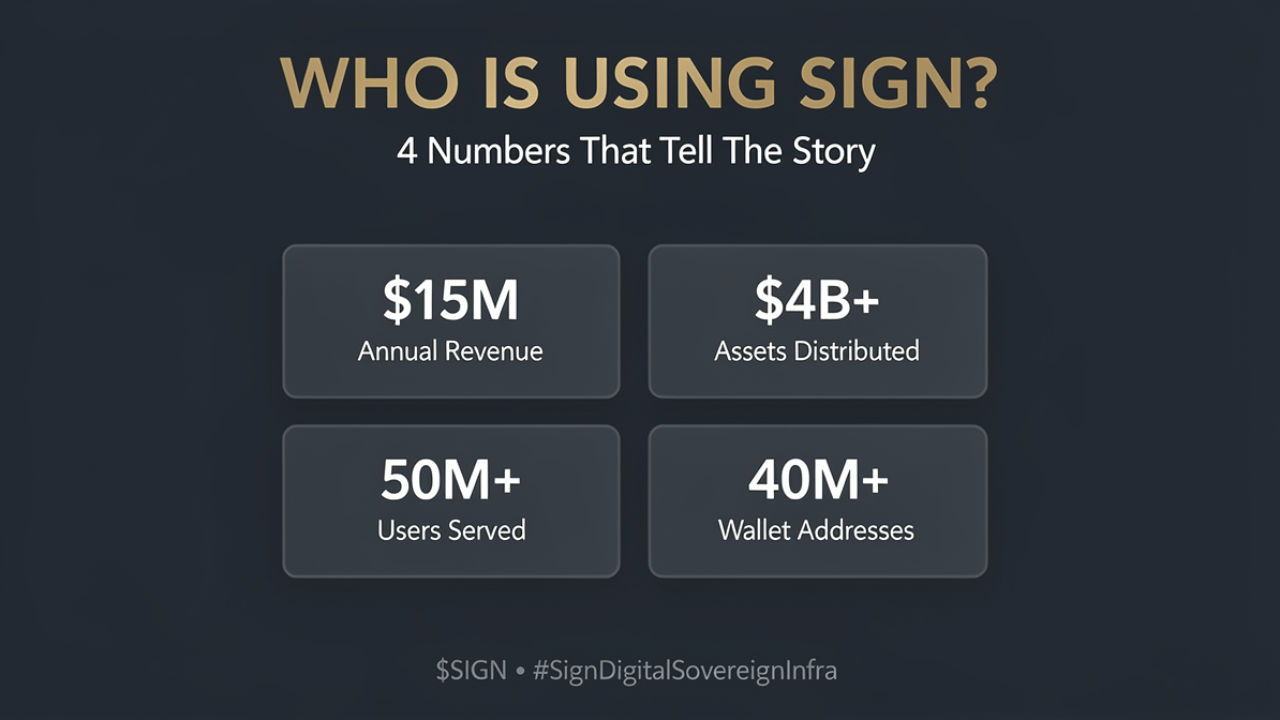
$15M in annual revenue.
That's not crypto funny money. That's real dollars from real clients.
I've looked at dozens of infrastructure projects. Most have zero revenue. They raise money, launch a token, and hope.
Sign already has paying customers. That changed how I look at them.
What I'm watching now: How fast does that number grow? If they hit $18M+ this year, adoption is accelerating.
THE SECOND NUMBER THAT SURPRISED ME
$4B+ distributed through TokenTable.
I had to read that twice.
Four billion dollars. Across 40 million wallets.
Projects like Starknet, ZetaChain, and Notcoin used TokenTable. Not small names. Real projects with real users.
This isn't a pilot. This isn't a testnet. This is production infrastructure handling billions.
What I'm watching now: Which new projects join TokenTable? More volume = more adoption.
THE THIRD NUMBER THAT MADE ME PAY ATTENTION
50 million users served.
Not wallets. Users. Real people.
I usually ignore "users served" metrics because projects inflate them. But 50M is too specific to fake completely.
These users come from TokenTable distributions, SignPass identity verification, and Protocol record creation.
What I'm watching now: Are they adding millions of users per quarter? That tells me if adoption is speeding up or slowing down.
THE FOURTH NUMBER THAT CONFIRMED IT
40 million wallet addresses.
Someone asked me: "Couldn't that be one person with 40 wallets?"
Maybe. But distribution patterns suggest otherwise. TokenTable sends to real users. Airdrops go to real people.
The network effect is real. More addresses mean more potential users.
What I'm watching now: New wallet growth. More addresses = more network effect.
WHAT THESE NUMBERS TELL ME
Put together, here's what I see:
Metric What It Tells Me
$15M revenue Real business, not speculation
$4B+ distributed Production infrastructure, not pilot
50M+ users Mainstream scale, not crypto-only
40M+ wallets Real adoption, not fake volume
This isn't a project hoping to get users. They already have users. Millions of them.
WHAT THESE NUMBERS DON'T TELL ME
I try to be honest about what I don't know.
Are users sticking around? 50M users served doesn't tell me retention. Are they coming back? Or did they use it once and leave?
Is revenue growing? $15M today. Was it $10M last year? $5M? I don't know. The growth rate matters more than the number itself.
Are governments adopting beyond Abu Dhabi? One partnership is a pilot. Three is a business. I'm watching for more.
WHERE I COULD BE WRONG
I've been wrong before. Could be wrong again.
Users don't always equal revenue. 50M users is impressive. But if they're not paying, it's not a business. The $15M revenue tells me someone is paying. But I want to see that number grow.
Distribution volume doesn't guarantee retention. $4B+ moved is real. But are those users coming back? Or was it one-time airdrops?
Past adoption doesn't guarantee future adoption. Just because they have users today doesn't mean they'll have users tomorrow.
BOTTOM LINE
The adoption metrics are real. $15M revenue. $4B+ distributed. 50M+ users. 40M+ wallets.
That's not a project hoping to get traction. That's a project with traction.
But I'm watching 2026 to see if that traction accelerates or stalls.
OVER TO YOU
What metrics do you track? What am I missing?
Drop your thoughts below. I read everything.
Sources:
TokenTable distribution data
Sign official announcements
On-chain wallet analysis
CEO interviews on adoption