
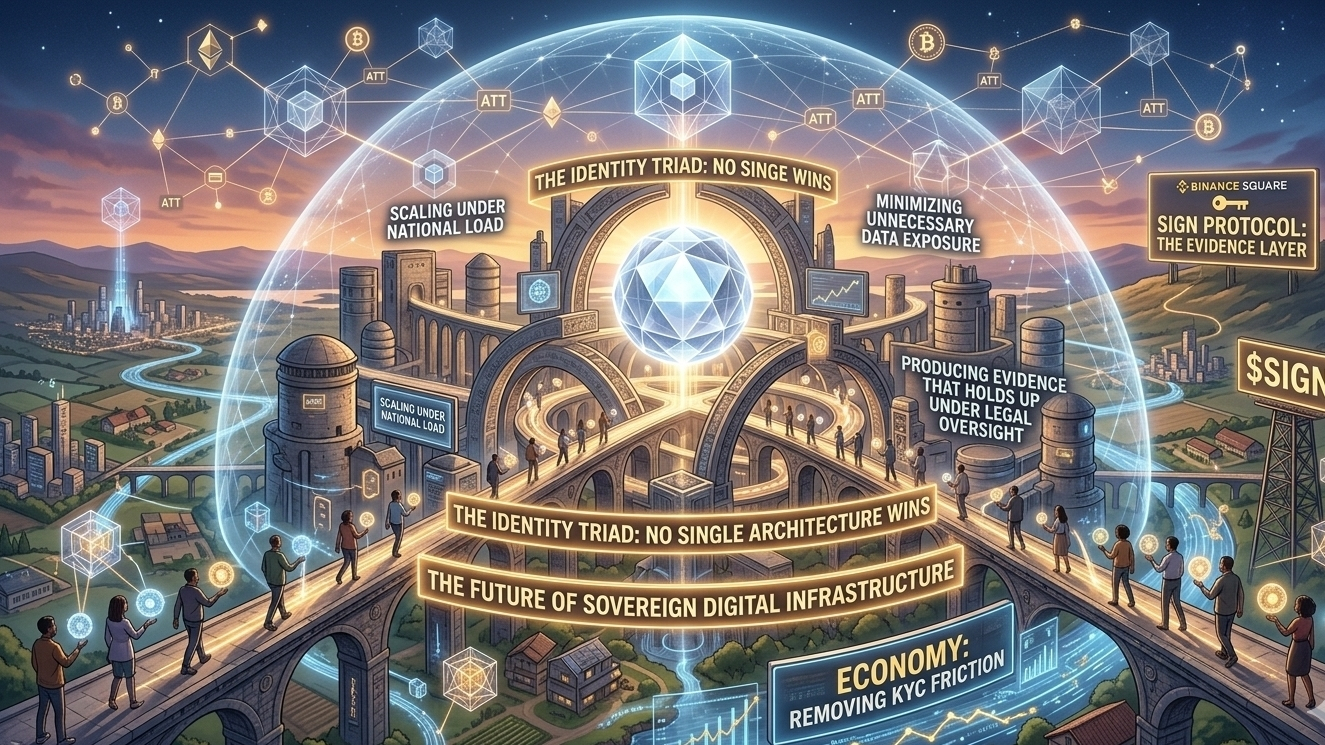
I’ve shared the common fantasy that many strategy decks lean on: the idea that a country can simply "build a digital ID" from scratch. As the article highlights, identity doesn't start at zero. Most nations are already operating a complex, messy patchwork of civil registries, tax databases, and siloed KYC systems. The real challenge isn't building a new database—it’s creating a coherent architecture that connects what already exists without compromising sovereignty or privacy.
I’m learning from the recent deep dives into Sign Protocol ($SIGN ) that the future of national infrastructure isn't about choosing one "winner" among identity models. Instead, it's about an integrated approach. When we look at how nations digitize, three distinct architectures usually emerge:
1. The Centralized Backbone
The Logic: One single source of truth (e.g., a national biometric database).
The Pro: Rapid deployment and extreme efficiency for government services.
The Pitfall: It creates a massive single point of failure and often leads to "surveillance by default," where every verifier gets more data than they actually need.
2. The Federated Exchange
The Logic: Connecting existing silos (banks, telcos, registries) through a shared layer.
The Pro: Respects existing institutions and avoids a "god-database."
The Pitfall: High complexity. If the interoperability layer isn't designed for national scale, it becomes a bottleneck that slows the country down.
3. The User-Centric (Sovereign) Model
The Logic: Individuals hold their own "Verifiable Credentials" (VCs) in digital wallets.
The Pro: Maximum privacy. You prove you are "over 18" without revealing your birth date or home address.
The Pitfall: Shifting the burden of security to the citizen is a massive UX challenge that requires a durable trust layer.
Why Architecture is Policy
I know that in the world of Web3 and Digital Sovereign Infrastructure, architecture is policy written in code. The reason projects like Sign are gaining traction on Binance Square is that they don't try to replace these systems; they provide the Evidence Layer.
By using @SignOfficial , a nation can issue "Attestations"—tamper-proof digital receipts of identity or eligibility—that work across all three models.
For Governments: It ensures "lawful auditability" and control.
For Citizens: It enables "privacy-preserving" interactions.
For the Economy: It removes the friction of manual KYC, allowing capital to move at the speed of the internet.
Final Thoughts
The "winner" won't be a single app or a single database. It will be the system that best manages the Identity Triad: scaling under national load, minimizing unnecessary data exposure, and producing evidence that holds up under legal oversight.
As we move toward a "Sovereign Digital Future," the focus shifts from who has the data to who can verify the proof.