
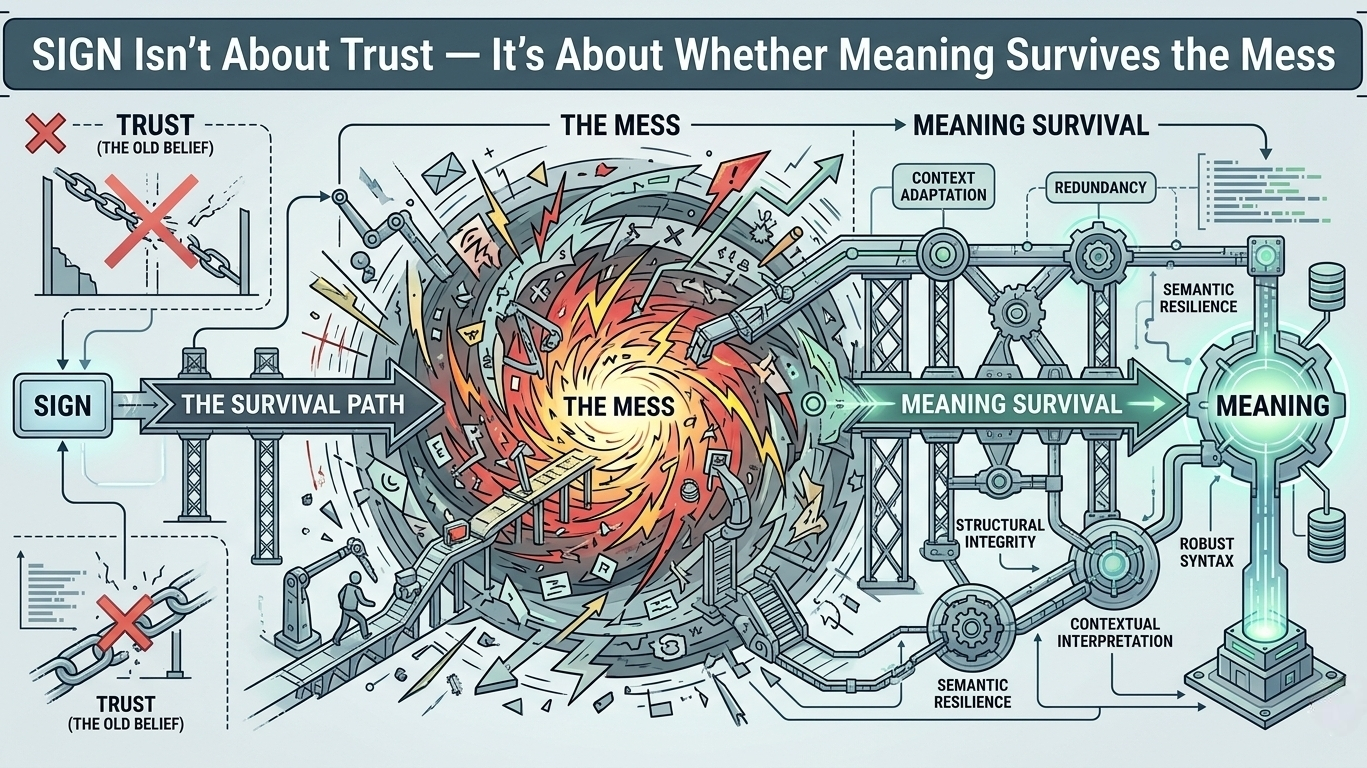

Look, I’ll be honest. The market is exhausted.
Every other project talks about “trust,” “identity,” “coordination.” I’ve seen this movie before. Same script, different logo. And yeah, it sounds smart at first… until you actually try to use these systems and everything starts breaking in weird, quiet ways.
Data doesn’t move cleanly. Credentials don’t mean the same thing everywhere. And suddenly all that “composable infrastructure” talk? It falls apart.
So when something like SIGN shows up positioning itself as infrastructure for credential verification and token distribution I don’t get excited. I get suspicious. That’s just how this space trains you.
Because the idea itself isn’t new. Not even close.
But here’s where it gets interesting… and also messy.
The first thing people don’t talk about enough is this: a credential and a token distribution are not the same thing. Not even remotely.
A credential is basically someone saying, “yeah, this person qualifies.”
A distribution is actually giving them something of value.
Simple, right? You’d think.
But most systems just mash these together like it’s one clean pipeline prove something → get tokens. Done.
That’s lazy thinking. Honestly.
Because in real life, eligibility changes. Issuers aren’t always reliable. And sometimes… even if someone qualifies, they still don’t get anything. Policies, timing, funding there’s always something.
If SIGN treats these two layers like they’re identical, that’s a crack in the foundation. A big one.
Now let’s talk about the real problem. Not storage. Not speed.
Meaning.
Yeah, meaning. The thing nobody builds for.
A credential isn’t just data sitting somewhere. It’s a claim. And that claim comes with baggage:
Who issued it?
Under what rules?
At what time?
And who actually trusts that issuer?
Move that credential somewhere else and boom, half that context disappears.
I’ve seen this happen over and over. A proof that made total sense in one system suddenly looks useless somewhere else. Not because it’s wrong… but because nobody knows how to interpret it anymore.
That’s what I call proof decay. And it’s everywhere.
So the real question for SIGN isn’t “can you verify something?”
That part’s easy.
The real question is: can that meaning survive travel?
Because if it can’t, then what’s the point?
And then there’s the real world. Which, let’s be real, is a mess.
People lose wallets.
They reuse identities.
They forget things.
Institutions? Even worse. Inconsistent, slow, sometimes just wrong.
Records aren’t clean. They’re incomplete. Sometimes duplicated. Sometimes outdated.
This is the environment SIGN has to live in.
Not a perfect, trustless fantasy. Chaos.
So yeah, I start asking uncomfortable questions:
What happens when a credential needs to be revoked… but it’s already everywhere?
What if two issuers say opposite things about the same person?
What if someone only has half the credentials they need?
What stops someone from reusing a valid claim in a totally different context?
These aren’t edge cases. This is normal behavior.
If SIGN doesn’t handle this stuff, it won’t fail loudly. It’ll fail quietly. And that’s worse.
Another thing that bugs me and it happens a lot in Web3 is how people flatten everything into “proofs.”
Not all data is the same. Not even close.
A signed agreement? That’s a commitment between parties. Context-heavy. Legal implications.
A credential? That’s just a claim about someone. Might expire. Might get revoked.
A token distribution record? That’s history. It happened. Done.
Three completely different things.
But systems love to treat them like identical Lego blocks. Plug and play.
Bad idea.
You end up with weird situations like treating a temporary credential as permanent truth, or assuming a financial transaction somehow proves legitimacy.
It doesn’t.
If SIGN can’t keep these categories separate, things will get confusing fast. And confusion in financial systems? Yeah… that’s where problems start.
Now let’s get into token distribution, because this is where things usually break.
Most people think distribution is just logistics. Who gets what.
It’s not.
It’s a verification problem. And honestly, it’s kind of adversarial.
Airdrops, grants, incentives they fail all the time. Not because the system can’t send tokens, but because it can’t define who actually deserves them.
SIGN tries to flip this by focusing on claims instead of addresses.
That’s smart. I’ll give it that.
Instead of “this wallet gets tokens,” it’s more like “this person qualifies based on these proofs.”
But here’s the catch.
The more precise you make those rules, the harder they are to understand. And if people can’t understand why they qualify or don’t they stop trusting the system.
And then you get gaming.
People don’t contribute real value. They just optimize for the criteria. Farm the credentials. Hit the checklist.
You’ve seen it. I’ve seen it.
So yeah, better verification helps… but it doesn’t magically fix behavior.
There’s also the time problem. Nobody wants to deal with this, but it matters.
Every credential expires. Or at least, it should.
Something that was true last year might not be true today. But systems love to treat proofs like they’re eternal.
They’re not.
If SIGN doesn’t build in time like actual expiration, renewal, context awareness it’s just going to collect stale claims. And over time, those claims start misleading people.
That’s how trust quietly erodes.
So where does that leave us?
Honestly… somewhere in the middle.
I’m not dismissing SIGN. There’s something here. The focus on claims, on portability, on tying verification to distribution it’s directionally right.
But direction isn’t enough.
If this turns into just another attestation layer, it’ll fade into the background. We’ve got plenty of those already.
If it tries to force rigid standards, institutions won’t play along. They never do.
And if it ignores how messy the real world is, it’ll break the moment it scales.
But if and it’s a big if it manages to carry meaning across systems… not just data, but actual meaning, with context, constraints, and time baked in?
That’s different.
That’s not exciting. It’s not flashy. Nobody’s going to hype it on a bull run.
But it’s useful. Quietly useful.
And when the noise dies down and it always does systems that preserve order tend to stick around.
Everything else?
It just adds to the pile of things that almost worked.
#SignDigitalSovereignInfra @SignOfficial $SIGN
