


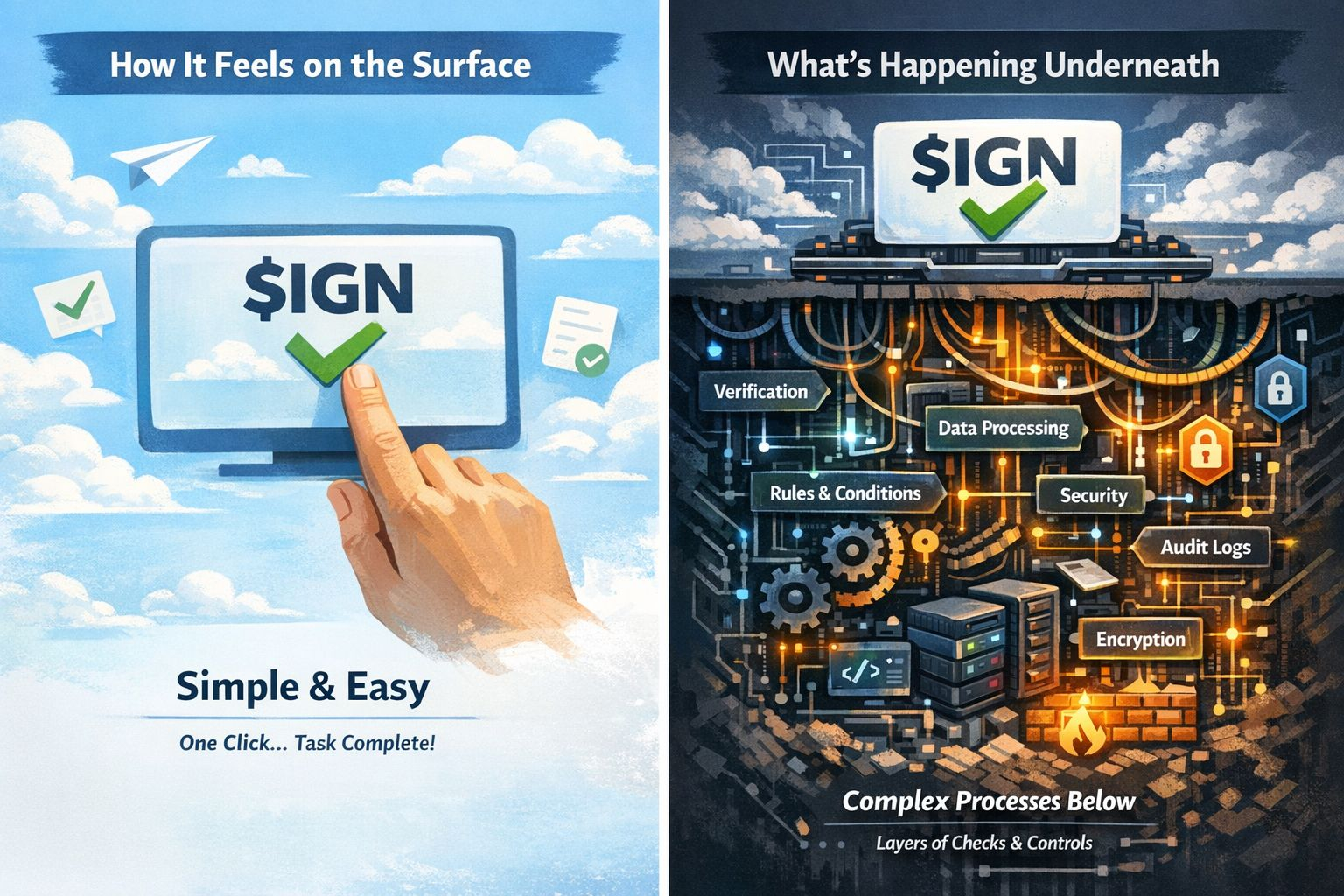
been interacting with SIGN for a few days now and one thing I can’t ignore… from the outside, everything feels very light.
you do a task, it goes through.
no complex steps, no confusion, no heavy process.
and honestly, that’s what makes it easy to keep using.
but the more I think about it, the more it feels like that simplicity is only on the surface.
because behind every “simple” action, there’s actually a lot happening.
verification layers.
rules.
conditions.
checks that you don’t even see.
you click once… but the system is doing way more than that single action.
and that’s not necessarily a bad thing.
in fact, that’s what good infrastructure usually looks like. complex underneath, simple on top.
but here’s the part that stands out to me.
when systems become this smooth, users stop asking questions.
you don’t think about what’s being verified, how it’s being stored, or what conditions are being applied in the background.
you just assume it works the same way every time.
and most of the time, it probably does.
but “most of the time” isn’t the same as “always”.
because if something changes underneath, you won’t really notice immediately.
the interface stays the same.
the flow looks identical.
but the logic… might not be.
and that’s where things get a bit tricky.
because now you’re relying on something you don’t fully see.
again, I’m not saying this is a flaw. almost every system works like this once it scales.
but I think it’s still worth being aware of.
especially when the system is tied to things like identity, verification, or approvals.
because at that point, it’s not just convenience anymore.
it’s influence.
right now, I’m still using it the same way. tasks, interactions, testing things out.
just paying a bit more attention to what might be happening beyond that single click.
#signdigitalsovereigninfra $SIGN
