
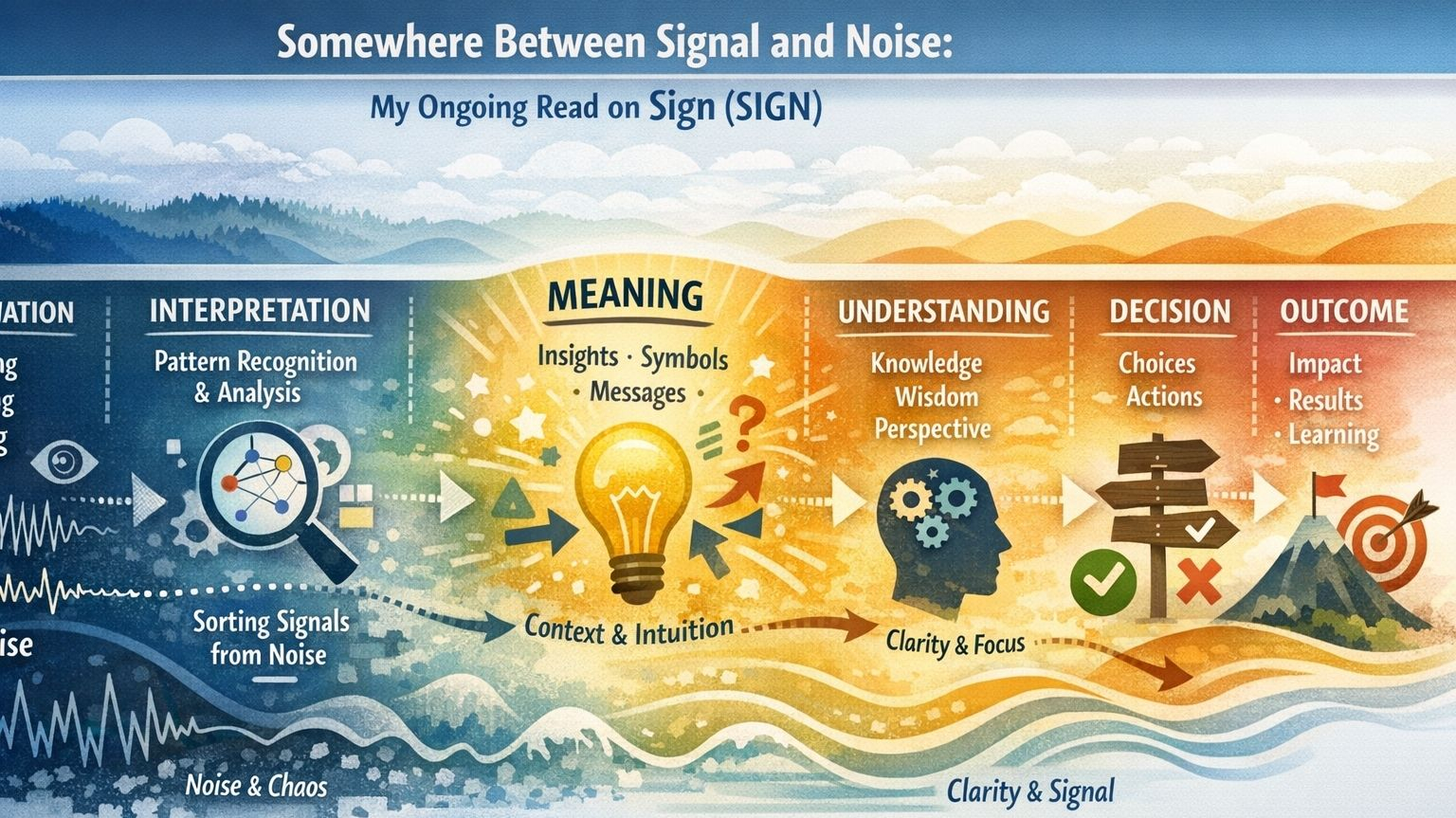

I’ve been watching SIGN for a while now, and if I’m being honest, my first reaction wasn’t excitement—it was hesitation.
Anything tied to identity, credentials, or token distribution always sounds important on paper. It sits right at that intersection where real-world problems meet crypto infrastructure. But that’s also exactly why I’ve learned to be careful. I’ve seen this narrative recycled too many times—different branding, same promises—so I’ve trained myself to slow down instead of jumping in.
What actually made me look deeper wasn’t the story, but the structure behind it and the fact that it seemed to be doing something beyond theory.
When I stripped it down, the idea started to make more sense. SIGN isn’t trying to rebuild the entire concept of identity from scratch. Instead, it focuses on verification—proving that something is true without forcing everything into a single centralized system. That alone feels more grounded than most “Web3 identity” pitches.
The way they’ve designed it is surprisingly practical. They separate the heavy lifting from the verification layer. Data gets created and processed off-chain, while the proof of that data—what actually matters—is anchored on-chain. It’s one of those decisions that doesn’t sound flashy, but it solves a real problem. Fully on-chain systems are expensive and inefficient, and most projects pretending otherwise end up collapsing under their own design.
What caught my attention even more was the distribution side. TokenTable, their distribution system, isn’t just theoretical—it’s been used at scale. When you start seeing billions in token distributions and millions of users passing through a system, it at least tells me this isn’t just a whitepaper experiment. Something is happening there.
But this is also where things start getting complicated.
The token itself is where my curiosity turns into caution. A 10 billion supply with only around a fifth circulating tells me we’re still early in the emission cycle. And I’ve seen how this usually plays out. Early stages feel strong, liquidity is tight, price moves quickly—but the real pressure comes later.
The allocation looks “community-heavy” at first glance, which sounds good until you ask what that actually means. Community doesn’t always mean long-term believers. Sometimes it just means airdrop hunters and short-term capital rotating in and out. That difference matters more than most people admit.
The vesting structure reinforces that feeling. There’s a delay, then a steady stream of unlocks over time. It creates that familiar setup: limited supply early, then gradual dilution. The kind that doesn’t crash a chart overnight, but slowly weighs on it if demand doesn’t keep up.
And when I look at the valuation gap between current market cap and fully diluted valuation, that’s where I get more cautious. That gap isn’t just a number—it represents future supply that the market still has to absorb. If real demand doesn’t grow alongside it, the pressure builds quietly in the background.
Lately, the activity pattern has looked very familiar to me. Spikes around listings, bursts of volume during campaigns, increased wallet activity when distributions happen. I’ve seen this cycle enough times to recognize it almost immediately. It’s not necessarily bad—but it’s not proof of long-term strength either.
The real question I keep coming back to is simple: are people actually using this system, or are they just passing through it?
Because there’s a big difference.
Narratives can carry a project for a while. Words like “infrastructure,” “identity,” and “verification layer” sound powerful, and they attract attention. But narratives don’t build staying power—usage does.
To be fair, SIGN feels more realistic than most projects in this space. It’s not trying to replace governments or rebuild identity systems overnight. It’s positioning itself as a layer that can plug into existing systems. That’s a much more believable path forward.
Still, I find myself asking the same questions over and over.
Are these attestations happening because they’re actually needed, or because people are incentivized to create them?
Are token distributions driven by real projects, or just campaigns designed to generate activity?
Are developers choosing this because it’s the best tool, or because they’re being paid to try it?
These aren’t obvious questions, but they’re the ones that matter.
Because in the end, everything comes down to retention.
It’s easy to attract users with airdrops and incentives. It’s much harder to keep them once those incentives disappear. If people only interact with the system once, the network doesn’t grow—it just cycles.
For SIGN to really prove itself, I think it needs repeat behavior. Credentials that get reused. Applications that rely on the system more than once. Developers who keep building even when the funding slows down. Maybe even institutions that don’t just test it, but stick with it.
Without that, it risks becoming another loop of temporary activity—busy on the surface, but hollow underneath.
Where I’ve landed for now is somewhere in the middle.
I don’t see it as empty hype. There’s a real idea here, and the design choices show some level of thought that a lot of projects lack. The early usage isn’t nothing either—it suggests there’s at least some product-market interaction happening.
But at the same time, I don’t think it’s proven. Not yet.
There’s still a gap between activity and conviction, between usage and necessity.
So I’m watching closely. Not the price as much as the behavior behind it.
If I start seeing consistent usage that isn’t tied to incentives, if people keep coming back to the system because they actually need it, then my view shifts. That’s when it becomes more than just an interesting structure.
Until then, I see SIGN as something with real potential—but still standing in that uncertain space where it has to prove that the product matters more than the token.
@SignOfficial #SignDigitalSovereignInfra $SIGN
