
Most systems don’t look broken from the outside.
But the moment you step into them, especially when applying for government support, the experience changes.
Forms get submitted. Updates are unclear. Decisions arrive without context.
And once funds are released, the visibility ends there.
That gap between process and proof is where things start to fall apart.
@SignOfficial approaches this differently.
It doesn’t just digitize the system.
It rebuilds how trust works inside it.
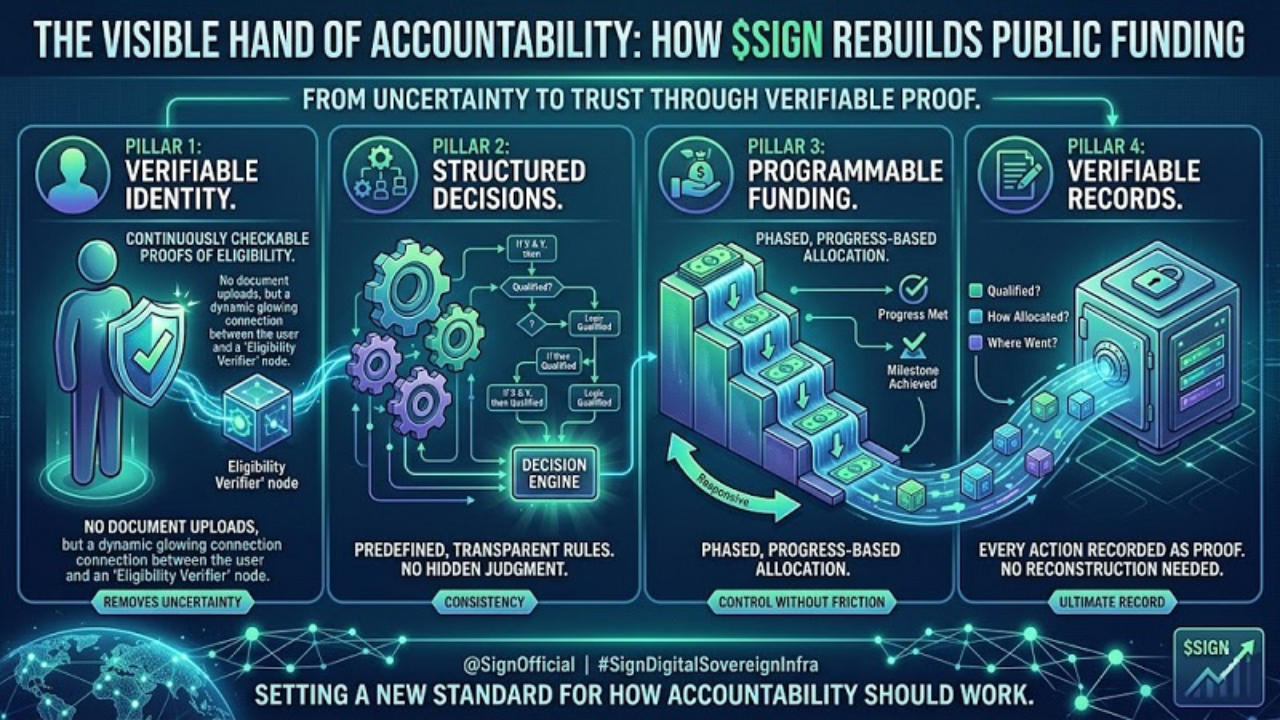
Everything begins with identity, but not the usual kind.
Instead of static uploads, users create verifiable proofs that confirm eligibility in a way that can be checked anytime.
Not once.
Continuously.
That alone removes a huge layer of uncertainty.
Then comes decision-making, which is often the most unpredictable part.
With #SignDigitalSovereignInfra , rules aren’t loosely defined or left to interpretation.
They are structured in advance, clearly and transparently.
Who qualifies is known.
What they receive is predetermined.
The conditions are visible from the start.
There’s no reliance on hidden judgment calls.
The process becomes consistent.
Funding itself also evolves.
Rather than sending money in a single, irreversible transfer, it can move in phases.
Tied to progress.
Linked to conditions.
Responsive if something doesn’t go as planned.
It creates control without adding friction.
And behind all of this, something critical is happening.
Every action is recorded as proof.
Not scattered logs or internal notes, but verifiable records that explain every outcome.
Why someone qualified.
How funds were allocated.
Where they went next.
So when someone asks questions later, the answers already exist.
No reconstruction needed.
In a time where transparency is becoming a global expectation, systems like this are no longer just innovative.
They’re necessary.
Sign isn’t just making funding clearer.
It’s setting a new standard for how accountability should work.
$SIGN is quietly building in a space that affects millions, yet rarely gets attention.