
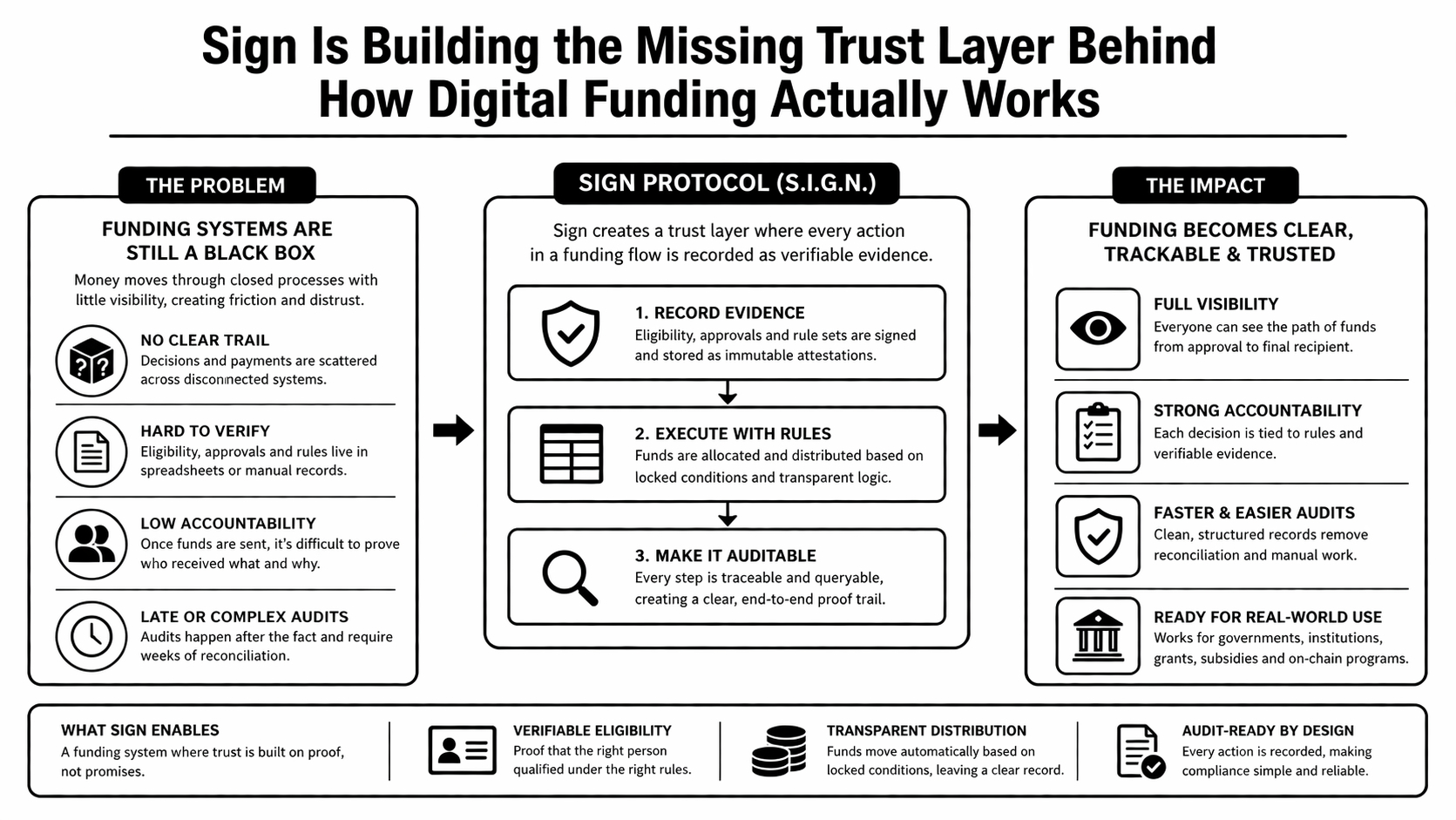


What keeps pulling me back to Sign is that it seems to be working on a real problem, and in this market that already puts it ahead of half the field.
I’ve seen too many projects wrap themselves in big language, sell a clean narrative, raise on vibes, and then disappear into the same recycling loop. New branding. Same noise. Same pitch dressed up with a different ticker. Sign does not hit me that way. At least not yet.
Most crypto teams say they want to fix finance. Fine. Everybody says that. Very few want to touch the part where the actual mess lives. The approvals. The tracking. The records. The part where money moves through layers of friction and nobody can fully explain what happened once it is gone. That is where things usually start to rot.
That is what makes Sign interesting to me.
It is not really selling speed in the way most projects do. It is going after proof. Proof of who qualified. Proof of what got approved. Proof of where funds went. Proof that the process followed actual rules instead of turning into another closed loop nobody can audit without burning through weeks of paperwork and trust.
And honestly, that matters more than most people want to admit.
A lot of funding systems already feel like black holes. Public money goes in. Decisions get made somewhere in the middle. Funds come out the other side. Maybe. People see the announcement. They see the distribution. They do not see the full trail. They do not see the logic clearly. They do not see the evidence. Just fragments. Screenshots. Reports. Delayed explanations. It is the same old grind, only now everybody pretends digitization fixed it.
It did not.
That is where I think Sign has a real angle. The project seems built around the idea that every meaningful step in a funding flow should leave a record that is actually usable later. Not decorative transparency. Not some dashboard theater. Real evidence. If someone qualifies, that should be there. If a payment gets approved under a specific set of conditions, that should be there too. If funds get distributed, there should be a clean trail behind it instead of another foggy sequence of “trust the process.”
I like that because it feels grounded. Heavy, maybe. But grounded.
The crypto market is full of projects trying to sound bigger than they are. Sign feels like it is trying to be more precise than loud. I respect that. Maybe because I’m tired of the opposite. Tired of watching teams build a whole identity around future potential while the actual product sits in a half-finished state held together by narrative management.
Sign, at least from the way I read it, is not aiming at shallow attention. It is trying to make funding flows more legible. More structured. More accountable. That is not sexy. It is not the kind of thing that gets the timeline screaming for a week straight. But it is the kind of thing that matters if the system underneath actually needs to work.
And that is the part I keep circling back to.
Because once money starts moving at scale, nobody really cares about slogans anymore. They care about whether the right people got paid, whether the process can be checked, whether the records hold up when someone finally starts asking hard questions. Most systems fail there. Not at the pitch deck stage. Later. In the operational grind. In the ugly middle. Sign looks like it was built with that ugliness in mind.
But here’s the thing.
I’m not giving it a free pass just because the thesis sounds more mature than the usual altcoin debris. I’ve seen enough “serious infrastructure” projects go nowhere to know that clean ideas do not mean clean adoption. Not even close. The gap between a strong concept and actual usage is where most of these things die. Quietly, too. No drama. Just slow irrelevance.
That is the real test.
If Sign wants to matter, it has to become something people rely on when there is actual weight behind the money. Real distributions. Real accountability. Real pressure. Not just another project with a smart framework and a loyal group of holders reading depth into architecture slides. I’m looking for the moment this actually breaks into something larger than promise.
Still, I can’t ignore the fact that the need is real. Governments, institutions, digital funding systems, all of them run into the same wall eventually. Lack of clarity. Weak records. Fragmented approval flows. Too much room for confusion. Too much room for convenient forgetting. If Sign can reduce that mess, even a little, then it has a reason to exist beyond the usual speculative cycle.
That alone gives it more weight than most.
I also think the timing makes sense, even if the market is too drained to care properly right now. Everything is getting more digital. Money. Identity. Access. Distribution. Fine. But once all of that gets digitized, the old trust-based mess does not magically disappear. It just gets pushed into new interfaces. Same opacity. Better design. That is not progress. That is just cleaner packaging. Sign seems to understand that the real value is not just making money move. It is making the path of that money visible enough that people can check it without guessing.
That is a much harder problem. Which is probably why I take it more seriously.
I’m not calling it a winner. I’m way past that stage with most projects. I don’t really get impressed easily anymore. What I do notice is when something feels necessary instead of decorative. Sign feels closer to necessary than decorative.
And in this market, with this much recycling and this much dead language floating around, that is enough to make me stop and look twice.
Now I’m just waiting to see whether it stays a good idea on paper, or becomes something people actually cannot ignore.