
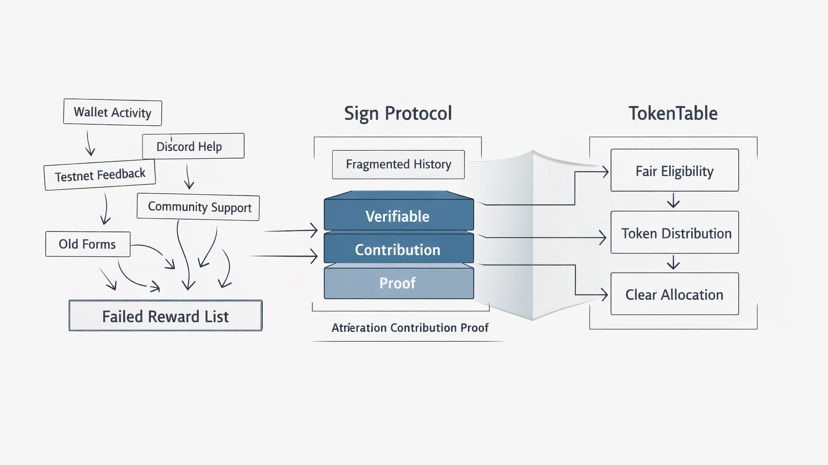
One night I was talking to a friend who had spent months helping a Web3 community grow. He was not the loudest account and he was not farming attention every day but he was always there. He joined testnets early. He wrote useful feedback. He helped new users in chats. He stayed active when most people disappeared. Then the reward list came out and his name was missing. He sent me screenshots of his wallet activity his old messages and his contribution history and asked a simple question that stayed in my mind. If the work was real then why was proving it still so broken.
That question feels small at first but it points to a much bigger problem. In crypto we talk a lot about fairness but fairness becomes weak when proof is scattered everywhere. One part of your story lives on one chain. Another part sits in a Discord thread. Another part is hidden in an old form or spreadsheet. When teams try to verify users they often end up depending on messy manual checks random screenshots or partial wallet history. That is exactly where strong contributors lose trust in the system. The issue is not only who deserves rewards. The deeper issue is that digital reputation still has no clean portable structure.
This is why SIGN started looking important to me from a completely different angle. According to SIGN’s official docs Sign Protocol is an omni chain attestation protocol built around schemas and attestations so structured claims can be defined once and then written stored and queried across different environments. It supports multiple storage models including fully on chain fully Arweave and hybrid approaches which matters because not every proof should live in the same place. The whole point is to stop verification from becoming a fresh manual task every single time.
What makes that powerful is the idea of reusable trust. A schema gives structure to what a claim means and an attestation becomes the signed verifiable record linked to that structure. SIGN’s FAQ explains that the goal is to make verification reusable across applications by standardizing how claims are structured signed stored queried and referenced. In simple words this means a contribution proof a role proof an eligibility result or a work credential does not have to be rebuilt from zero for every new project. That changes the whole feeling of participation because the burden moves away from the user constantly defending their own history.
Then I started thinking about TokenTable in a more practical way. SIGN’s documentation describes TokenTable as a product for allocation and distribution workflows where eligibility rules controlled distribution and reporting need to work as an auditable system. That matters because reward chaos in Web3 usually starts before tokens are even sent. Teams struggle to define who qualifies who should be excluded and how to prove that without opening the door to manipulation. When attestations and distribution logic work together the process becomes much more credible. Instead of screenshot battles and last minute spreadsheet drama there can be a system where eligibility is based on verifiable evidence and distribution follows clear logic.
The reason this topic feels personal to me is simple. Too many real contributors are still treated like they have to beg for recognition in systems they already helped build. They are asked to repeat old proof dig through wallets search chat logs and explain the same history again just to show they were actually there. That should not be the future of digital communities. A better future is one where meaningful work becomes attestable and portable from the start.
So when I look at $SIGN now I do not just see another infrastructure project. I see a way to fix one of the most frustrating social problems in crypto. Not market noise. Not branding. Trust. The kind of trust that lets a real contributor carry proof of real work without starting from zero every time. And honestly that feels like one of the most useful shifts Web3 can make right now. #SignDigitalSovereignInfra