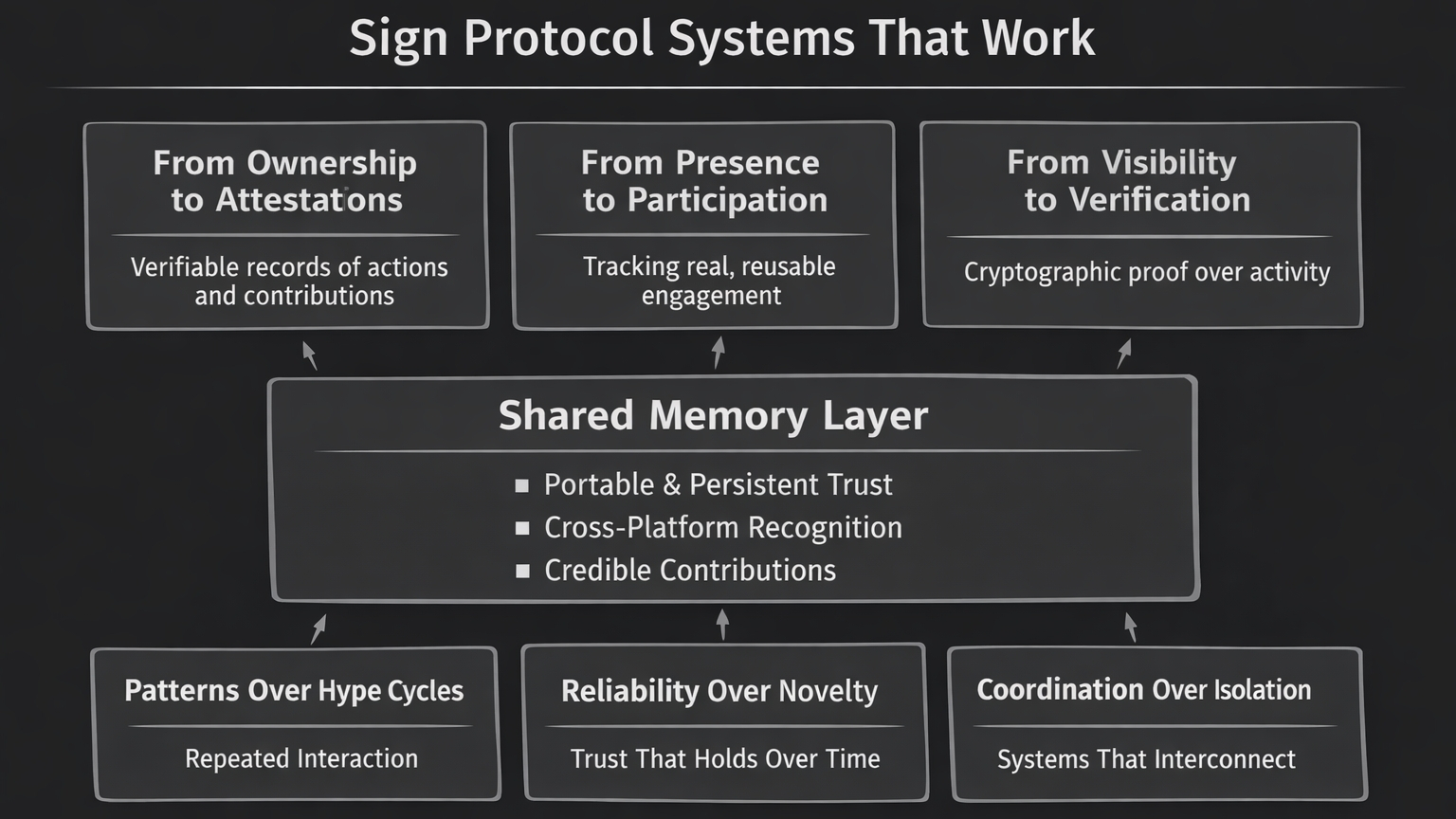
I used to believe that adoption in crypto was mostly a matter of time. If the architecture was strong, if incentives were aligned, if the theory made sense, users would eventually come. It felt logical in a clean, almost academic way. Build something correct and the market would recognize it. But the longer I stayed in the space, the more that belief started to feel incomplete. Not wrong, just disconnected from how things actually unfold in practice. What began to stand out wasn’t failure. It was repetition. The same pattern playing out across different projects, different narratives, different cycles. Protocols would launch with detailed architectures, clear documentation, and measurable activity. There would be transactions, wallets, usage metrics. On the surface, everything looked alive. But when you stepped back and watched over time, something felt missing. Users didn’t stay. Behavior didn’t compound. Nothing really carried forward. At first, I thought this was a distribution problem. Maybe the right audience hadn’t discovered these systems yet. Maybe better marketing or timing would fix it. But that explanation started to feel too convenient. Because even when attention came, even when usage spiked, it didn’t translate into continuity. People showed up, interacted, and then disappeared. And the system didn’t seem to notice that loss in any meaningful way. That’s when it started to feel structural. Like these systems weren’t failing to attract users, they were failing to retain meaning. They were designed to exist, but not to be lived in. When I looked closer, the inconsistencies became clearer. Governance frameworks were present, but participation was shallow and often symbolic. Identity solutions existed, but they didn’t persist beyond isolated interactions. Coordination tools were built, but they lacked any form of memory. Nothing was obviously broken, but very little was building on itself. And that’s a subtle kind of failure. Not visible in charts, but obvious in behavior. The space kept talking about decentralization, ownership, coordination, but those ideas rarely translated into repeated engagement. Most interactions were one-time events. Most signals were visible, but very few were verifiable. And over time, this created a distortion in how we interpreted progress. We started confusing activity with trust and visibility with adoption. That shift in perspective changed how I evaluated systems. I stopped asking whether something works and started asking whether it holds. Whether it can maintain continuity across interactions. Whether it can preserve something meaningful over time. Because a spike in transactions might show attention, and a surge in wallets might suggest distribution, but neither tells you who comes back, what persists, or what the system actually remembers. And increasingly, it became clear that most systems don’t remember anything meaningful at all. That realization is what made Sign Protocol stand out to me, not because it was loud, but because it wasn’t. It didn’t try to dominate attention or position itself as the next big narrative. If anything, it felt quiet in a way that almost made it easy to overlook. But the more I looked at it, the more that quietness felt intentional. Because Sign isn’t trying to solve how systems attract users. It’s asking something more fundamental. How do systems recognize, verify, and reuse meaningful participation over time? Most governance systems today are built around ownership. You hold tokens, you vote occasionally, and influence follows capital. In theory, that creates alignment between participants and outcomes. But in practice, it often creates distance. Because ownership doesn’t explain behavior, and governance without behavior becomes symbolic rather than functional. Sign Protocol approaches this from a different starting point. It doesn’t begin with voting or tokens. It begins with attestations. These attestations are not just simple records. They are verifiable proofs of actions, roles, or claims that are cryptographically signed, stored, and made reusable across systems. And this changes something fundamental about how participation is measured. Instead of asking who holds what, the system begins to track who did what, and whether that action can be verified. An attestation can represent a contribution, a credential, a responsibility, or involvement in a process. But what matters is not just the creation of that record. It’s what happens after. That action becomes something that can be verified, something that can be reused, something that persists beyond the moment it was created. This is where the structure starts to feel different from most systems. In typical environments, trust has to be rebuilt every time. Each application creates its own version of identity, reputation, and credibility. There’s no continuity between them. Sign changes that by turning verification into a shared layer. Something that different systems can read, validate, and build on without recreating trust from scratch. The easiest way to understand this is to think about how most systems behave today. They are effectively stateless in practice. You interact, but your actions don’t carry forward in any meaningful way. Sign introduces something closer to a shared memory layer, where participation accumulates, contributions persist, and trust becomes something you can inspect instead of something you assume. And that shift is deeper than it looks. Most systems measure presence. Some measure capital. Very few measure credible participation. And even fewer make that participation reusable across different contexts. That’s why Sign Protocol doesn’t feel like just another governance tool. It feels more like infrastructure. A layer that enables systems to recognize and reuse trust itself. When you zoom out, this connects to a bigger gap in crypto. We’ve removed the need for centralized trust, but we haven’t fully replaced how trust actually functions in real systems. Because trust isn’t just about rules or code. It’s about patterns. Repeated interaction, visible contribution, consistent behavior over time. Without those patterns, systems may function technically, but they don’t feel meaningful. And users don’t stay in systems that feel empty, even if they technically work. This becomes even more important in emerging markets, where adoption isn’t driven by novelty. It’s driven by reliability. If identity is fragmented, if contributions aren’t remembered, if trust isn’t portable, users don’t build on top of the system. They pass through it without forming any long-term relationship with it. At the same time, the market continues to optimize for attention. Price movements, volume spikes, distribution metrics. These are easy to measure and easy to promote. But they don’t tell you whether a system is becoming part of someone’s routine. They don’t tell you whether behavior is compounding. That’s where the real gap exists. Between what looks active and what actually works. Of course, none of this guarantees that Sign Protocol will succeed. Systems built around verification and identity face real challenges. Attestations depend on credible issuers. Adoption depends on integration. Identity introduces tradeoffs around privacy, control, and user experience. And most users still prioritize convenience over structured participation. There’s also a coordination challenge that can’t be ignored. A shared memory layer only becomes powerful if multiple systems choose to recognize and use it. Portability only matters when it’s actually adopted across environments. But even with those challenges, the direction feels clear. We are moving toward systems where actions matter more than claims. Where participation carries forward instead of resetting. Where trust is not just assumed or displayed, but structured, verified, and reused across contexts. And this shift doesn’t happen loudly. It doesn’t show up in sudden hype cycles or immediate attention. It builds quietly, in the background, changing how systems behave over time rather than how they appear in the moment. Personally, I’ve started paying attention to different signals because of this. Not announcements, but applications that require verified identity. Not spikes in activity, but patterns of repeated interaction. Not theoretical decentralization, but systems where actions are recorded, referenced, and built upon over time. Not ownership, but verifiable contribution. That’s where Sign Protocol starts to make sense. Not as a product competing for attention, but as a structural layer that changes how systems hold meaning. And in the end, my perspective has become simpler. I no longer assume that the most visible narratives define the space. Trends like DeFi or AI may shape direction, but beneath them, something more foundational is forming. Systems that don’t just execute, but remember. Systems that verify before they coordinate. Sign Protocol may or may not become the defining example of that shift. But it highlights something important that’s easy to overlook. Adoption doesn’t come from what a system allows. It comes from what a system recognizes, preserves, and makes usable over time. And the systems that truly do that rarely need to be loud about it.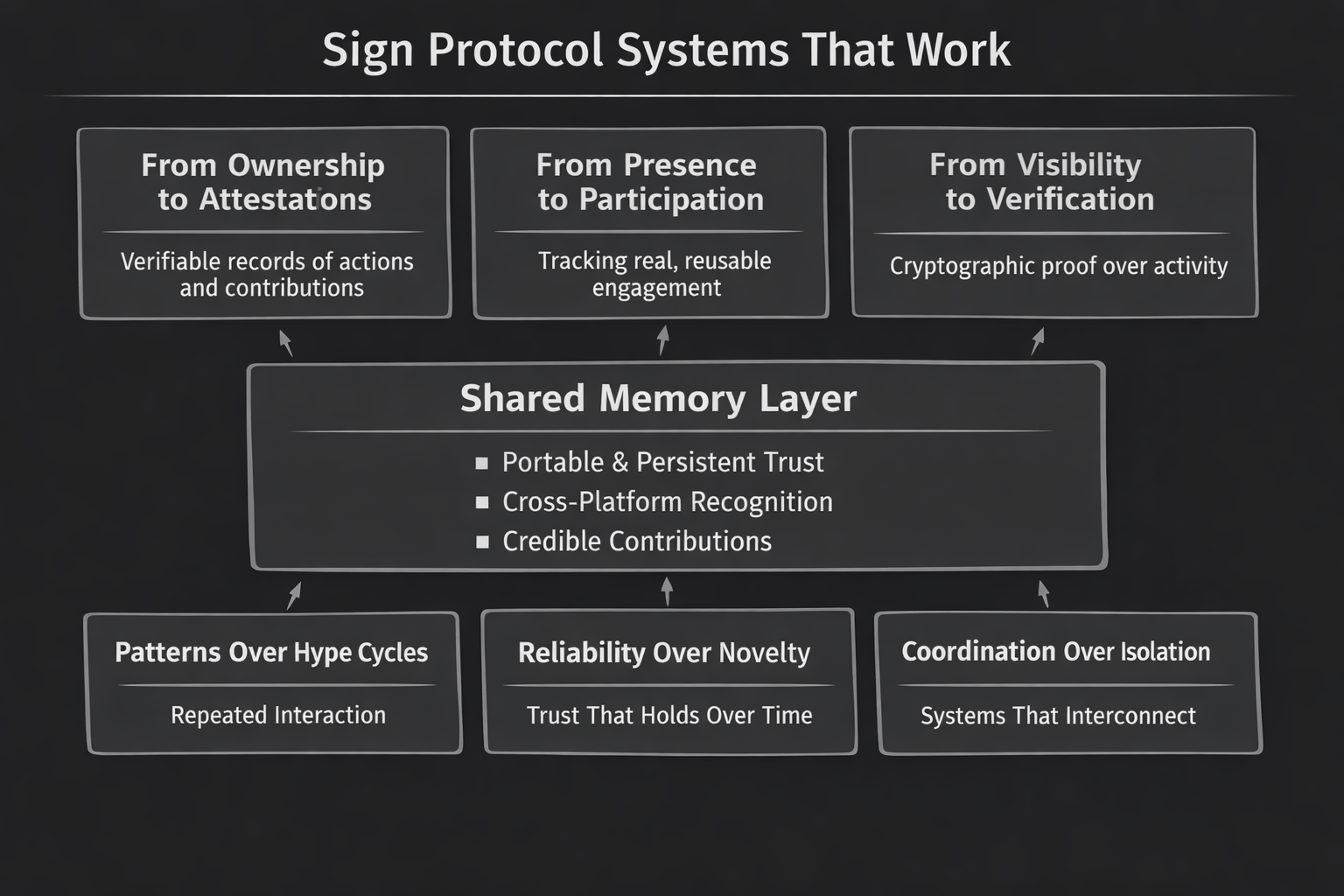

Articol
Where Trust Becomes Memory: Why Sign Protocol Quietly Changes How Systems Actually Work

--
Declinarea răspunderii: Include opinii ale terților. Acesta nu este un sfat financiar. Poate include conținut sponsorizat. Consultați Termenii și condițiile