
For a long time, I thought scaling systems was about handling more.
More users.
More data.
More interactions.
If a system could process all of that efficiently, it could scale.
That felt complete.
But the more systems grow, the more another limitation starts to appear.
They don’t struggle with volume.
They struggle with repetition at scale.
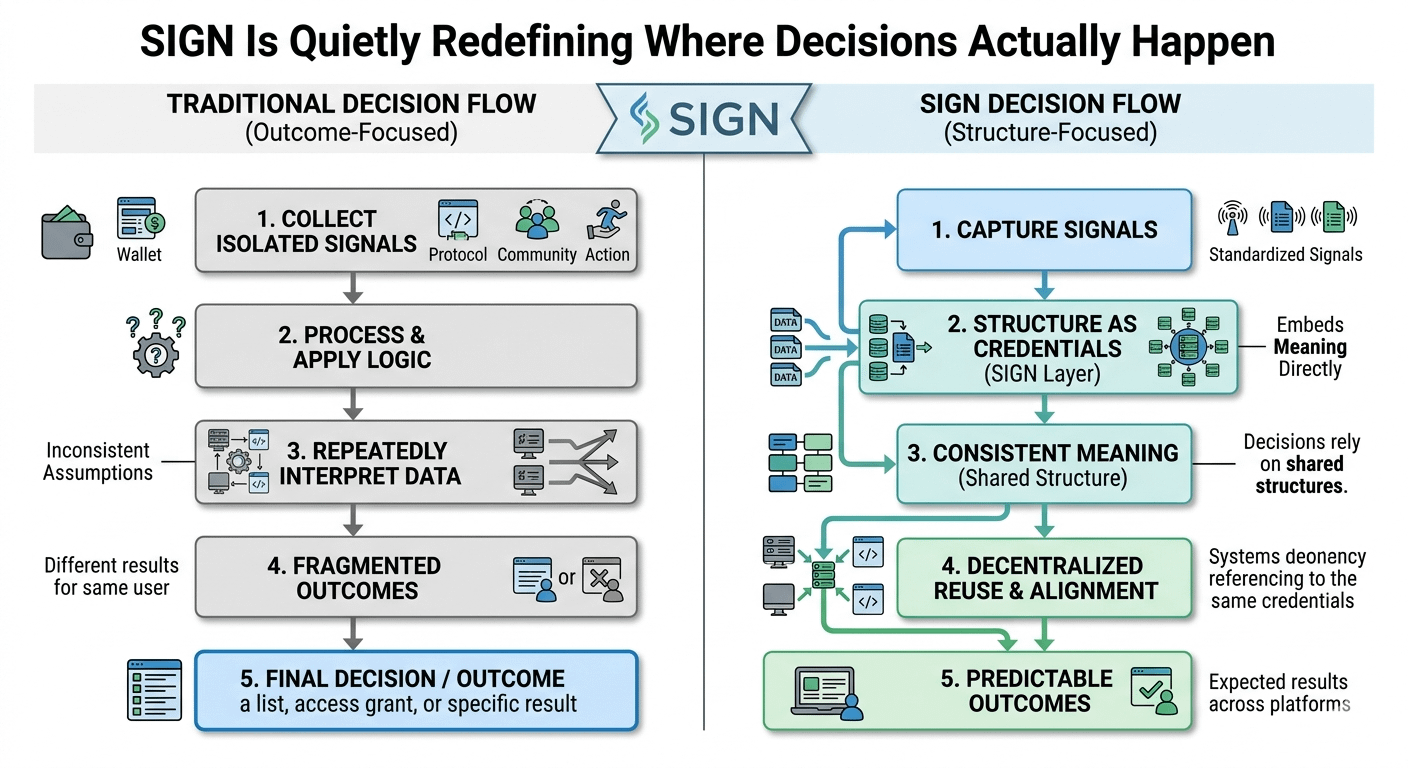
The same action gets evaluated multiple times.
The same condition gets checked in different places.
The same conclusion gets rebuilt again and again.
Nothing new is happening.
But the system keeps treating it like it is.
That’s where real inefficiency begins.
Not in processing new information—
but in reprocessing what was already understood.
A user performs an action once.
They participate.
They contribute.
They qualify under certain rules.
That moment produces a decision.
This counts.
That should be the end of it.
But it isn’t.
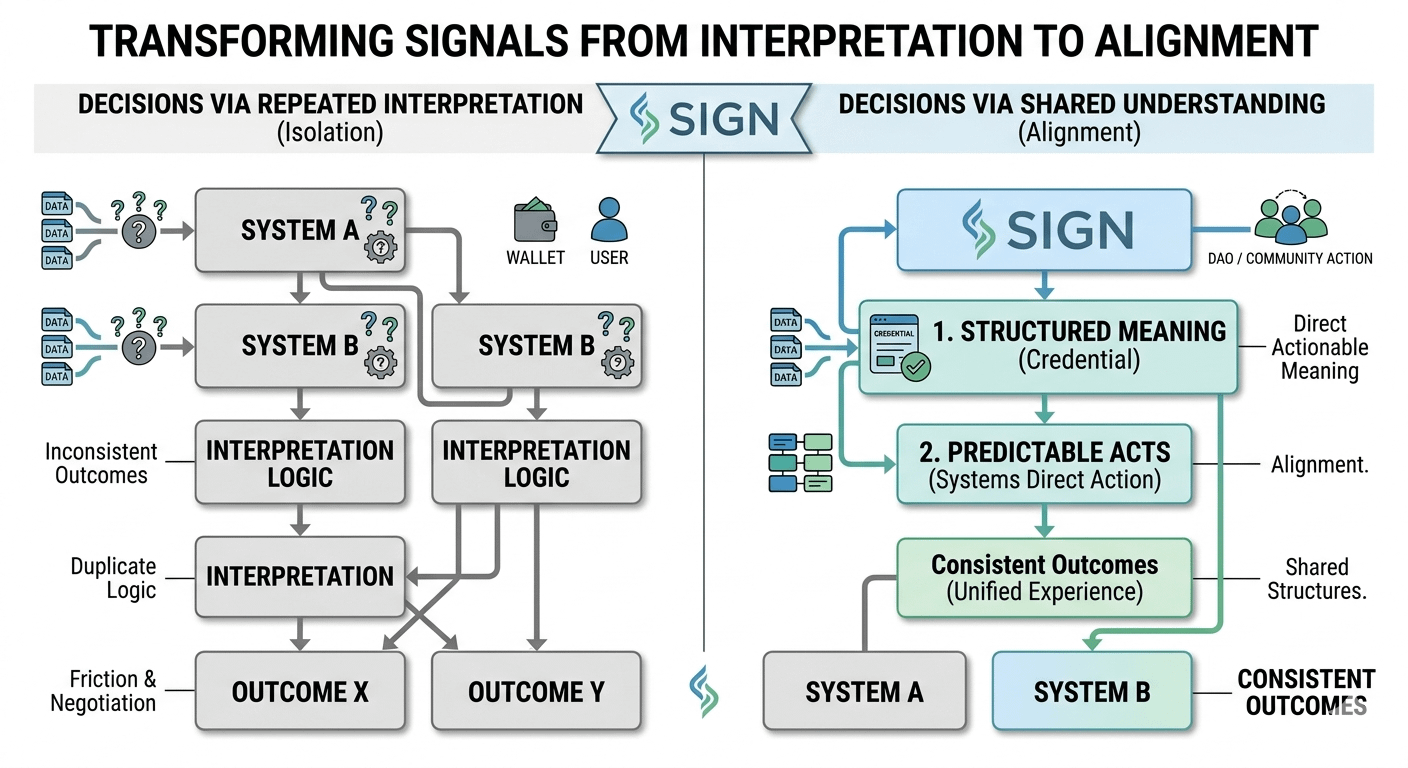
As soon as that signal moves into another system, the process restarts.
Does this qualify here?
Should this matter in this context?
The answer might not change.
But the system doesn’t know that yet.
So it evaluates again.
This pattern repeats across systems.
And at small scale, it feels harmless.
At large scale, it becomes the hidden ceiling.
Because scaling doesn’t just multiply activity.
It multiplies repetition.
More systems means more independent evaluations.
More evaluations means more chances for variation.
More variation means weaker alignment.
Nothing breaks.
But everything becomes heavier.
SIGN feels different because it targets this exact layer.
Not the activity.
Not the data.
But the repetition of decisions around that data.
Instead of treating every system as a fresh evaluator,
it introduces a structure where decisions don’t disappear after they are made.
They persist.
This is where credentials change meaning.
They are not just proof that something happened.
They are proof that something has already been understood and evaluated.
So when another system encounters that signal,
it doesn’t face uncertainty.
It doesn’t need to start from zero.
It can continue from what is already known.
That removes one of the biggest hidden costs in scaling systems.
Re-decision.
And once that disappears, everything downstream changes.
Processes become lighter.
Outcomes become more consistent.
Systems align without constant adjustment.
Because instead of every system rebuilding the same logic independently…
they begin to rely on shared understanding.
That’s the shift.
Not faster systems.
Not bigger systems.
But systems that don’t keep repeating themselves.
Over time, something subtle happens.
The system stops behaving like a network of isolated checkpoints…
and starts behaving like a continuous flow of decisions building on each other.
That continuity is what most systems never reach.
Not because they lack capability.
But because they never solved how to carry decisions forward without recreating them.
SIGN is working exactly at that boundary.
It doesn’t eliminate decision-making.
It removes unnecessary repetition of it.
And when repetition stops scaling alongside the system…
something important happens.
Scaling stops feeling heavy.
Because the system is no longer doing the same work over and over again.
It is finally building on what it already knows.
@SignOfficial #signdigitalsovereigninfra $SIGN