


I noticed something recently while moving between a few different platforms, and it’s one of those things you don’t question at first but then it starts to feel strange. Every time you connect your wallet, the system can see your activity, but it doesn’t actually know what you’ve already proven somewhere else. It doesn’t know what you’ve been verified for, what you qualified for before, or what claims have already been established about your wallet. It just reads raw data and starts interpreting again from zero.
That’s where Sign Network starts to feel important from a more subtle angle. Not just as an attestation layer, but as a way to make proofs persist and travel. Because right now, even when something is verified, it stays trapped inside the platform that issued it. It doesn’t carry forward in a structured way. So every new system ends up repeating the same process — checking, validating, interpreting — over and over again.
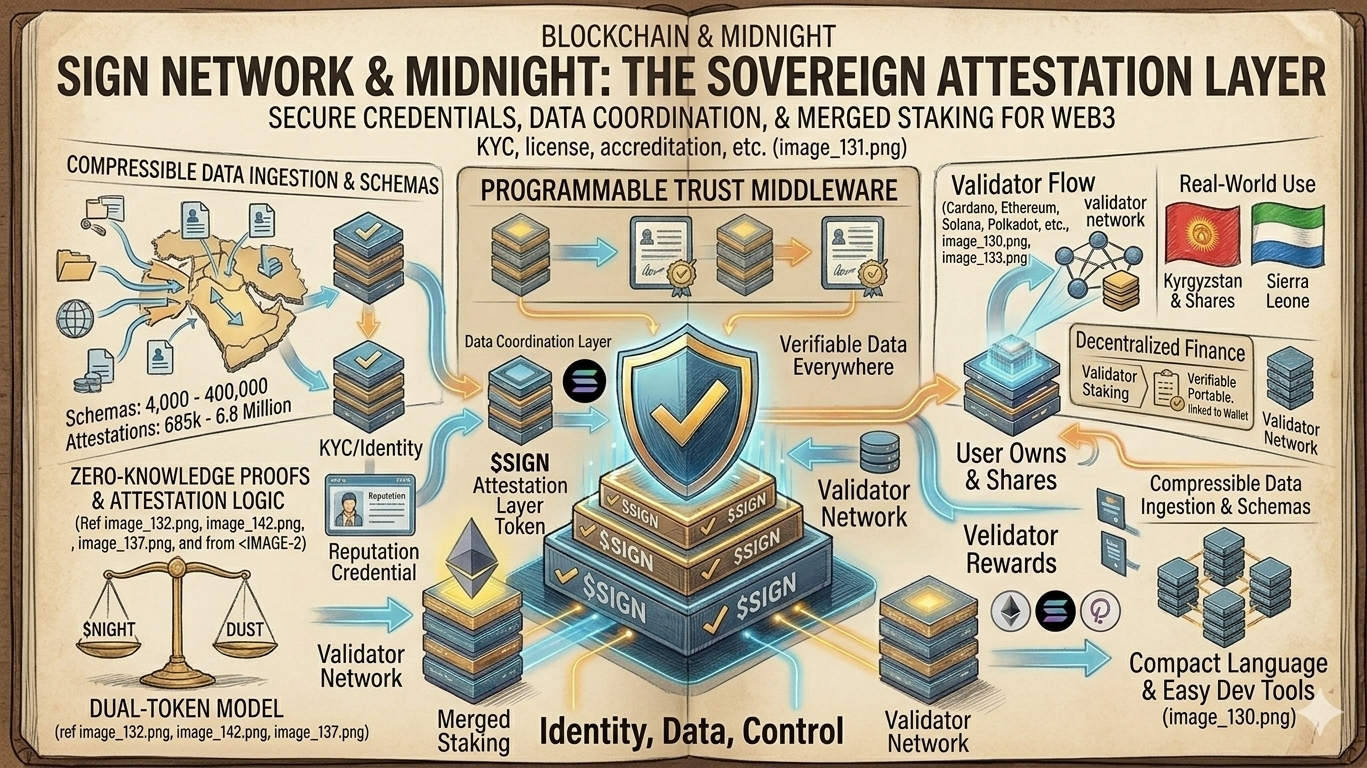
With Sign, those verifications can exist as attestations that don’t reset every time you move. A claim is defined once, issued under clear conditions, and then it becomes something reusable. So instead of proving the same thing repeatedly, you carry that proof with you. And that changes how systems interact with users, because they’re no longer starting from raw data — they’re starting from verified context.
This is where the idea of Digital Sovereign Infrastructure becomes more concrete. It’s not just about owning your data, it’s about owning the proofs attached to that data. What you’ve done, what’s been verified about you, what conditions you’ve already satisfied — all of that becomes something you can bring into new environments without losing it. That makes identity in Web3 feel less like a reset loop and more like a continuous record.
What I find interesting is that this doesn’t require changing the underlying blockchain layer at all. The data is already there. What’s missing is a consistent way to structure and reuse meaning. Sign is basically filling that gap by turning isolated verifications into something that can exist across systems. And once that happens Web3 starts to feel less fragmented because users aren’t rebuilding trust from scratch every time they move.
The more I think about it this might be one of the reasons the ecosystem still feels disconnected despite being open by design. Data is shared but proofs are not. Sign is trying to fix that by making proofs portable so what you’ve already established doesn’t disappear the moment you switch platforms. And honestly that feels like a necessary step if Web3 is supposed to become a connected system rather than a collection of isolated experiences.