
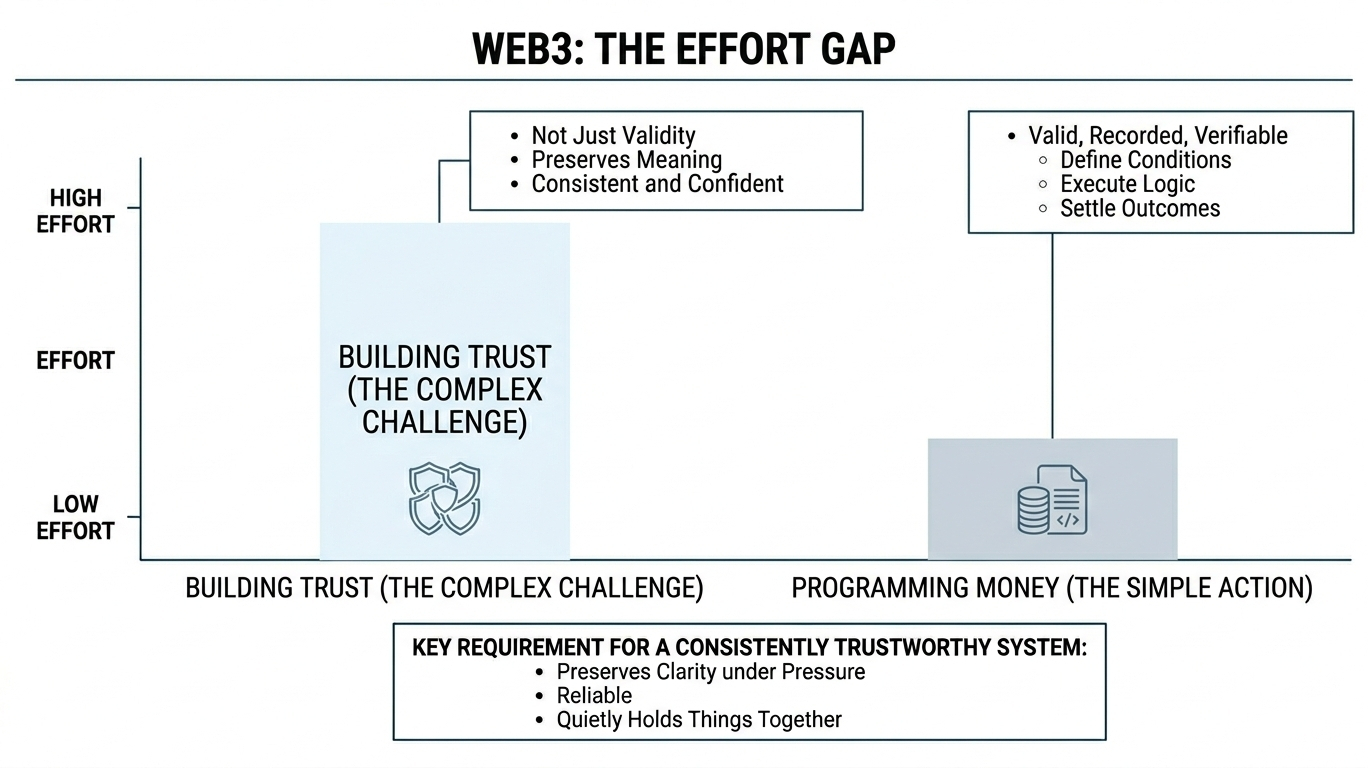
There was a moment when I tried to trace a simple on chain action back to what actually triggered it, and I remember feeling something I couldn’t ignore. The transaction itself was perfectly visible confirmed, recorded, and verifiable. Nothing was missing on the surface. But when I tried to mentally connect it back to the real intention behind it, it felt slightly distant, almost like I was looking at a result without fully seeing the path that produced it. That gap stayed in my mind longer than expected.
After seeing this kind of thing repeat across different systems, I started to understand a broader pattern in crypto infrastructure. We are very good at making money programmable. We can define conditions, execute logic, and settle outcomes with precision. But what I noticed is that trust doesn’t behave in the same structured way. Trust is not just about whether something is valid it is about whether the system consistently preserves meaning while moving through time, load, and complexity.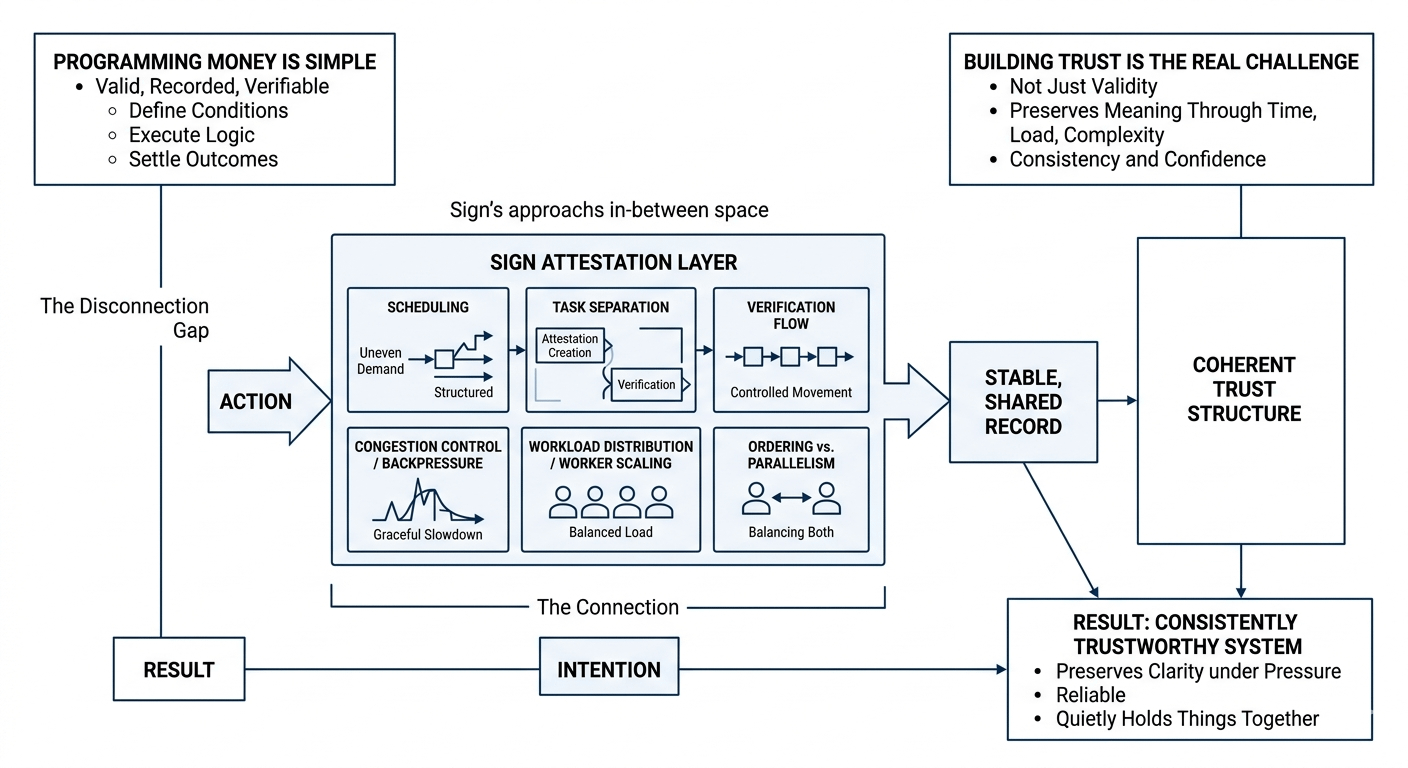
And in real usage, that’s where things become less ideal than they first appear. A system can be completely correct and still feel slightly uncertain when it is under pressure. Events can arrive out of order, or be processed at different speeds, and nothing technically “breaks,” but the overall feeling of coherence becomes weaker. Over time, those small inconsistencies shape how much confidence you naturally place in the system, even if every individual piece is functioning properly.
I often think of it like a courier network in a large city. Every parcel is scanned at each checkpoint, and every scan is accurate. But the real trust in the system doesn’t come from the scan itself it comes from how smoothly parcels move through the entire chain when traffic is heavy, routes overlap, and timing becomes unpredictable. If coordination weakens even slightly, the system still works, but it stops feeling fully dependable.
When I look at how Sign approaches this, what caught my attention is that it seems to focus on exactly this in between space the layer between an action happening and that action becoming a stable, shared record. The design feels like it treats trust not as something assumed from verification, but as something that needs its own structure to stay consistent under real conditions. From a system perspective, that already sets a different direction of thinking.
What interests me more is how that idea reflects in the internal mechanics. Scheduling is not just about ordering tasks, but about controlling how attestations enter the system when demand is uneven. Task separation reduces hidden dependencies between creation and verification, which is often where subtle delays or inconsistencies start to appear. Verification flow becomes more controlled, helping ensure that results don’t just appear correct, but remain consistent across different states of the system.
Then there is congestion control, which in practice is one of the most important parts of any real network. Systems rarely fail when they are calm they strain when activity spikes. Backpressure, in that sense, is not just a technical detail; it is what allows a system to slow down gracefully instead of collapsing into instability.
Workload distribution and worker scaling also matter in ways that are not always visible at first glance. It is not just about increasing capacity, but about how evenly pressure is shared across the system. Uneven distribution creates invisible stress points, and those stress points are usually what show up later as delays or inconsistencies.
And then there is ordering versus parallelism. Real world events don’t arrive neatly, but systems still need to produce a structured outcome. Too much ordering slows everything down. Too much parallel execution can make results harder to interpret consistently. In my experience watching networks, the most reliable systems are the ones that balance both without exposing that complexity to the user at all.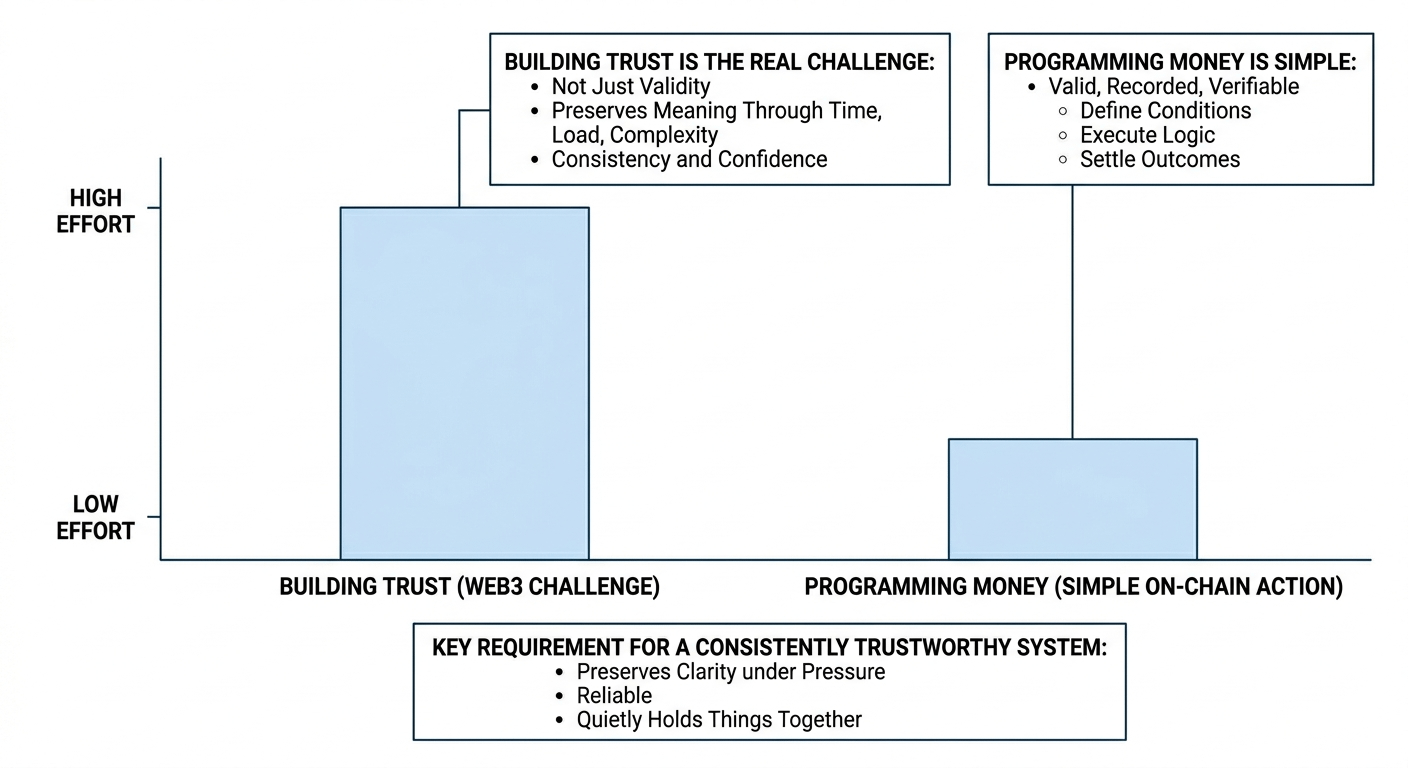
The more I think about it, the more I feel that the real challenge in Web3 is not just making things verifiable it is making them feel consistently trustworthy as they move through complex, busy systems. That requires more than execution logic. It requires a dedicated structure for trust itself.
A reliable system is not the one that simply produces correct outputs. It is the one that preserves clarity, consistency, and confidence even when everything around it is under pressure. Good infrastructure doesn’t need attention. It quietly holds things together in the background, even when conditions are far from simple.