
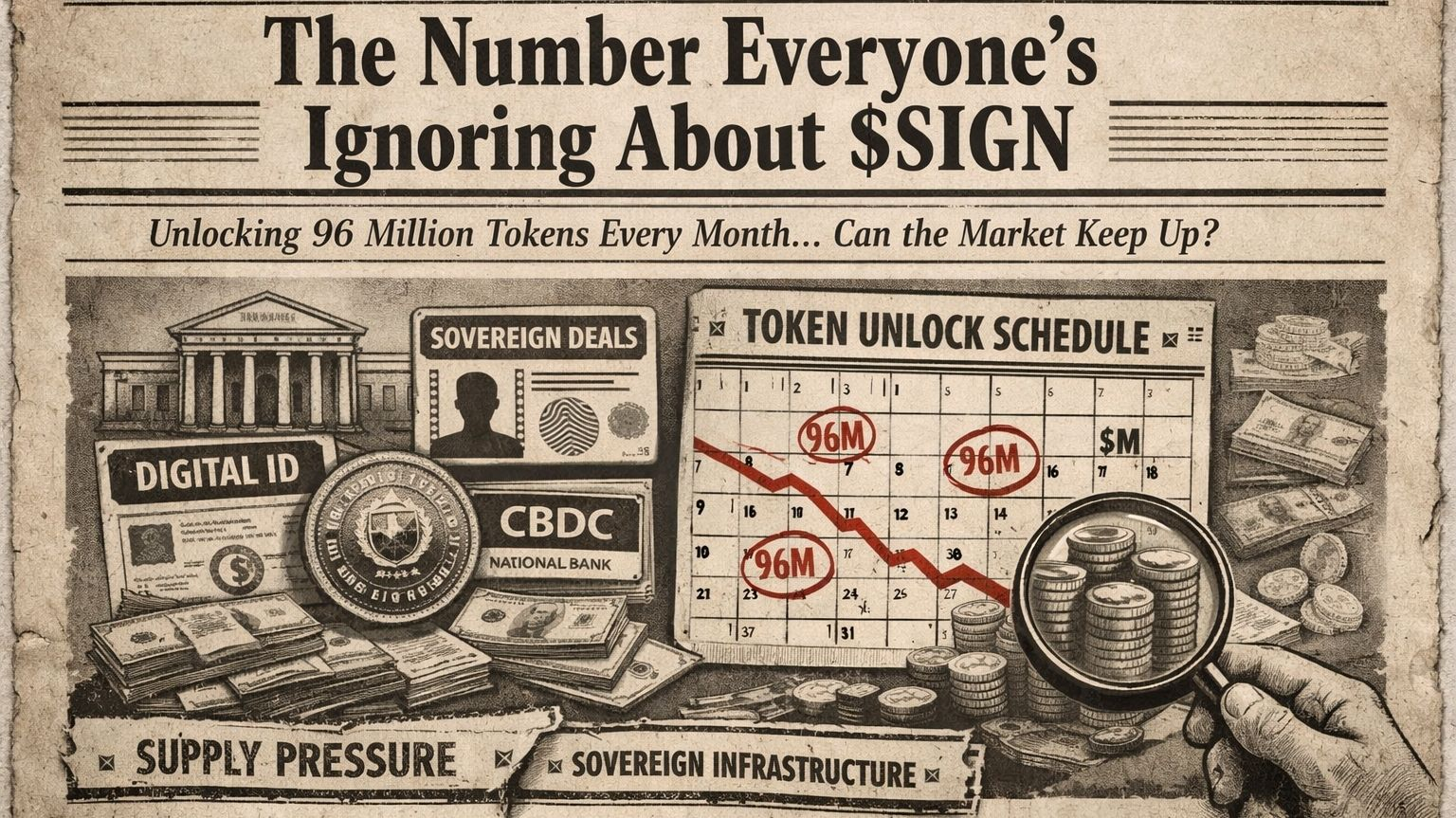

I'll be honest about where my head was a few weeks ago. I was watching the sovereign government headlines stack up Kyrgyzstan, Sierra Leone, $25.5 million from YZi Labs and IDG Capital and I was starting to get comfortable. Too comfortable. The kind of comfortable where you stop reading the tokenomics page carefully and start reading the partnership announcements instead.
Then I actually looked at the unlock schedule.
Sign has been releasing roughly 96.67 million tokens every single month since the TGE. That's not a rumor or an estimate. It's on-chain, scheduled, repeating. And when you zoom out and do the math, the picture gets more interesting than the press releases suggest. The current circulating supply sits at around 1.64 billion tokens out of a maximum of 10 billion. That means more than 83% of the total supply hasn't entered the market yet. Most of it is still waiting.
Now here's where I had to sit with this for a minute, because the first instinct is to treat that number as a death sentence for the price. But that's actually too simple. The real question isn't whether unlocks create supply pressure they do, that's just math the real question is whether what's being built underneath the price can absorb that pressure over time.
Sign's stated mission for 2026 is to reach more of the roughly 200 nations in the world with deployable blockchain infrastructure, having already signed deals with Kyrgyzstan's national bank for a CBDC and with Sierra Leone's government for a national digital ID and stablecoin payment system. Those aren't sandbox experiments. They're live agreements with ministries and central banks. That kind of institutional legitimacy takes years for most projects to even approach.
And yet. SIGN hit an all-time high of $0.1282 back in September 2025 and is currently sitting about 75% below that level. You can tell a story about macro conditions and altcoin cycles, and that story isn't wrong. But you can't fully separate the price action from the unlock rhythm either. When 290 million tokens unlocked in January 2026, valued at over $11 million, it hit during a period of already fragile market sentiment. The supply showed up. The demand didn't match it in real time. That's how you bleed.
What I keep coming back to is the buyback. The Sign foundation bought back 176 million tokens valued at $800 million in August 2025, retaining them for ecosystem partnerships rather than burning them. A lot of people read that as bullish because it signals conviction. And it might be. But "ecosystem partnerships" is a phrase that can mean almost anything, and if those tokens eventually re-enter circulation under a different label, the supply story gets complicated again. I'm not saying that's what's happening. I'm saying the ambiguity is worth paying attention to.
The S.I.G.N. architecture Sovereign Infrastructure for Global Nations is positioned as a full blockchain stack for governments covering new money systems, new identity systems, and new capital distribution systems. That's a genuinely ambitious scope. Not "we have a whitepaper about this scope" ambitious they have signed agreements, technical service contracts, and a second strategic funding round in the same year. The October 2025 round brought total funding to $55 million across two YZi Labs-led rounds. Repeat conviction from the same lead investor is a meaningful signal.
But here's the tension I can't shake. The fundamentals are real. The execution is real. The unlock schedule is also real, and it doesn't care about either of those things. Every month, roughly another 96 million tokens become tradable. The people receiving those tokens early backers, team allocations, ecosystem reserves have different time horizons and different cost bases than someone buying in the open market today. Some of them will hold. Some won't.
The bet on $SIGN at this point isn't really a bet on whether the technology works. I think it probably does, or at least does enough to matter. The real bet is on whether sovereign adoption compounds fast enough and visibly enough to give the market a reason to absorb supply rather than front-run it. Governments move slowly. Token unlocks don't.
I'm still watching. But I'm watching the unlock calendar just as closely as the partnership announcements now.