
The row is already there.
Wallet set. Amount set. Proof attached. Payout window close.
Then ops catches something ugly. The proof behind this row should not still be live.
Maybe the case changed after the row was prepared. Maybe the attestation was used too early. Maybe the wallet matched the rule when the table was built and no longer should. Whatever the reason, the clean part is over now. The only thing that matters is that this row is still alive, release is getting close, and the person who originally issued the proof is not around to kill it.
That is the moment I keep testing SIGN against.
Because this is where weak systems start acting busy instead of staying hard. A message lands in chat. Hold this wallet. Do not release yet. Someone from support says there is a problem. Someone from ops says wait. For a few minutes it feels like control. It is not. The row still looks payable. The proof is still sitting there. The stop exists in people, not in the record.
And if the stop only exists in people, payout can outrun it.
So now the case is brutally simple. This one row has to stop before value moves. Not later. Not after the payout run. Right now. And the stop cannot depend on the original issuer suddenly showing up to rescue the workflow.
That is why this exact interruption is more interesting to me than any broad explanation about proof systems.
The row needs a real freeze before movement. The proof behind it needs to die through a path that still carries authority. And the reason for that death needs to stay attached, because a dead row with no reason is just another support mess waiting to come back.
That is the part in SIGN that feels real.
The proof does not have to stay half-alive just because one specific actor is missing. Delegated revocation means the stop can still happen through authorized action, with the reason recorded on the way in. That changes the whole texture of the moment. It stops being a team trying to remember what they decided in chat. It becomes a row whose state actually changed before payout moved.
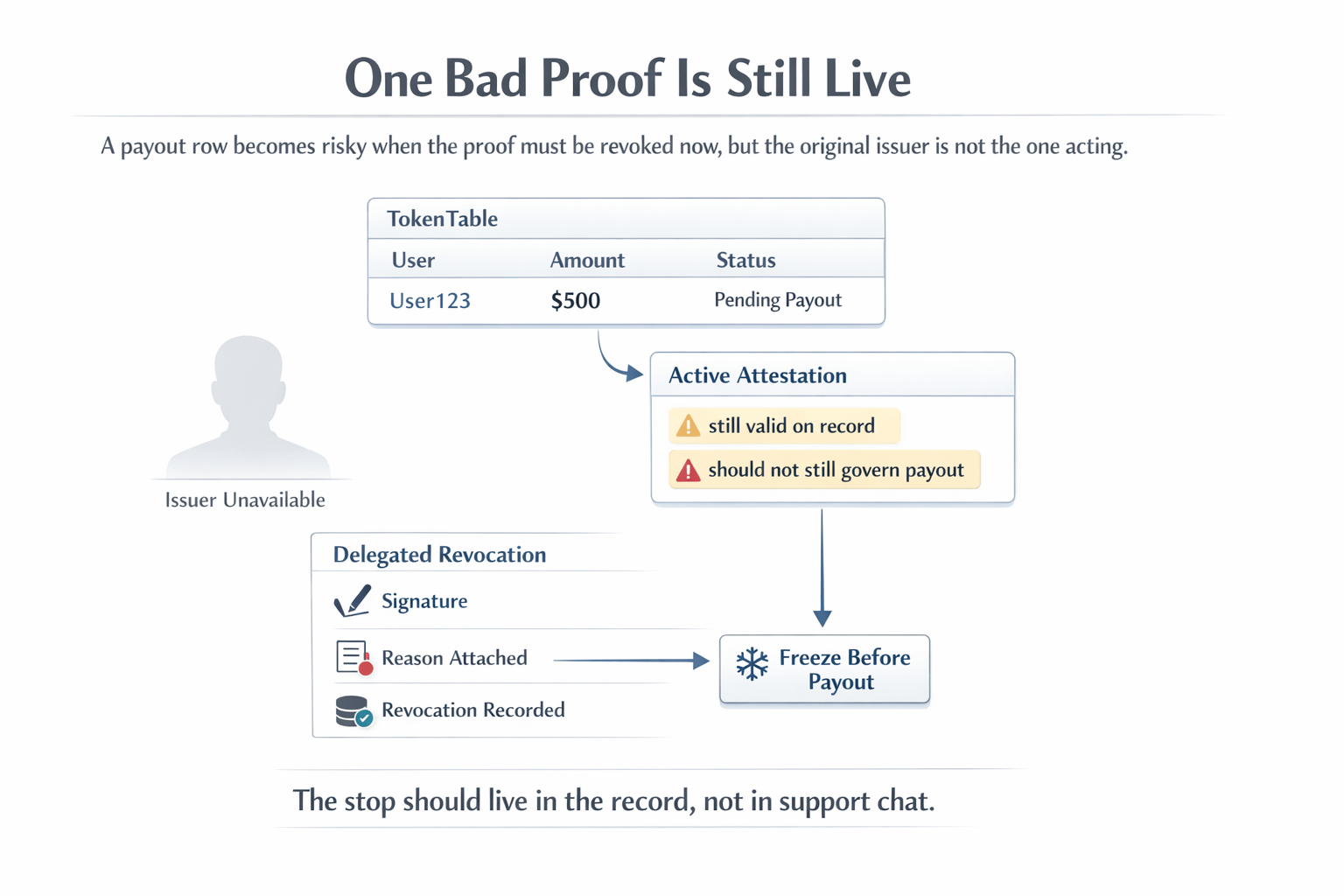
And once the row is sitting in TokenTable, that pressure gets even uglier.
Because now there is no place to hide behind nice wording. Either the row froze before release or it did not. Either the proof was killed through delegated authority with the reason attached or the team improvised around the system and hoped nobody would need to untangle it later.
That later part is the piece people keep underestimating.
The payout does not disappear when the row is held. It comes back as a case. Finance reopens it. Support reopens it. Maybe the wallet owner asks why this row did not clear while similar ones did. Maybe audit wants to know whether value was stopped because the record changed in-system or because somebody got nervous off-record and stalled the release manually.
Those are not the same outcome.
If finance cannot prove that the stop came from actual delegated authority before the payout window closed, then the whole thing starts smelling wrong. Not because the row was frozen. Because nobody can show whether it froze as part of the system or as part of a human scramble outside it. At that point the proof layer looks less like control and more like decoration around emergency behavior.
That is why I do not read this as some small ops edge case.
One bad proof close to release tells you much more than a hundred clean rows ever will. Clean rows do not expose where authority really lives. This moment does. One row is live. Ops spots the problem late. The issuer is unavailable. Value has not moved yet. The stop has to happen now. And months later, when the case gets reopened, the row still has to explain itself without leaning on memory, chat screenshots, or "we handled it" stories.
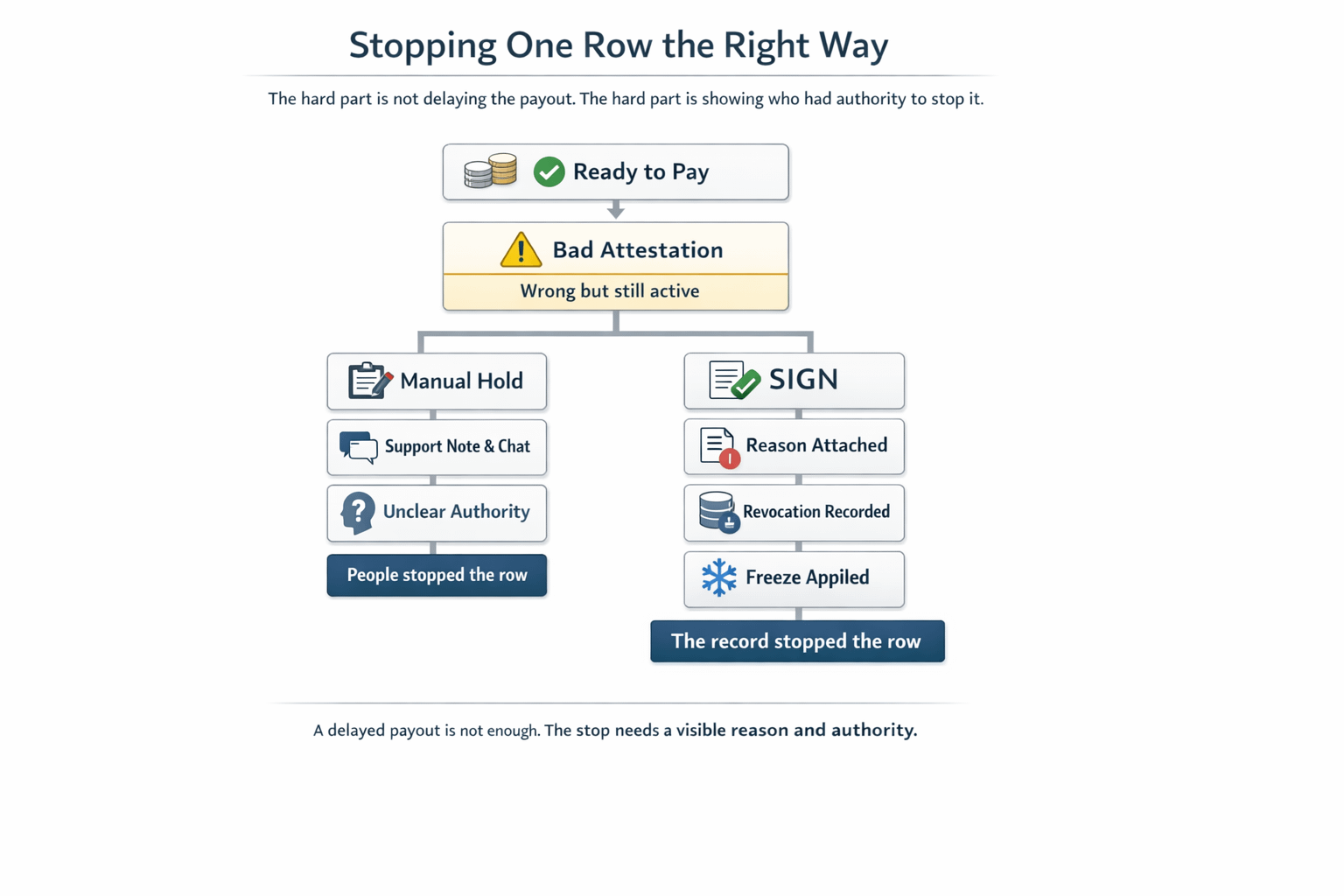
That is where $SIGN feels serious to me.
Not when the record is clean and nobody interrupts anything. When one payout-ready row goes bad at the worst time and the system still has enough hardness to stop it properly. Freeze before value moves. Kill the proof through delegated authority. Keep the reason attached. Then let that same row survive the reopening later without turning the answer into support folklore.
That is the standard I keep coming back to.
#SignDigitalSovereignInfra $SIGN @SignOfficial
