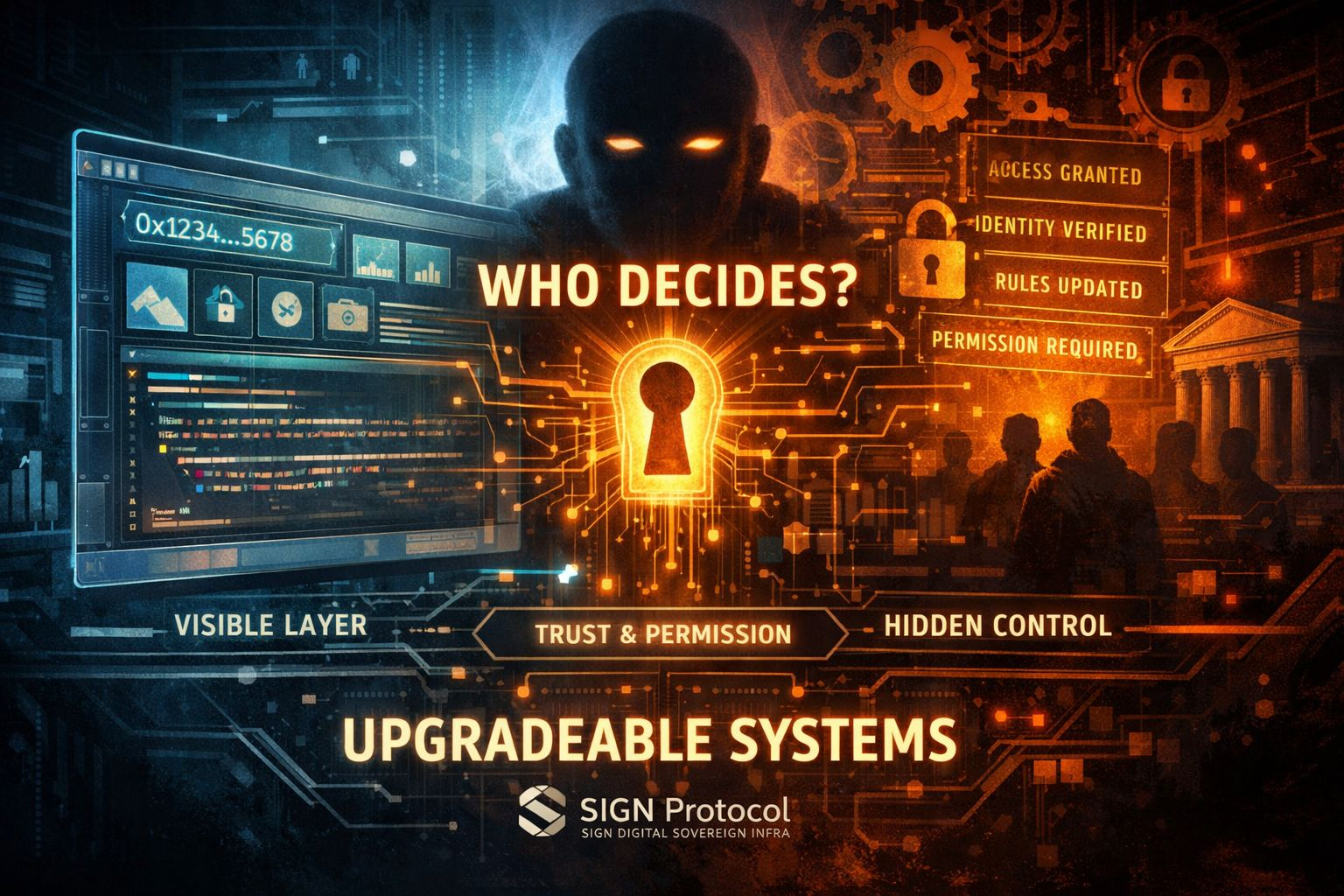
I mean seriously... Samtimes it seems like the systems we use are not as stable we think they are. Everything stays same on the outside - the same address, the same interface, the same habits... but inside, something can change and we don't even realize it. This place is a little uncomfortable - a very bad feeling. We usually asume that blockchain means that once deployed, it will stay the same forever. Code is law - we've heard this many times. But in reality, many protocols are now being developed in a way where code itself can change. Not directly, but in a roundabut way. There is a proxy in front, and the logic changes behind. At first glance, this doesn't sound too bad... in fact, it seems reasonable. Because to be honest, software is never perfect. There be bugs, logic will be wrong, new requirements will come. Then if everything has to be deployed again, user migration has to done - the whole system becomes a state of collapse. In comparison, upgradeable systems much more practical. But here we have to stop. Because within this practical solution lies a silent question - who will upgrade?
I think...
Let's say a small dev team. They are providing updates, fixing bugs... Okay, there is a trust here - they have to trusted. But what that same mechanism is in the hands of a large company? Then will that upgrade be just a bug fix, or will it gradually shape user behavior well? And what if a state or regulatory authority holds that key? Then it is no longer just a "technical upgrade". Then it becomes a tool for enforcing policies. This is where a new layer enters - which was not so visible before. This is where ideas of the Sign Protocol come to the fore. Because here it is not just code updating - here "proof" and "permission" are working together. Who is valid, who is not... who can do what, under what conditions - all this is gradually entering the system. Everything is the same from outside. But a decision layer is being created inside but... It's nice to hear - because it makes the system smarter, more targeted, and less misused. But if you stop and think about it for a moment, the question remains - who is setting these decisions? Because once the system learns this kind of conditional behavior, it is no longer just "neutral tehnology". Then it doesn't just run transactions - it decides which transactions will run. And this is where all comes in. Sign Protocol brings this thing very clearly to the fore - trust and logic together.
I mean actually…
Not just data… decisions also entering the code... It's powerful - there's no way to deny it and it's absolutely impossible to say it's not. But with powerful things there's always a question - where is the control? Because if identity, atestation, verification - everything is centralized within a system, then upgrades don't just mean bug fixes… it becomes behavior shaping. I think we often think too much about "what can be done". But let's skip the question of "who decides what to do". Upgradeable systems stand right in between these two. On one hand, flexibility - without which no system can evolve. On the other hand, stability - without which no system can trusted. And between these two, Sign Protocol adds a new layer - where trust and permission become programable. It is necessary as it is sensitive. Because if there is a mistake here, it is not just a mistake in the code - it is a mistake in the decision. So now when I look at a protocol, I don't just look features. I look at - who can upgrade, who defines the rules, and how visible that process is. Because in the end, the code you see is today. But what will happen tomorrow - often depends on that layer, which you can't see. And maybe this is where the bigest change is happening - and while thinking all this, my mind says- Meri dil my yaar abhi bhi bohot kuch hy.
Control is no longer loud. It is quiet. It doesn't force... it defines. And defining layer is gradually becoming the most important.. Really...🤔🚀