
I used to think SIGN was just another attempt at putting document verification on-chain—something like a blockchain version of DocuSign. A file gets uploaded, hashed, stored somewhere “immutable,” and that’s supposed to be the innovation. It sounded neat, but not exactly meaningful in the bigger picture.
That assumption doesn’t really hold once you look closer.
What SIGN is building has less to do with documents and more to do with infrastructure—the kind that sits underneath systems people actually rely on. Not prototypes or experimental pilots, but frameworks that could plug into how governments operate at scale.
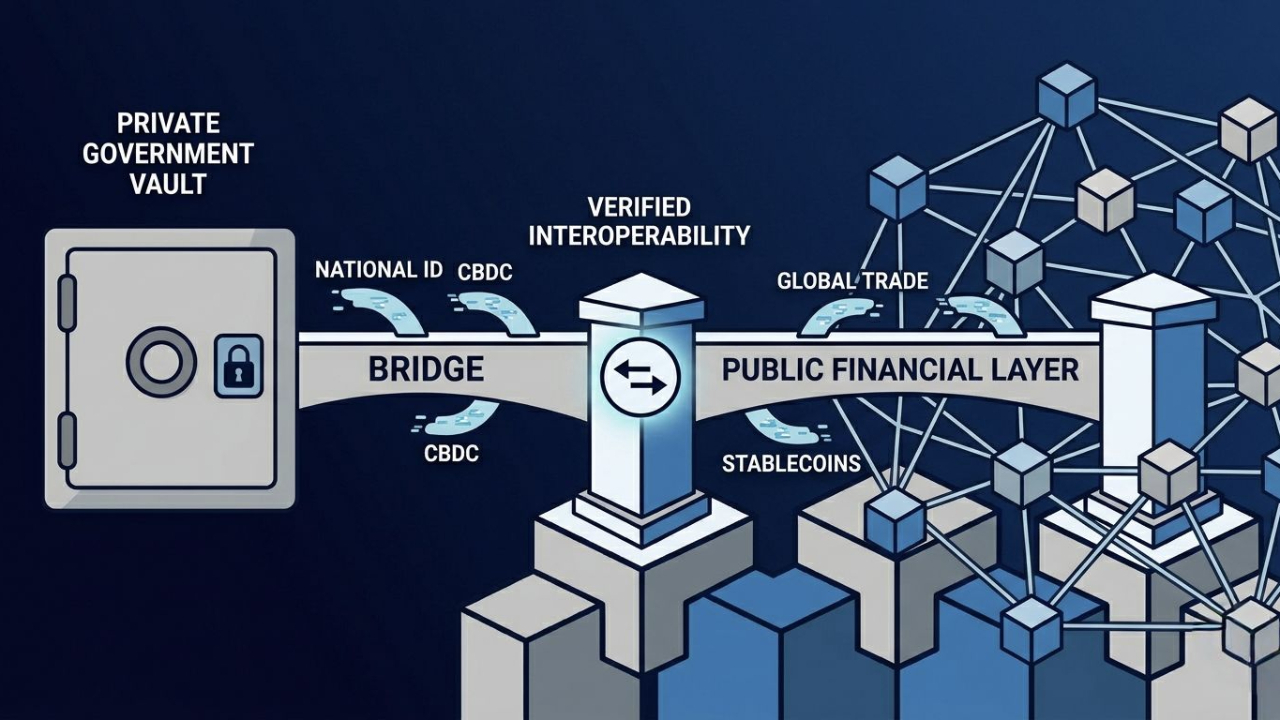
The structure is surprisingly pragmatic. On one side, there’s a controlled environment—something closer to a private system where sensitive data like identity records or national financial operations can exist securely. On the other, there’s a public-facing layer where value can move, interact, and connect beyond borders. The real focus isn’t either side individually, but the bridge between them.
That bridge is where the relevance starts to show.
Right now, governments are caught between two extremes. Legacy systems are slow, fragmented, and heavily manual. At the same time, open crypto networks offer speed and global reach but come with volatility and a lack of control that institutions aren’t comfortable with. SIGN’s approach is to sit between those worlds, not replacing either, but making them interoperable.
At its core, the focus narrows down to two areas that matter more than anything else in public systems: identity and money.
On the identity side, the idea is straightforward but difficult to execute well. Instead of repeatedly verifying the same person across different services, identity becomes something reusable and cryptographically verifiable. A government-issued credential can move across platforms without constant revalidation, reducing both friction and fraud. Underneath this sits Sign Protocol, which connects traditional identity frameworks with verifiable on-chain attestations.
Then there’s the financial layer. Central bank digital currencies have been discussed for years, but most remain isolated within controlled environments. SIGN’s model leans toward interoperability—designing systems where national digital currencies can interact with stablecoins and broader blockchain networks. The goal isn’t just digitizing money, but making it move more efficiently across systems and borders.
What makes this more than a theoretical model is that parts of it are already being tested in real-world settings.
In 2025, work around Kyrgyzstan’s “digital som” moved forward after legislation gave the central bank authority to issue and manage a national digital currency, with pilot infrastructure and testing underway. At the same time, SIGN entered into an agreement tied to that initiative, contributing to the development of the underlying system.
Around the same period, a separate agreement in Sierra Leone focused on building a national digital identity framework alongside a stablecoin-based payment system, aiming to deliver accessible and low-cost digital services at scale.
Those aren’t abstract ideas—they’re attempts at deployment, which is where most projects tend to fall short.
Technically, the stack reflects that ambition. A hybrid architecture combines private networks for sensitive operations with public chains for transparency and interoperability. Sign Protocol handles attestations and identity, while TokenTable manages large-scale distribution, including things like government payments or subsidies, through programmable systems.
None of this is simple to execute. Working with governments introduces friction that doesn’t exist in typical crypto environments—slow decision cycles, political risk, and shifting priorities. Scaling across multiple countries only compounds that complexity.
So it’s not a clean, risk-free narrative.
But it is a different one.
While much of the space is still driven by speculation and short-term cycles, SIGN is positioning itself closer to where long-term usage might emerge—inside systems that handle identity, payments, and public infrastructure. Not visible in the way trading charts are, but embedded in how things function behind the scenes.
And that distinction—between visibility and utility—is what makes it worth paying attention to.
@SignOfficial