
If you really sit and think about how the internet works today, you’ll realize that almost everything around us is built on trust. We trust platforms with our personal data, we trust systems to verify who we are, and we trust that what we see online is real. But the truth is, most of this trust is not based on certainty. It is based on assumption. We believe things are working correctly because we are told they are, not because we can actually verify them ourselves.
Over time, this kind of blind trust has started to show its weaknesses. Data breaches happen, fake accounts spread everywhere, bots manipulate systems, and rewards are often distributed unfairly. The system looks smooth on the surface, but underneath, there are cracks. The more digital the world becomes, the more visible these problems get. And this is where the question begins to rise: what if trust was no longer needed in the traditional sense?
When blockchain technology entered the space, it introduced a powerful idea — “don’t trust, verify.” This was a major shift. Instead of trusting banks or institutions, people could verify transactions directly on-chain. It removed the need for middlemen in financial systems. But even with all this progress, one major gap remained. While we could verify transactions, we still couldn’t easily verify people. Anyone could create multiple wallets, pretend to be someone else, or manipulate participation in systems like airdrops and campaigns.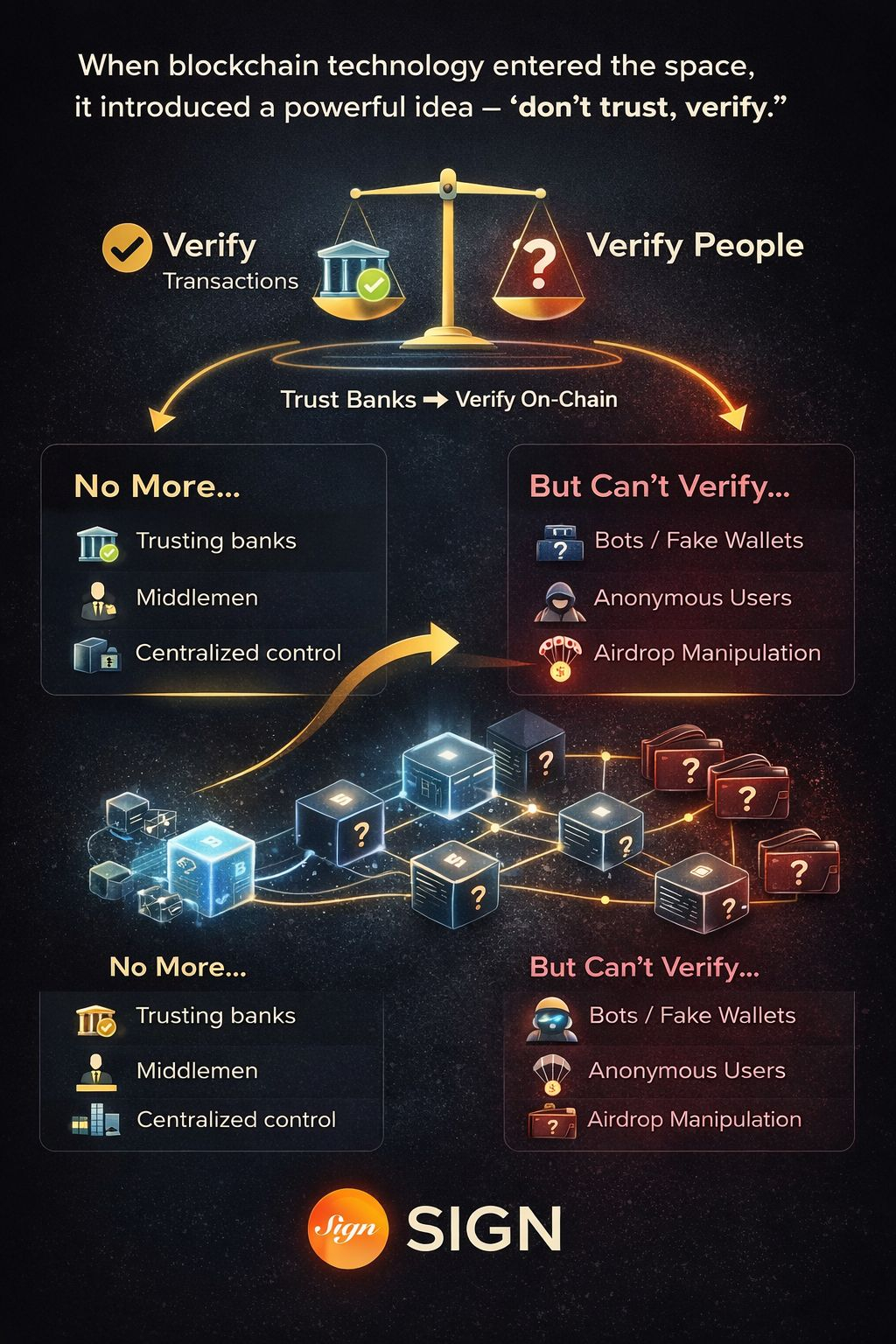
This created a new kind of problem. The system itself became trustless, but the users inside it were still unverified. In a way, Web3 solved half the problem but left the other half open. And that missing piece is exactly where the next evolution is happening.
The future is not about eliminating trust completely. It is about transforming it. Instead of relying on belief, the system moves toward proof. Instead of asking whether someone is trustworthy, it asks whether they can prove their validity. This is a completely different approach. Proof does not depend on opinions or authority. It depends on mathematics. And mathematics is consistent, predictable, and unbiased.
When we say that the future of trust is mathematical, what we really mean is that trust is no longer emotional or subjective. It becomes logical and verifiable. You don’t need to reveal who you are in detail. You only need to prove that you meet certain conditions. This shift allows systems to maintain privacy while still ensuring authenticity.
This is where SIGN starts to stand out. SIGN is not just another project trying to follow trends. It is working on something much deeper — building a system where trust is replaced by proof. Instead of relying on user claims or centralized verification, SIGN introduces a model where everything can be verified through cryptographic methods.
At its core, SIGN uses mathematical proofs to validate information. This means that instead of exposing sensitive data, the system generates a proof that confirms the validity of that data. The proof can then be verified without revealing the actual information behind it. This approach solves one of the biggest problems in digital systems — how to verify something without compromising privacy.
For example, imagine you need to prove that you are eligible for a reward. In a traditional system, you might have to share personal data or rely on a platform to verify you. In a system like SIGN, you don’t share the raw data. You generate a proof that shows you meet the criteria. The system checks the proof, not your personal information. This creates a balance between privacy and verification.
Another important aspect of SIGN is its credential system. Instead of treating users as anonymous or unverified entities, SIGN allows the creation of verifiable credentials. These credentials are not just labels; they are backed by proof. They represent actions, participation, or eligibility in a way that can be trusted without manual validation.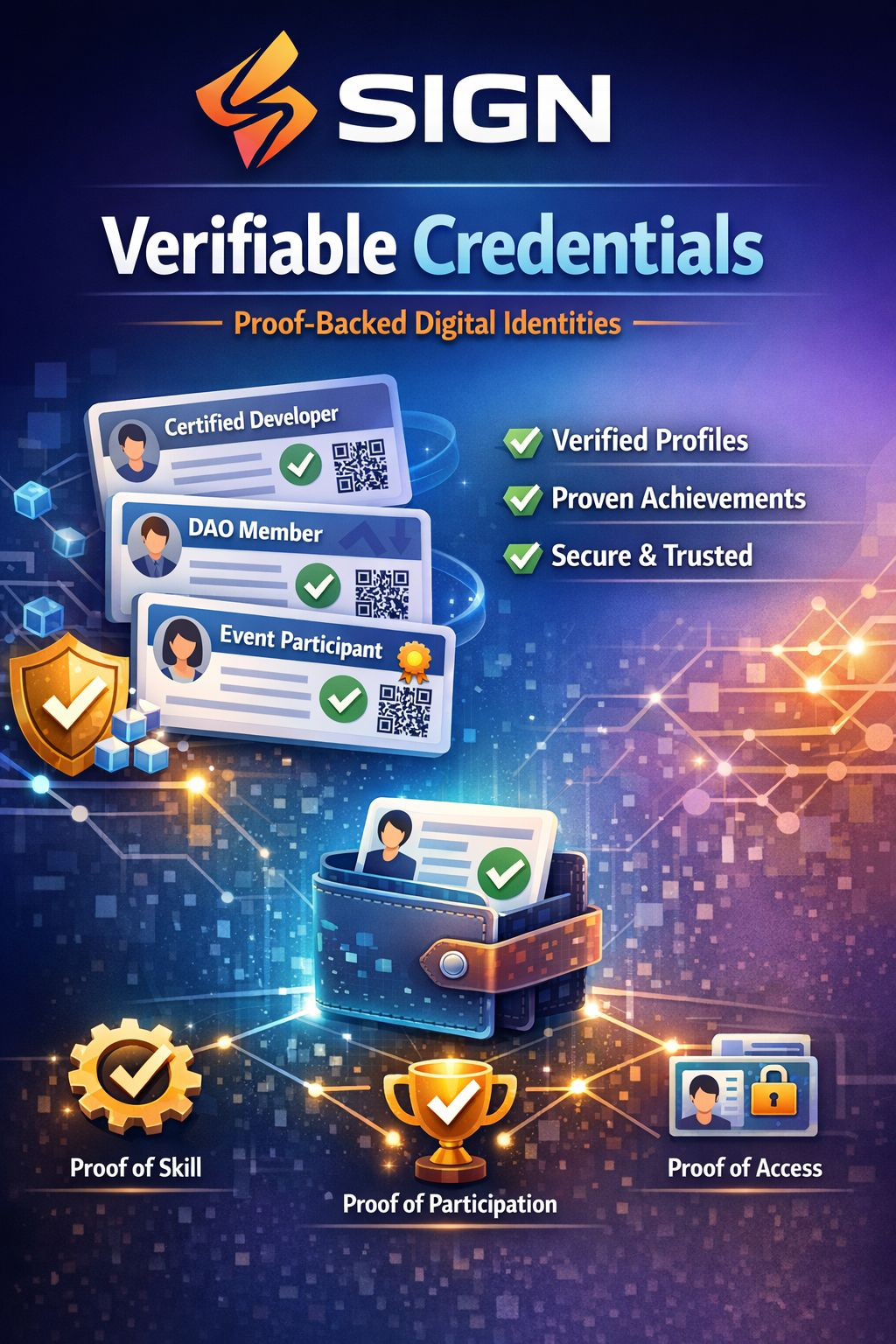
This becomes especially powerful in areas like token distribution. One of the biggest issues in crypto today is unfair airdrops. Bots, fake accounts, and multi-wallet users often take advantage of systems that are based on assumptions rather than proof. SIGN changes this by ensuring that only verified participants receive rewards. It filters out fake activity and creates a more balanced environment.
What makes this even more interesting is that all of this happens without a central authority. There is no single entity controlling the verification process. Instead, the system relies on code, cryptography, and blockchain validation. This makes it more transparent and resistant to manipulation.
If you look at the bigger picture, SIGN is not just solving a small problem. It is addressing a fundamental issue in digital systems — the lack of reliable trust. By converting trust into mathematical proof, it creates a foundation that can be used across multiple applications, from identity systems to governance and beyond.
The idea of mathematical trust may sound complex at first, but it is actually very natural when you break it down. In real life, we often rely on proof. We show documents, certificates, or evidence to validate claims. SIGN is simply taking this concept and upgrading it for the digital world, making it faster, more secure, and privacy-focused.
As the internet continues to evolve, the importance of verification will only increase. More systems will require users to prove things without exposing unnecessary data. More platforms will move away from blind trust and toward verifiable truth. And this is where projects like SIGN become important.
It is not about hype or short-term gains. It is about building a system that can support the future of digital interaction. A system where trust is not assumed but proven. A system where privacy and verification coexist. A system where mathematics replaces uncertainty.
In the end, the shift is simple but powerful. We are moving from a world where we believe things to a world where we can prove them. And once that shift fully happens, the way we interact online will never be the same.
SIGN is not just part of this change — it is helping define it.
@SignOfficial #SignDigitalSovereignInfra $SIGN
