
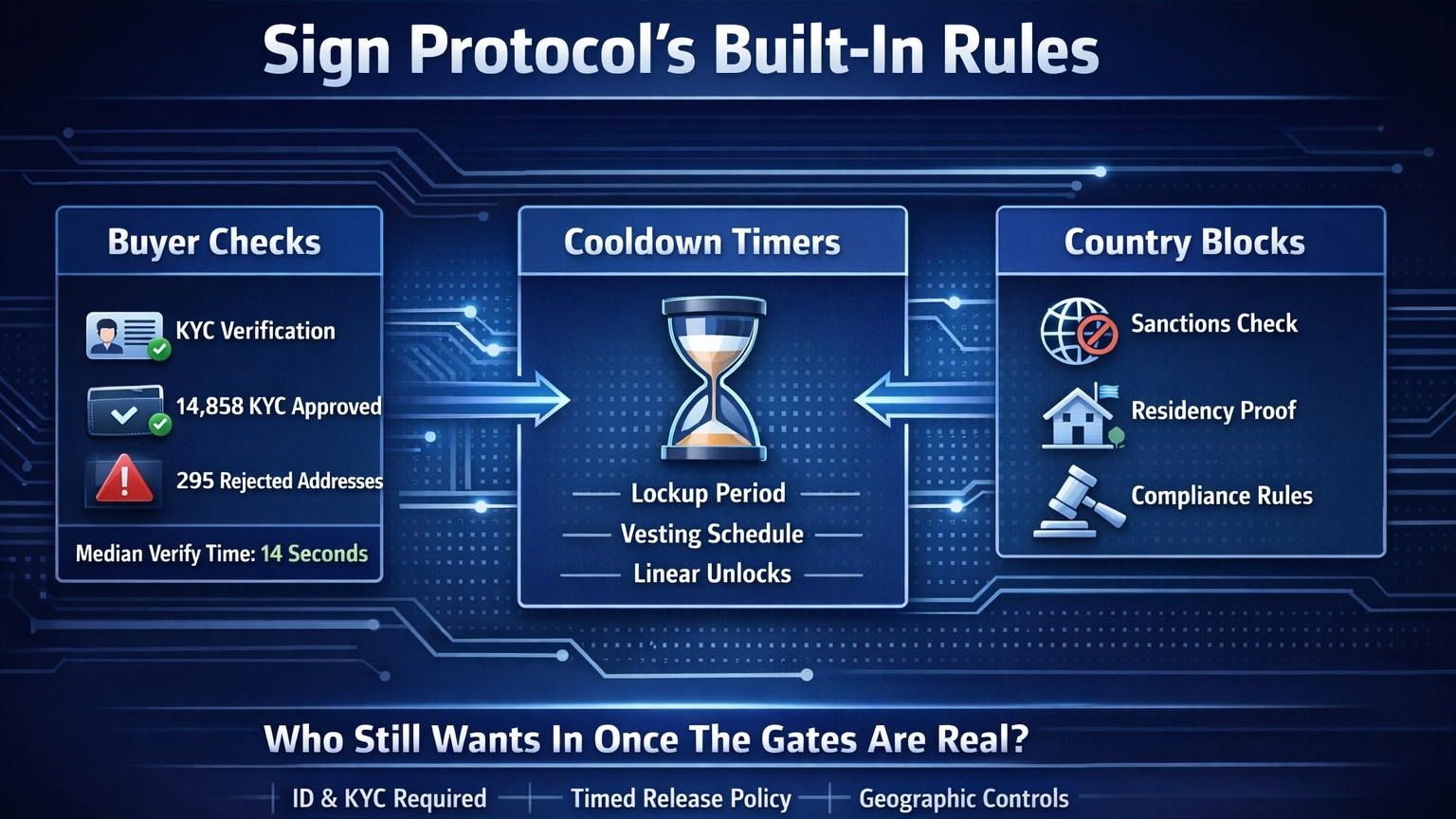
Most people only notice rules in crypto when the button stops working. I've seen that moment a lot. A wallet connects, the claim page loads, then the screen says no. Confusion comes first. Then anger. Then the lazy read; “the team changed the rules.” With @SignOfficial , I think the better read is colder. Sign Protocol is not built to feel smooth. It is built to make actions prove something before value moves.
SIGN’s docs frame Sign Protocol as the evidence layer, while TokenTable handles allocation and distribution. So when people talk about cooldowns, buyer checks, and country blocks, they are talking about a rule stack, not a token button. At a crowded bus station, the driver does not argue with every rider.
There is a ticket check, a gate, and a departure time. Miss one piece and the bus leaves. That is how I explain Sign’s buyer checks. Look, this is not a fuzzy trust score. In Sign’s ZetaChain case study, users from non-sanctioned geographies connect, submit ID through Sumsub, then use Sign Protocol to attest that their wallet is tied to that KYC result. After that, TokenTable’s Unlocker contract checks the attestation before the claim can happen.
Wait, let’s see. It means Sign turns an off-chain fact into an on-chain pass card. No pass card, no entry. The data gives the filter weight: 14,786 KYC-whitelisted addresses, 12,858 passed KYC, and 295 were rejected due to block list or fraud, with a median verification time of 14 seconds. It is a working gate. Then comes the part people call a cooldown, even when the docs use other words.
I had to pause here, because cooldown sounds like trader slang, while Sign’s docs speak in lockup terms, vesting schedules, cliffs, and linear unlocks. Fine. Same family, different label. In the claim flow above, users can view lockup terms before they claim.
Elsewhere, Sign’s New Capital System says the engine supports vesting schedules, cliffs, linear unlocks, revocation, clawback logic, and batch execution. To be clear, that is the point. A cooldown is just time turned into policy. Like a pharmacy that will fill the script, but only on the date the refill opens.
Sign bakes delay into the flow so a project can slow supply release, stage access, or stop dumping after a claim. Is it perfect? No. Time locks can still annoy users, and they do not rescue a weak token design. They only make the rules visible and enforceable. Because geography still matters, the country block is less ideological than traders want to admit.
Crypto people act shocked when borders show up on a claim page. I do not. Sign’s example says only whitelisted wallets from non-sanctioned geographies could join the ZetaChain claims flow, and the docs place sanctions checks, residency proofs, and compliance rules inside the eligibility layer for capital programs. Here’s the thing, that makes Sign more useful for real distribution and less romantic for open-access dreams.
A country block is a door rule tied to law, risk, or partner policy. Harsh? Maybe. But it is cleaner than pretending every wallet is equal when the issuer clearly cannot treat them that way. In market terms, this may cut fake demand, trim legal risk, and leave a more real user base, even if the pool gets smaller. SignOfficial gets more interesting when I stop judging it like a meme trade and start judging it like a rule machine.
Actually, that shift removes nonsense. Sign Protocol says it is infrastructure, not an app, and schema hooks let builders add whitelists, payments, and custom logic that can even revert the whole call if a rule fails. The point is, cooldowns, buyer checks, and country blocks are not side features glued on for optics.
They are friction tools for cases where tokens touch identity, law, and capital flow. I still would not worship that. Rules can protect a system, but they can also reveal how narrow the market really is. So when SIGN talks about trust, my question is not whether the gates work. My question is who still wants in once the gates are real.
@SignOfficial #SignDigitalSovereignInfra $SIGN
